
Where Are The Transition Metals On The Periodic Table

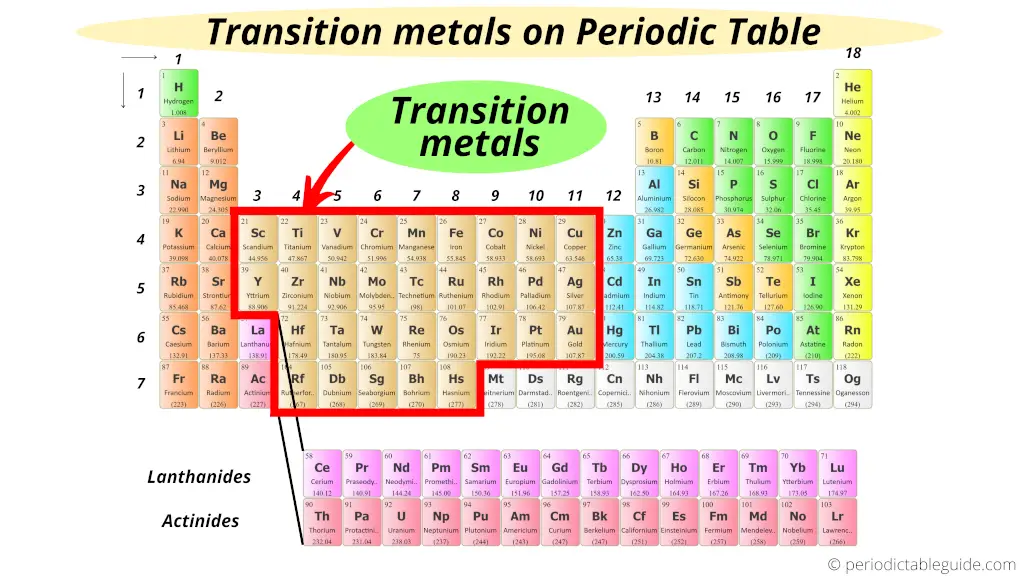
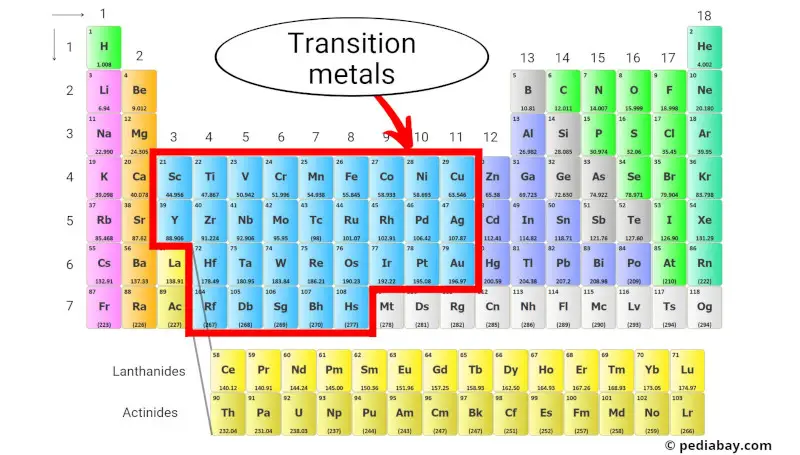
Ever looked at the periodic table and thought, "Wow, that's a lot of squares!"? You’re not alone. It’s like a giant wall of organized chemistry. But let's zoom in on a particularly fascinating neighborhood: the transition metals. Where are they exactly? Imagine the periodic table as a blocky 'H'. The transition metals hang out in the middle of the 'H', connecting the left and right sides.
The Middle Children of the Periodic Table
Think of the first two columns on the left (the alkali and alkaline earth metals) as the super-eager, always-reacting family members. Then, the right side (the nonmetals) are the ones a bit more reserved, picky about who they hang out with. The transition metals in the middle? They're the cool, collected middle children. They connect the extremes and bring a bit of stability (and a whole lot of flash) to the table.
Specifically, look for the long block of elements nestled between Group 2 and Group 13. That’s where the party is! From Scandium (Sc) to Zinc (Zn), Yttrium (Y) to Cadmium (Cd), and so on. It’s a veritable who’s who of elements that make our world colorful and functional.
Must Read
Why Are They So Special?
So, what makes these middle children so intriguing? Well, for starters, they're responsible for a lot of the things we love. Want vibrant colors in your jewelry? Thank the transition metals! Think of the deep blue of a sapphire, the rich green of an emerald, or the fiery red of a ruby. These colors are often due to the presence of transition metal ions.
"It's not just about looking pretty, though. These elements are workhorses in the industrial world."
Many are excellent conductors of electricity. Copper (Cu), for example, is the king of electrical wiring. Iron (Fe) is the backbone of our buildings and infrastructure. These elements are strong, durable, and reliable. They are essential for building our modern world.
A World of Variable Valences (Say That Five Times Fast!)
One of the coolest quirks of transition metals is their ability to have multiple "personalities." Chemically speaking, this means they can form ions with different charges. This variable valence (how many electrons they can lend or borrow) is what gives them so much versatility in forming compounds.
Think of iron (Fe) again. It can be Fe2+ or Fe3+. This seemingly small difference leads to a massive range of compounds with different properties and colors. It's like having a chameleon that can change its spots depending on who it’s hanging out with!
More Than Meets the Eye
The transition metals aren't just sitting pretty in the middle of the periodic table. They're actively involved in countless chemical reactions, both in nature and in the lab. They act as catalysts, speeding up reactions that would otherwise take forever. Without them, many industrial processes wouldn't be possible.
Want to make plastics? Need to refine oil? Transition metal catalysts are often the unsung heroes behind the scenes. They're the ultimate facilitators, making things happen faster and more efficiently.
Go Explore!
So, next time you glance at the periodic table, give a nod to the transition metals in the middle. They’re not just filling space. They're a powerhouse of chemical activity, responsible for a huge chunk of the technology and beauty we see around us. They are truly special and are worth a second glance. Maybe even a third! Head over to a periodic table and see what interesting elements you can find lurking in the center. You may just discover your new favorite element.
Who knows? Maybe you'll even be inspired to become a chemist and unlock even more of their secrets! The world of chemistry is waiting!
