
Where Are Metalloids Found On The Periodic Table
Hey, friend! Ever stared at the periodic table and felt...lost? Don't worry, we've all been there. It's like a map of the universe, but way more confusing at first glance. Let's talk about something super cool: metalloids! Yeah, those sneaky elements that are kinda metal, kinda not.
Think of them as the chameleons of the element world. They're not quite ready to commit to being full-on metals, but they're definitely not sticking with the non-metal crowd either. They're vibing somewhere in between. So, where do you find these fence-sitters on the periodic table? Let's dive in!
The Staircase to Semi-Metaldom
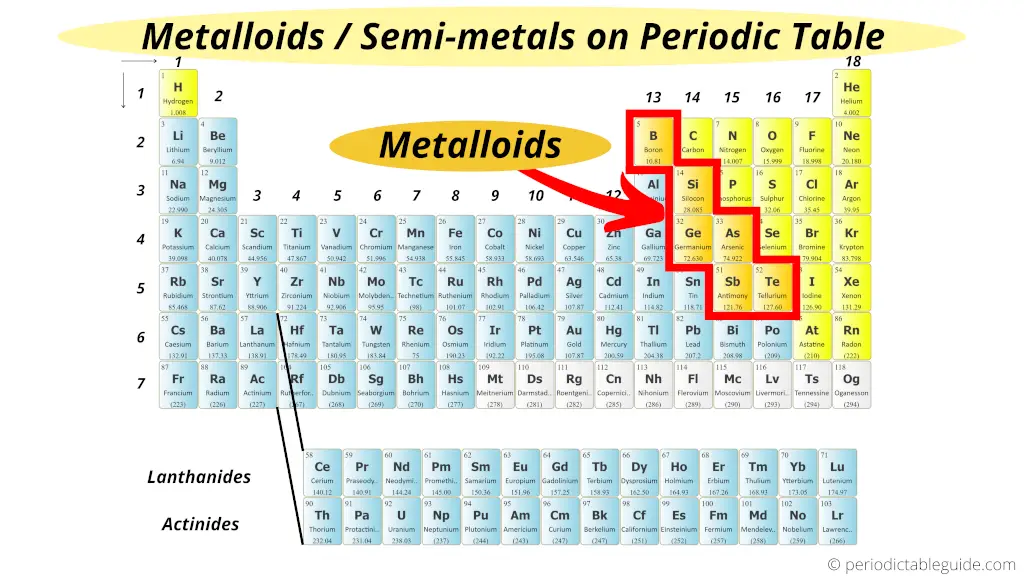
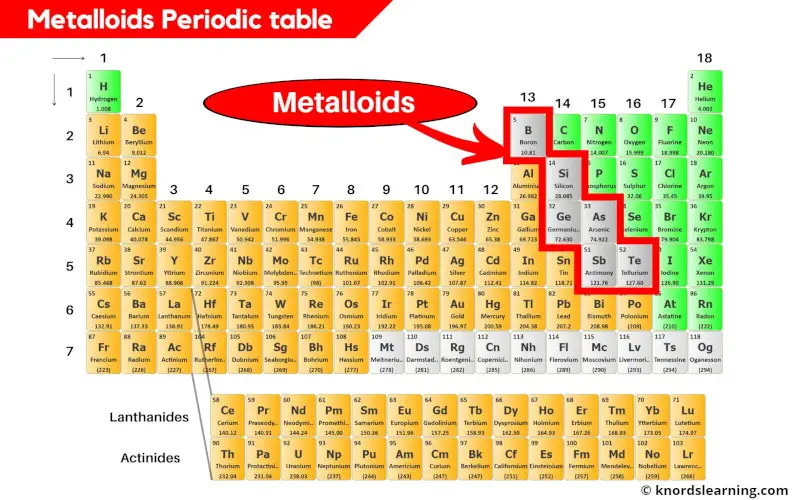
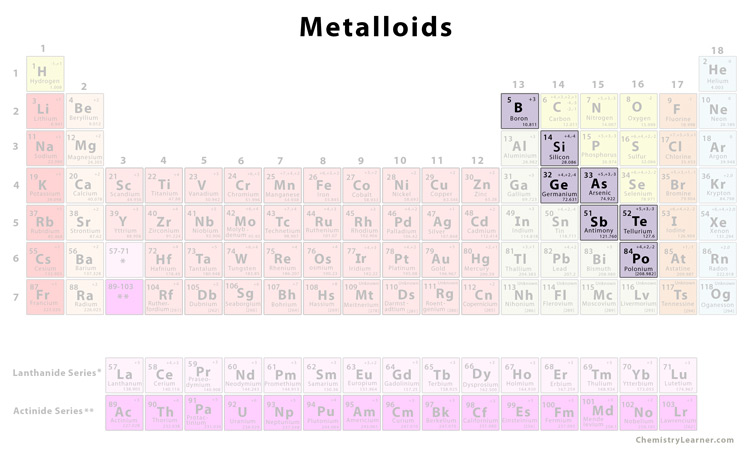
Okay, so imagine the periodic table. Got it? Now, picture a zigzag line, almost like a staircase, cutting diagonally down the right side. That's your metalloid highway! This staircase separates the metals (on the left) from the nonmetals (on the right). And guess who lives right along that staircase? Ding ding ding! Metalloids!
Must Read
Specifically, we're talking about elements like boron (B), silicon (Si), germanium (Ge), arsenic (As), antimony (Sb), and tellurium (Te). Some folks also include polonium (Po) and astatine (At) in the metalloid club, but that's a bit more controversial. Think of it as a metalloid debate – spicy!
Why Are They So Special? (And Where ELSE Can You Find Them?)
So, why are these elements so interesting? Well, their in-between-ness is what makes them so darn useful. They have properties of both metals and nonmetals. Some are shiny like metals, but poor conductors of electricity like nonmetals. Others are semiconductors, meaning they conduct electricity under certain conditions. This is HUGE! Think electronics.
Ever heard of Silicon Valley? Well, silicon (Si) is a metalloid. It's the star of the show when it comes to computer chips and other semiconductors. Without silicon, your phone, your computer, even your smart toaster wouldn't work! Seriously, give silicon a round of applause!
Germanium (Ge) is another essential metalloid. It was used in early transistors, before silicon took over. Now, you'll find it in fiber optics and solar cells. Solar power? Thank germanium! It's pretty cool how these little elements power our world.
Arsenic (As)? Okay, arsenic has a bit of a bad rep, thanks to its use in poisons (yikes!). But in small doses, it’s used in some semiconductors and even in certain medications. Talk about a Jekyll and Hyde element!
Antimony (Sb) is used in alloys to increase their strength and hardness. You'll find it in batteries, flame retardants, and even some types of solder. It's like the secret ingredient that makes things tougher!

Tellurium (Te) is used in solar cells and in the production of steel. It helps improve the machinability of metals. It's the metalloid that makes other metals behave!
Metalloids: The Undecided Element Crew
So, next time you're looking at the periodic table, give a shout-out to the metalloids hanging out along that zigzag line. They're the quirky, versatile elements that are essential to modern technology. They might not be the flashiest elements, but they're definitely the most adaptable.

They're the ultimate team players, borrowing traits from both metals and nonmetals to create materials that are stronger, faster, and more efficient. Think of them as the swing voters of the element world, always keeping us on our toes.
And who knows what new uses we'll find for these amazing elements in the future? The possibilities are endless! So keep exploring, keep learning, and never stop being curious about the wonderful world of chemistry!
Now, go impress your friends with your newfound metalloid knowledge!