
What Size Return For 3 Ton Unit

Okay, imagine this: you're trying to enjoy a ridiculously thick, delicious milkshake, but all you've got is one of those tiny coffee stirrers. You suck and suck, your cheeks ache, you get maybe a pathetic dribble of milkshake, and frankly, you're just mad. Frustrating, right?
Now, picture your poor, hard-working 3-ton air conditioner feeling pretty much the same way. Except instead of milkshake, it's trying to gulp down all the warm, stale air from your house so it can cool it down and send it back to you, fresh and breezy. If it's trying to do that through a straw that's too small, well, you can guess the result.
This, my friends, brings us to the often-overlooked, yet utterly critical, question: What size return air duct do you need for a 3-ton unit? It's a question that surprisingly few homeowners ever ask, but it's vital for your system's health and your comfort.
Must Read
Why Does Return Air Even Matter?
Think of your HVAC system like a giant lung for your house. It breathes in the warm air (that's the return air), filters it, cools or heats it, and then breathes it back out as conditioned air (that's the supply). The return duct is the inhale. If the inhale is restricted, the entire system struggles.
A properly sized return duct ensures your unit can "breathe" easily. It allows for adequate airflow, which is measured in Cubic Feet per Minute (CFM). Without enough airflow, your unit isn't just inefficient; it's actively working against itself. It's like running a marathon while breathing through a tight bandana – exhausting and pointless.
Demystifying the "Ton"
Before we dive into sizes, let's quickly clarify what a "3-ton unit" means. It doesn't mean your AC weighs three tons. In HVAC lingo, a "ton" refers to the cooling capacity of the unit. One ton of cooling capacity is equivalent to removing 12,000 BTUs (British Thermal Units) of heat per hour. So, a 3-ton unit can remove 36,000 BTUs of heat per hour.
Why is this relevant? Because the amount of air your system needs to move is directly tied to its cooling capacity. More cooling capacity means more air needs to be processed.
The Magic Number: CFM Per Ton
Alright, let's get to the nitty-gritty. The general rule of thumb (and a pretty solid one at that) is that you need about 400 CFM of airflow per ton of cooling capacity. This is your baseline, your starting point, your holy grail number.
So, for our 3-ton unit, the math is pretty simple:
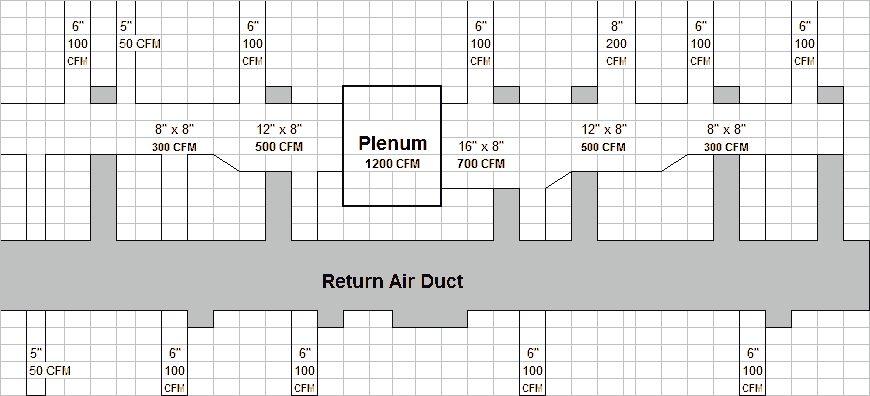
- 3 tons * 400 CFM/ton = 1200 CFM
Your 3-ton unit needs to be able to pull in approximately 1200 cubic feet of air every minute. That's a lot of air! Now, how do we translate 1200 CFM into actual duct size?
Translating CFM into Duct Dimensions
This is where it gets a little more nuanced. There isn't just one perfect size, because other factors come into play:
- Duct Material: Smooth metal ducts allow air to flow more easily than flex ducts.
- Duct Shape: Round ducts are generally more efficient than rectangular ones for the same cross-sectional area.
- Duct Length & Bends: Longer ducts and more bends increase friction and restrict airflow.
- Filter Grille Size: The grille itself can be a choke point!
- Static Pressure: This is the resistance to airflow in your duct system. Your furnace/air handler is designed to overcome a certain amount of static pressure. Too much resistance (from undersized ducts, dirty filters, etc.) means your fan motor works harder, uses more electricity, and shortens its lifespan.
Given these variables, giving you one exact measurement is impossible. However, we can talk about common recommendations.

For 1200 CFM, you're generally looking at:
- A single, large return duct: Something in the range of a 20" x 25", 24" x 24", or even 16" x 30" rectangular duct.
- Or, if you have multiple returns: Perhaps two 16" x 20" ducts or one large central return combined with a smaller one in a far-off room.
These are just ballpark figures to give you an idea of the scale. This is a significant space your air needs to travel through. If your return grille looks barely big enough for a pet, you might have a problem!
The Dangers of an Undersized Return
If your return duct is too small, your AC unit literally can't get enough air. This leads to a cascade of problems, none of which you want:

- Reduced Efficiency: Your unit runs longer and harder to achieve the set temperature, spiking your energy bills.
- Poor Comfort: Uneven cooling, hot spots, and generally less effective air conditioning.
- System Strain & Shorter Lifespan: The fan motor works overtime, the evaporator coil can freeze up (a common, damaging issue!), and components wear out faster. That expensive piece of equipment you rely on? It's slowly failing.
- Increased Noise: Air rushing through small ducts can create annoying whistling or roaring sounds.
An undersized return is like putting a muffler on your car's intake – it stresses the engine and doesn't work right.
So, What Now? Don't Guess, Get a Pro!
While I've given you the basic principles and some rough ideas, measuring and designing ductwork is not a DIY job for the faint of heart or anyone without specialized knowledge. There are calculations involving friction loss, equivalent length, and static pressure that go well beyond "milkshake straws."
My best advice, and truly the most important takeaway from this article, is to always consult with a qualified HVAC professional. They can perform a proper load calculation for your home, measure your existing ductwork, and recommend the precise sizing for your return (and supply!) ducts. They'll ensure your 3-ton unit is breathing easy and keeping you perfectly comfortable for years to come.
Don't let your AC suffer through a small straw. Give it the proper airflow it deserves!