
What Is The Mass Number Of This Element Lead

Ever heard of Lead? Yep, that heavy, dense stuff! It's been around forever. And it has a number... a special mass number, that is!
Lead: The Ancient Metal
Think about Roman plumbing. Ancient weights. Even bullets used to be made from it. Lead has a long and interesting history. People have relied on it for many purposes. Why? Because it's so easily shaped and doesn't corrode easily. But we’re here to talk numbers! Specifically, its mass number.
What's a Mass Number Anyway?
Imagine every atom as a tiny, tiny building. In the center is the nucleus. Think of it as the building's control center. Inside this center you have protons and neutrons. Protons? They have a positive charge. Neutrons? They're neutral, hanging out without any charge.
Must Read
The mass number is simply the total number of protons and neutrons in the nucleus. It's like counting all the bricks and beams that make up the nucleus of the building. It tells you how "heavy" the nucleus is.
Lead's Magic Number
Okay, drumroll please... The most common isotope of lead has a mass number of 208. Ta-da! But why is this number so significant?
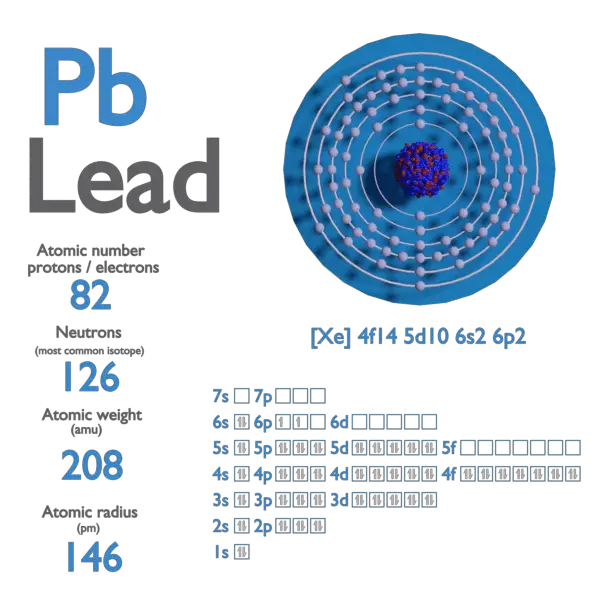
Well, it tells us that a typical lead atom has 82 protons (that’s what makes it lead, after all!), and a whopping 126 neutrons. 82 + 126 = 208. See? It adds up! Knowing the mass number helps us understand how stable the atom is, and how it will react with other elements.
Isotopes: Lead Has Many Faces
Here's where things get even more exciting. Not all lead atoms are exactly the same! They can have different numbers of neutrons. These are called isotopes. Think of them as variations of lead. They are all still lead, but they have slightly different weights.
Lead-204, Lead-206, Lead-207, and Lead-208 are the naturally occurring stable isotopes of lead. Notice how each one has a slightly different mass number? This difference in neutron number affects their stability and radioactive properties.
Why Should You Care?
Why bother learning about the mass number of lead? Because it's a tiny piece of the puzzle. It is part of understanding the world around us! It shows us how elements are built, and how they interact.
Understanding isotopes helps us date ancient artifacts through radiometric dating. It allows us to track pollutants in the environment. It helps understand how nuclear reactions work. Pretty cool, huh?

Lead and Radioactivity: A Special Relationship
You might have heard that lead is associated with radioactivity. That’s because lead is often the end product of the radioactive decay of heavier elements like uranium and thorium. Imagine uranium slowly transforming, step-by-step, until it finally settles down as stable lead. Each step gives off radiation. Knowing the different isotopes of lead, and their mass numbers, helps us understand this process.
This is why lead is also used to shield against radiation! It's dense and absorbs radiation effectively, protecting us from harmful exposure. So, lead isn’t causing the radiation, it’s often protecting us from it!
Go Explore!
So, next time you see a piece of lead, remember its magic number: 208 (for the most common isotope, anyway!). It's not just a random number. It represents the very heart of the lead atom. It reflects its composition and its place in the universe.

Now, go explore the periodic table! Discover the mass numbers of other elements. See how they compare to lead. It's a fascinating journey into the building blocks of our world. Who knows, you might just find your new favorite element!
“Science is not only a disciple of reason but, also, one of romance and passion.” - Stephen Hawking
Dive deeper into the world of elements. You will find there's a whole universe of atomic adventures waiting to be discovered!