
What Is The Lcm For 4 And 6

Ever find yourself staring blankly at a math problem and thinking, "When will I ever use this?" Trust me, we've all been there! But some math concepts, like the Least Common Multiple, or LCM, are surprisingly useful in everyday life. And guess what? It's not as scary as it sounds! Let's break down the LCM of 4 and 6 in a way that's easy, fun, and actually makes sense.
What Exactly is the LCM?
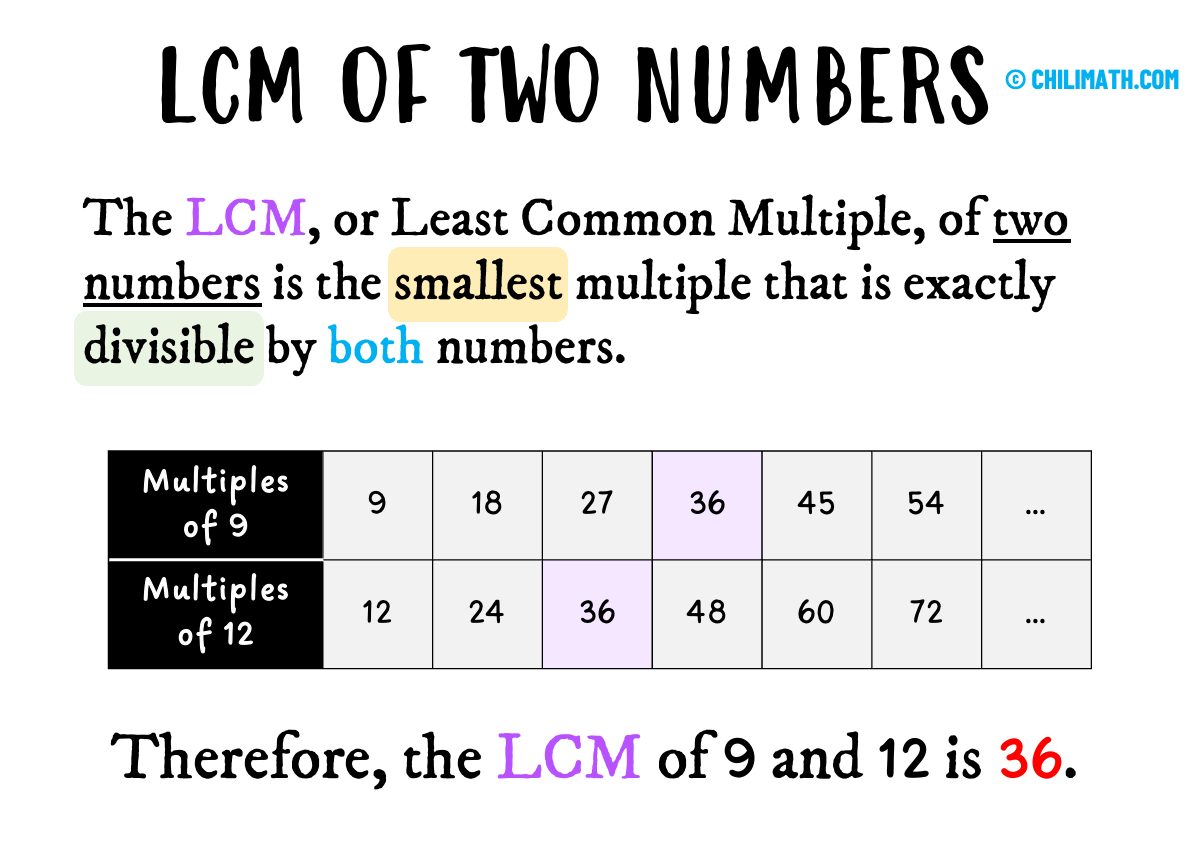
The Least Common Multiple is simply the smallest number that is a multiple of both of the numbers you're looking at. Think of it as the first time two numbers’ multiples 'meet' on a number line. For instance, if you're finding the LCM of 4 and 6, you're looking for the smallest number that both 4 and 6 can divide into evenly. No remainders allowed!
Finding the LCM of 4 and 6: The Easy Way
Okay, let's get down to business. Here's how you find the LCM of 4 and 6:
Must Read
- List the multiples of each number. What's a multiple? It's just what you get when you multiply the number by 1, 2, 3, and so on.
- Multiples of 4: 4, 8, 12, 16, 20, 24...
- Multiples of 6: 6, 12, 18, 24, 30, 36...
- Identify the common multiples. Look for numbers that appear in both lists. In this case, you'll see 12 and 24 (and more, if you keep going!)
- Choose the least common multiple. Out of the common multiples (12, 24...), which one is the smallest? It's 12!
So, the LCM of 4 and 6 is 12. Ta-da!
Real-Life LCM: Pizza and Party Prep!
"Okay, great," you might be thinking, "but when will I ever need this?" Prepare to be amazed! Imagine you're planning a party.

Let's say you want to buy pizza. Pizza place A sells pizzas cut into 4 slices each, while pizza place B sells pizzas cut into 6 slices each. You want to make sure everyone gets the same number of slices, and you don't want any leftover pizza.
To figure out the smallest number of pizzas you need to buy from each place so everyone gets an equal slice, you need the LCM! You need to find the smallest number of slices you can have where both pizza types contribute a whole number of pizzas.
You know the LCM of 4 and 6 is 12. This means you need 12 slices total. That's 3 pizzas from pizza place A (3 pizzas x 4 slices = 12 slices) and 2 pizzas from pizza place B (2 pizzas x 6 slices = 12 slices).
See? LCM to the rescue! You’ve ensured a perfect pizza party without any awkward slice-counting chaos!

More LCM Magic: Scheduling Fun!
Here's another example. Suppose you have two friends: one who visits you every 4 days and another who visits you every 6 days. When will they both visit you on the same day again? You guessed it – the LCM! They will both visit you again in 12 days.
Why does this matter? Knowing the LCM helps you plan. You can mark your calendar and maybe plan a special activity for the day both friends are visiting. It's all about being organized and making the most of your time!

LCM vs. GCF: Not the Same Animal
Sometimes, people confuse LCM with Greatest Common Factor (GCF). Remember: LCM is the smallest number that both numbers divide into. GCF, on the other hand, is the largest number that divides both numbers. They are different concepts with different uses. Think of LCM as “meeting up” at a larger number and GCF as finding what the two numbers can “share” as a smaller factor.
LCM: A Tool for Your Math Belt
So, the LCM of 4 and 6 is 12. More importantly, understanding the concept of LCM helps you solve practical problems in your daily life, from planning parties to scheduling events. It's a valuable tool to have in your math belt, even if you don't realize you're using it.
The next time you're faced with a situation that requires finding a common point, remember the LCM. It might just be the key to simplifying your life – and maybe even throwing a killer pizza party! Keep practicing and have fun with it! Who knew math could be so…delicious?