
What Is The Cause Of Hurricanes
Ever looked at a swirling hurricane from space, or even just seen the incredible power of one on the news, and wondered, "How in the world does something that massive even begin?" It’s a pretty mind-boggling thought, right? These monstrous storms pack an incredible punch, but their origins are actually a fascinating dance of some very fundamental natural forces.
Forget complicated science textbooks for a moment. Let's dig into what makes these giants tick, not with intimidating jargon, but with a bit of chill curiosity. Because, honestly, the way hurricanes form is actually super cool when you break it down!
The Ocean's Warm Embrace: Fueling the Beast
Alright, first things first: hurricanes are picky. They absolutely, positively need one thing above all else to even consider existing: warm ocean water. Think of it like this: a hurricane is a super-powerful car, and that warm ocean water is its premium, high-octane fuel. Without it? No go.
Must Read
We're talking water temperatures of at least 80°F (26.5°C) and usually even warmer, extending quite deep into the ocean. Why so warm? Because this heat provides the energy. The warmer the water, the more it evaporates, sending massive amounts of moist, warm air rising into the atmosphere. It’s like the ocean is steaming up a giant cosmic bathroom.
Rising Air and Low Pressure: The Vacuum Effect
As this warm, moist air rises, it creates a crucial ingredient: low pressure at the surface. Imagine a giant, invisible vacuum cleaner hovering over the warm ocean. As air rises and leaves the surface, it creates a void, an area of lower pressure.

What does air naturally do? It rushes from areas of high pressure to areas of low pressure. So, air from all around starts to flow inwards towards this developing low-pressure zone, bringing with it even more moisture. It's a self-feeding cycle! This inward-rushing air is the beginning of the storm's circulation.
Thunderstorms Galore: The Building Blocks
Now, as that warm, moist air continues to rise and cool, the water vapor condenses, forming clouds and, eventually, thunderstorms. Lots of them. These aren't just any thunderstorms; they're like the powerful engine cylinders of the hurricane.
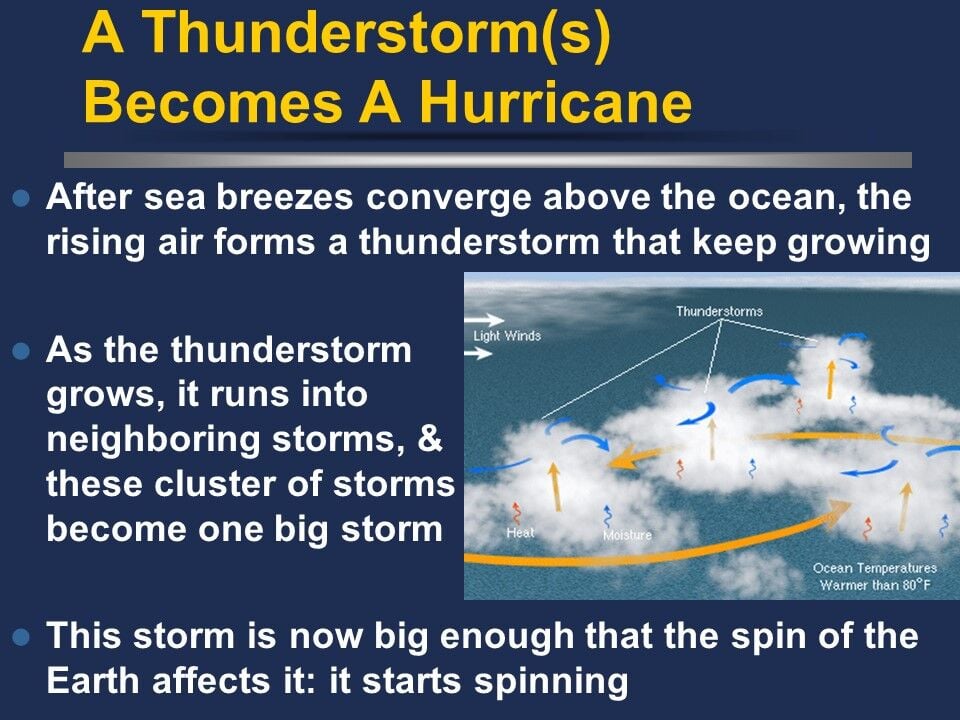
Each time water vapor condenses, it releases a huge amount of latent heat back into the atmosphere. This heat makes the surrounding air even warmer and lighter, causing it to rise even faster. It’s a super-efficient feedback loop, like a perpetual motion machine for rising air and energy release. More rising air, more condensation, more heat, more rising air!
The Earth's Spin: Getting the Swirl On (Coriolis Effect)
So, we've got warm water, rising air, low pressure, and a bunch of thunderstorms. But how does it get that iconic, dizzying swirl? That's where the Coriolis Effect comes in. This might sound fancy, but it's basically the Earth's rotation putting a spin on things.
Because our planet is spinning, any large-scale movement of air (or water, or anything really) gets deflected. In the Northern Hemisphere, this deflection is to the right, causing storms to spin counter-clockwise. In the Southern Hemisphere, it's to the left, causing a clockwise spin. Think of it like water swirling down a drain, but on a massive, planetary scale. Without the Coriolis effect, you'd just get a messy cluster of thunderstorms, not a tightly wound, organized hurricane. This is why hurricanes never form right on the Equator – there's virtually no Coriolis effect there!
The Missing Piece: Low Wind Shear
Here's a crucial, often overlooked piece of the puzzle: low wind shear. What's that? It basically means the winds at different altitudes aren't blowing in wildly different directions or speeds.
Imagine trying to build a really tall, delicate tower out of blocks. If someone keeps pushing the top of your tower from different directions while you're trying to build the bottom, it's going to wobble and fall apart, right? That's what strong wind shear does to a developing hurricane. It rips the top off the storm, preventing it from organizing into a cohesive, powerful system. So, for a hurricane to truly thrive, it needs calm, stable atmospheric conditions above it.
Bringing It All Together: A Symphony of Forces
So, a hurricane isn't just one thing; it's a magnificent, terrifying symphony of natural forces working together:
- Warm Ocean Water: The unstoppable fuel.
- Low Pressure: The atmospheric vacuum.
- Rising Air & Thunderstorms: The engine creating power and heat.
- Coriolis Effect: The spin master.
- Low Wind Shear: The calm, stable environment needed for growth.
It's truly incredible to think about how these elements combine, sometimes over days or even weeks, transforming a mere cluster of thunderstorms into one of the most powerful weather phenomena on Earth. They are nature's way of releasing vast amounts of heat energy from the tropical oceans back into the atmosphere, helping to regulate our planet's temperature.
So, the next time you hear about a hurricane, take a moment to appreciate the intricate dance of forces that brings it to life. It’s a powerful reminder of how interconnected and dynamic our planet really is, and honestly, a pretty cool lesson in Earth science, wouldn't you say?