
What Is Rank One Update In Nlp
Alright, settle in, grab your metaphorical latte, and let’s talk Rank One Updates. Now, before your eyes glaze over thinking this is some super-complex math gibberish only understood by robots who dream in binary, hear me out. It’s actually kinda cool, especially when you think of it as... gossip.
Yes, gossip. In the world of Natural Language Processing (NLP), which, let's be honest, is just fancy talk for "teaching computers to understand human language," Rank One Updates are like spreading juicy rumors. Think of your NLP model as a huge social network, and each piece of information (a word, a sentence, a paragraph) is a person.
What in the Neural Network is a Rank One Update?
Okay, deep breath. A Rank One Update is a way to tweak, refine, or straight-up change your NLP model with minimal effort. It's the difference between rebuilding your entire house (excruciatingly slow and expensive) and just adding a new coat of paint and some fancy curtains (quick, relatively cheap, and suddenly everyone thinks you're chic).
Must Read
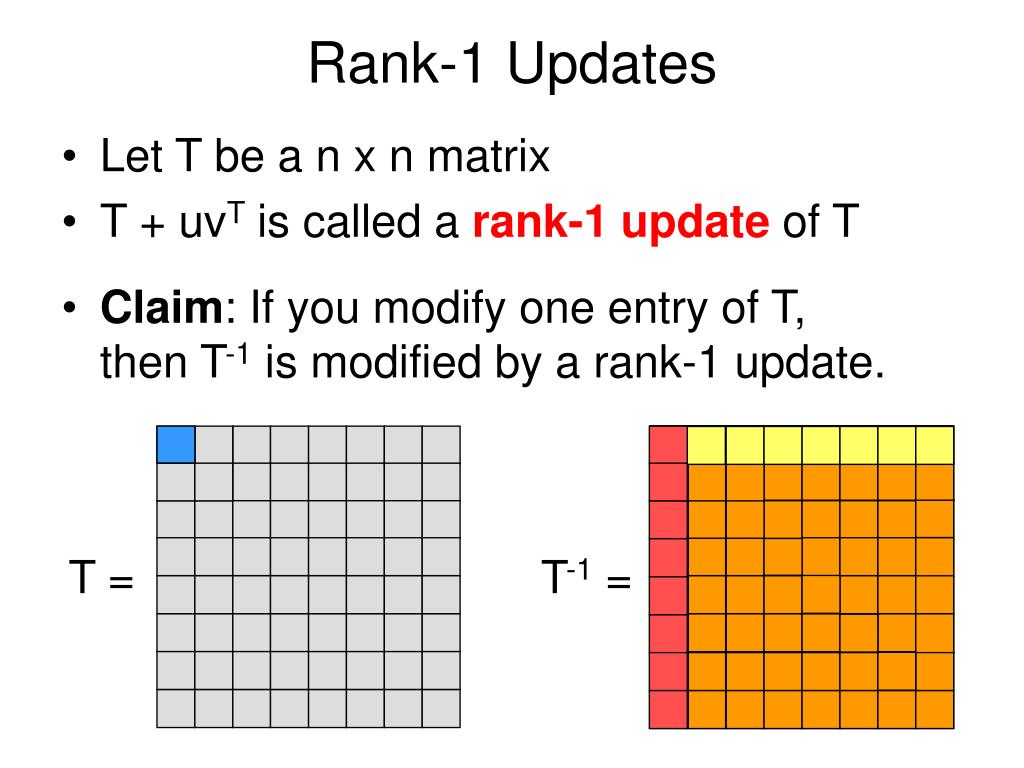
Think of it like this: You have a giant matrix – a table filled with numbers – representing your model's understanding of words. These numbers are like weights, determining how important a particular word is. A Rank One Update lets you adjust only one row or column of that matrix at a time. Hence, "Rank One." It’s updating only one “rank” of the matrix. BOOM. Explained. Pat yourself on the back.
Why is this useful? Well, imagine your model thinks "pizza" is a terrible food. Maybe it was trained on a dataset exclusively featuring people with gluten intolerance. But then you want it to understand that for most people, pizza is, like, the pinnacle of human achievement. Instead of retraining the entire model (which would be like re-educating everyone on Earth), you just tweak the “pizza” entry in your model's brain.
The Gossip Analogy (Because Everything's Better With Gossip)
Remember that social network? Let's say Sarah tells Tom a scandalous rumor about Mark. Tom believes Sarah (because she's usually right about these things). Now, Tom's understanding of Mark has changed. That's a Rank One Update!

Tom’s opinion of Mark (represented as a number) has been updated based on one new piece of information (the rumor from Sarah). He didn't need to interview Mark’s entire family and analyze his tax returns. He just needed one, well-placed piece of gossip. This single update, even though it affects only Tom's view of Mark directly, can indirectly influence the opinions of others in the network as Tom shares what he "learned."
Why Not Just Retrain Everything? (Are You Crazy?)
Retraining a large language model is like trying to teach a parrot the entire Encyclopedia Britannica. It’s slow, incredibly resource-intensive (think electricity bills the size of small countries), and frankly, probably cruel to the parrot.
Rank One Updates, on the other hand, are like teaching the parrot a few new phrases. "Want a cracker?" "Pretty bird!" "Release the kraken!" Much more manageable, right?
Also, sometimes you can't retrain. Maybe the data you trained on is now considered confidential. Or maybe you're working with a pre-trained model owned by a giant corporation that refuses to let you tinker with its core. In these cases, Rank One Updates are your only option. You’re like a secret agent, subtly altering the model's behavior without anyone knowing.
The Math (Don’t Panic!)
Okay, I promised I wouldn't get too math-y. But here's the gist: The update usually involves something called a vector. Think of a vector as an arrow pointing in a certain direction. The length of the arrow represents the magnitude of the change you want to make, and the direction represents what you want to change.
You take this vector and "add" it to the existing matrix in a very specific way. It’s not quite as simple as just adding numbers together (sorry to burst your bubble). But the key takeaway is: the update is designed to be efficient. You're not touching the entire matrix; you're just nudging it in the right direction.

And the result? A model that’s slightly better, slightly smarter, and slightly more likely to agree that pizza is, in fact, amazing.
Real-World Applications (Prepare to be Amazed!)
Rank One Updates are used everywhere, from improving search results to personalizing recommendations to fine-tuning language models for specific tasks (like writing hilarious cat captions).
Imagine you're building a chatbot that helps people find restaurants. Initially, it might struggle to understand slang terms like "nom noms" or "grub hub." A Rank One Update lets you quickly teach it these new words without having to retrain the entire chatbot. It’s like giving your chatbot a crash course in internet slang.

Or, suppose you're trying to build a sentiment analysis tool that can accurately gauge customer opinions. You might find that it consistently misinterprets sarcasm. By carefully crafting Rank One Updates, you can teach it to recognize the subtle cues that indicate sarcasm (like excessive exclamation points or the word "obviously").
So, What's the Takeaway?
Rank One Updates are a clever and efficient way to improve NLP models without the hassle of retraining. They're like targeted gossip, allowing you to subtly influence the model's understanding of the world. They are also highly suitable to on-device adaptation where computational resources are limited. Next time someone mentions Rank One Updates, you can nod knowingly and say, "Ah yes, the art of strategic information dissemination." Just try not to sound too pretentious.
Now, if you'll excuse me, I'm going to go spread some Rank One Updates about how delicious this imaginary latte is.