
What Is 6 To The Zeroth Power
Hey there, grab a virtual coffee and pull up a chair. We're about to dive into one of those math questions that sounds utterly baffling, but is actually surprisingly elegant and, dare I say, funny in its simplicity. We're talking about a number that makes grown calculators weep with confusion, a concept that feels like a riddle wrapped in an enigma, nestled inside a conundrum.
Today's brain-tickler? What is 6 to the zeroth power?
Yeah, I know. Your first instinct might be to picture a six just... standing there, looking bored. Or maybe it's a six that just got fired from its job as an exponent and is now at zero, collecting unemployment. But trust me, the answer isn't "six," and it's definitely not "zero."
Must Read
The Power of Powers (A Quick Refresher)
Before we tackle the big zero, let's remember what "to the power of" even means. It's essentially a shorthand for repeated multiplication. Think of it like a very efficient gossip network for numbers.
- 6 to the first power (written as 61) is just 6. Easy peasy. It's six, all by itself, perhaps contemplating its existence.
- 6 to the second power (62) is 6 multiplied by itself. So, 6 × 6 = 36. You might know this as "six squared," which always makes me think of a very symmetrical six.
- 6 to the third power (63) is 6 × 6 × 6. That's 36 × 6 = 216. This is "six cubed," like a tiny little six-sided die.
See a pattern? Each time we increase the exponent by one, we multiply by another 6. It's like adding another guest to the multiplication party.
The Head-Scratcher: 60
Now, what happens when we go the other way? When our exponent isn't 3, or 2, or even 1, but a bold, unwavering 0?
Imagine the mathematicians back in the day, probably in a smoky room, chalk dust flying, pondering this very question. "If 61 is 6, and 62 is 36, what in the name of Pythagoras is 60?!"
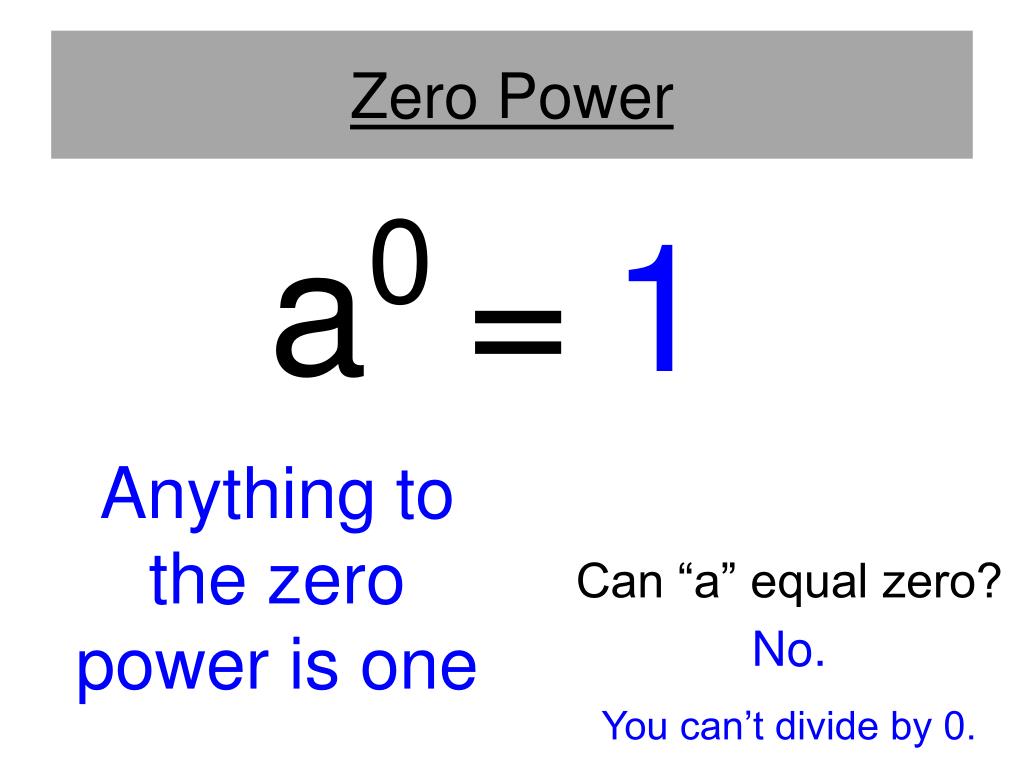
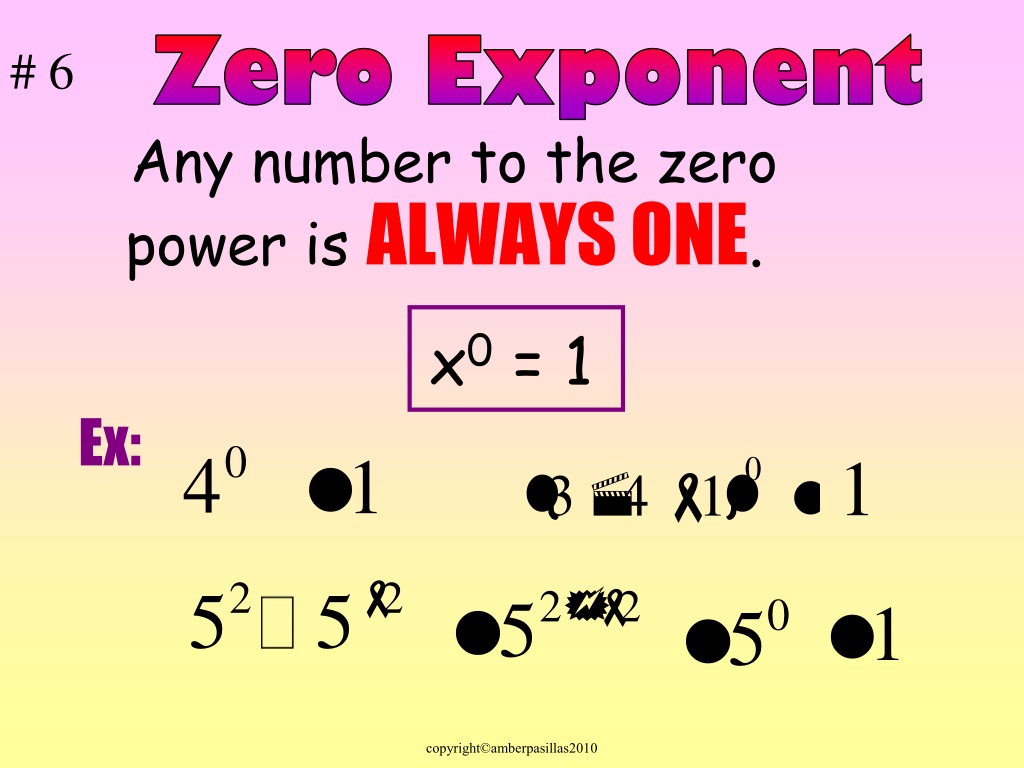
The answer, my friends, is not 6. It's not 0. It is, perhaps surprisingly, 1.
Yes, one. The most solitary of numbers. The beginning of everything. The number that often gets overlooked but is secretly the superstar of this particular show.
Why the Heck is it 1?! (The Pattern Method)
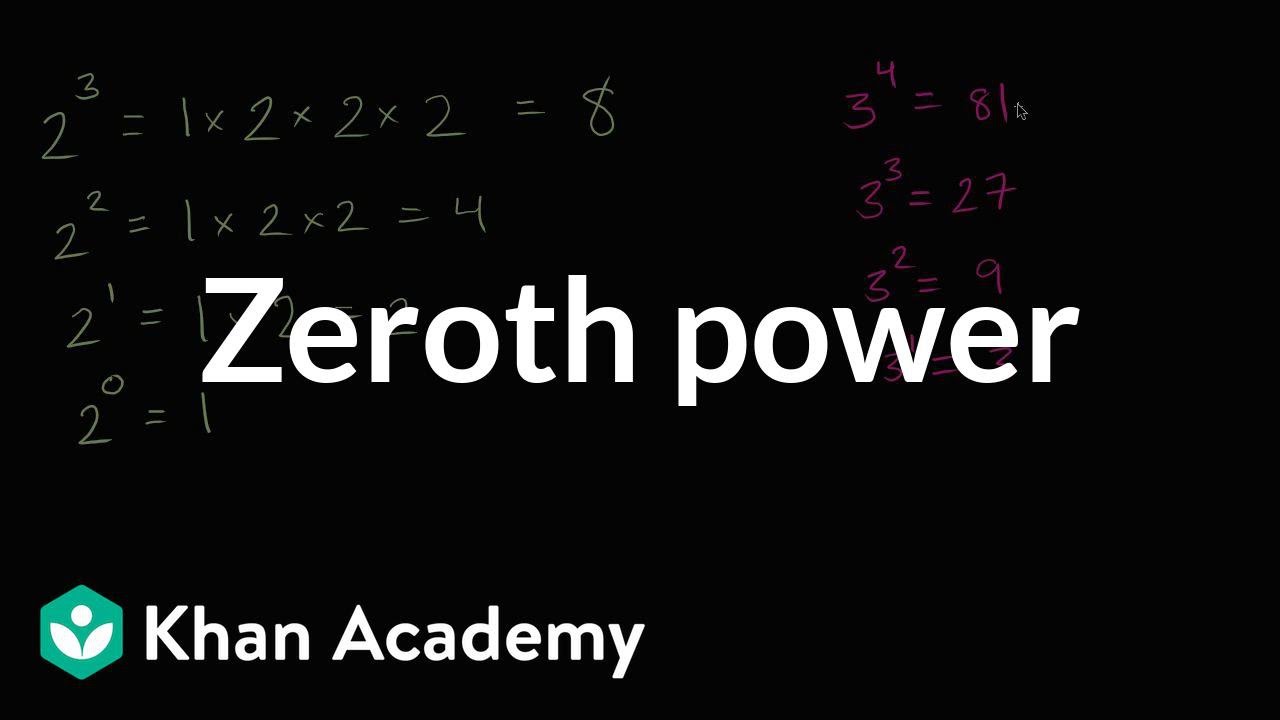
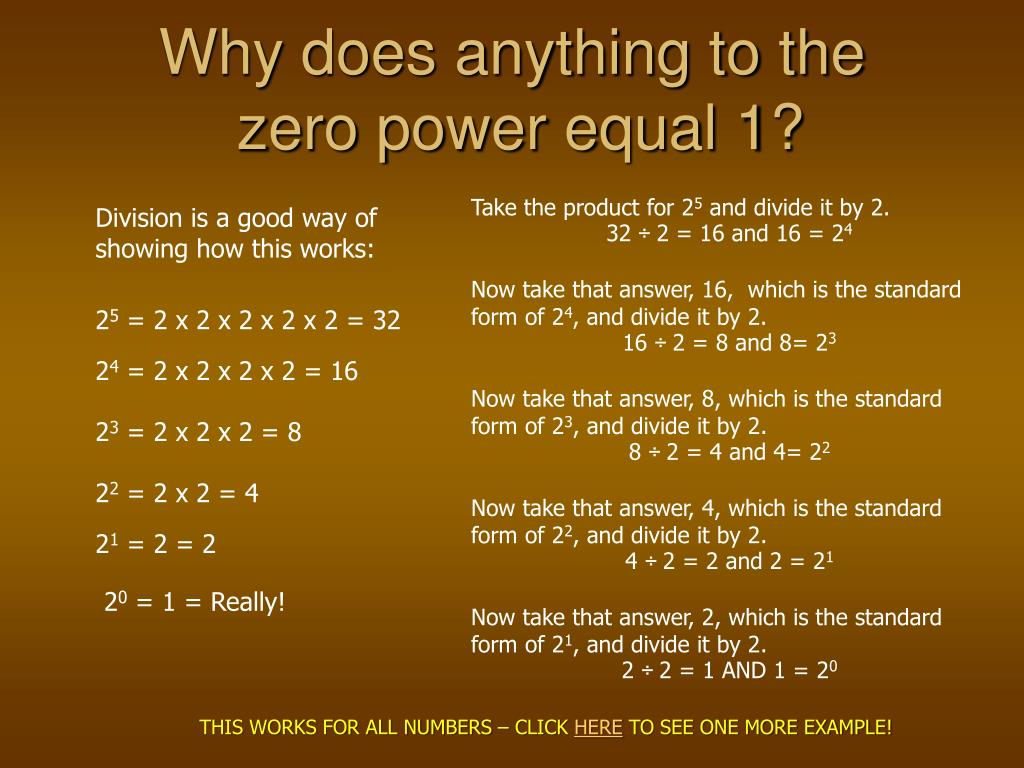
This is where the logic starts to hum like a well-oiled machine. Let's look at that pattern again, but this time, let's go down the list:
- 63 = 216
- 62 = 36 (Notice anything? We divided 216 by 6 to get 36!)
- 61 = 6 (And what did we do to 36 to get 6? Divided by 6 again!)
Are you seeing where this is going? To get from 61 to 60, we have to keep following the rule. We have to divide by 6 one more time!
So, 6 ÷ 6 = 1.
Voilà! The pattern holds! It’s like a magical numerical staircase where each step down involves dividing by the base number.
Why the Heck is it 1?! (The Division Method)
Here's another way to think about it, using a fundamental rule of exponents that often feels like a secret handshake among math enthusiasts. When you divide powers with the same base, you subtract their exponents.
For example:
- 65 ÷ 62 = 6(5-2) = 63
Makes sense, right? You're essentially cancelling out some of the multiplications.
Now, what if we divide a number by itself, using exponents?
- Let's say 63 ÷ 63.
We know that anything divided by itself is 1, right? If you have three cookies and you divide them by three cookies, you have one... pile of cookies. Or, more simply, if you have 6 chickens and you divide them by 6 chickens, you get 1.
So, 63 ÷ 63 = 1.
But wait! Using our exponent rule, 63 ÷ 63 = 6(3-3) = 60.
Therefore, if 63 ÷ 63 = 1, and 63 ÷ 63 = 60, then it must be true that 60 = 1!
Mind blown, right? It's like a mathematical detective story where all the clues lead to the same elegant truth.
Not Just 6! It's an Everybody Party!
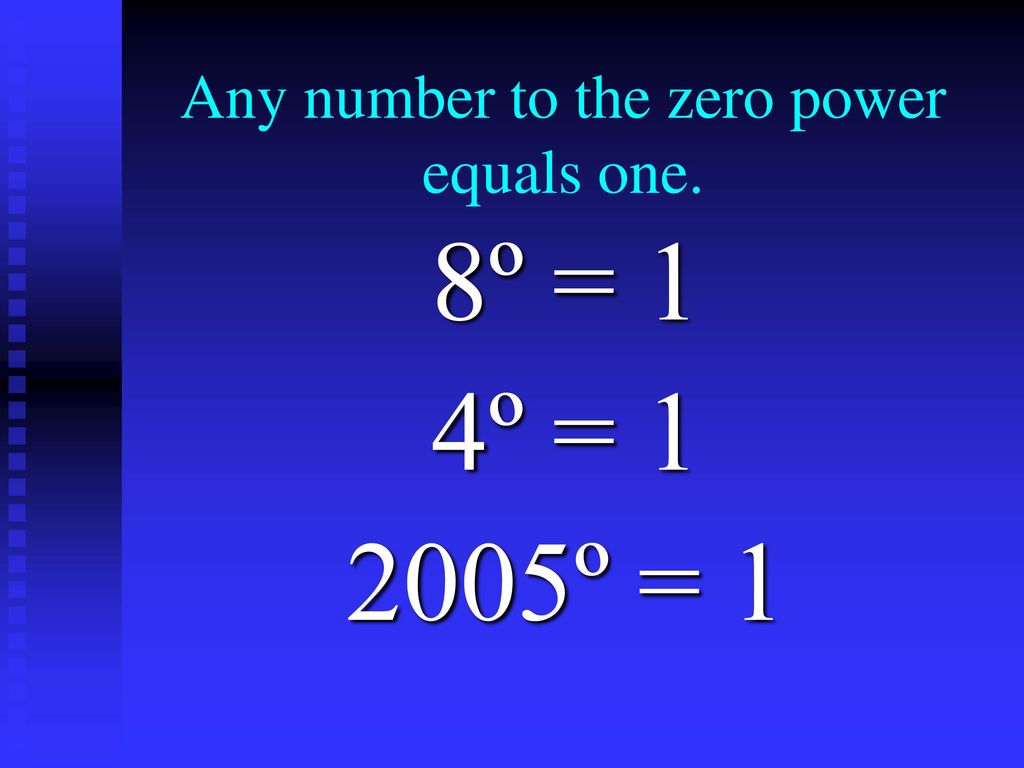
Here's the really cool part: this isn't just a special rule for the number 6. Oh no, my friend! This rule applies to any non-zero number.
That's right:
- 730 = 1
- 1,000,0000 = 1
- (Your lucky number)0 = 1
- (The number of hairs on your head)0 = 1 (assuming you have hairs, of course!)
It's one of those universal laws of mathematics. Any number (except for one quirky exception we'll glance at) raised to the zeroth power is simply 1. It's like the universe's way of saying, "You're starting fresh, with a single unit."
The Quirky Exception: 00
Now, I mentioned a "quirky exception." While almost everything to the power of zero is 1, the case of 00 is a bit of a mathematical celebrity. It's often considered undefined or an indeterminate form, meaning its value can't be easily nailed down to a single number without causing logical headaches.
Why? Because if you follow the pattern of 0 to any power (02=0, 03=0), it suggests 00 should be 0. But if you follow the "anything to the power of zero is 1" rule, it suggests 00 should be 1. It's like two mathematical trains trying to occupy the same track. So, for simplicity and to avoid tearing a hole in the fabric of space-time, we generally just say it's undefined.
But don't let that one oddball confuse you. For every other number, the rule is solid.
So, What's the Takeaway?
Next time someone asks you about a number to the zeroth power, you can confidently declare, "It's 1!" You'll sound incredibly smart, and now you even know why.
It’s a beautiful example of how mathematical rules, once established, consistently lead to elegant and sometimes unexpected truths. The humble 1, hiding in plain sight, proving its worth even when no multiplication is actively happening. It just goes to show, sometimes doing nothing (zero power) can still result in something significant!