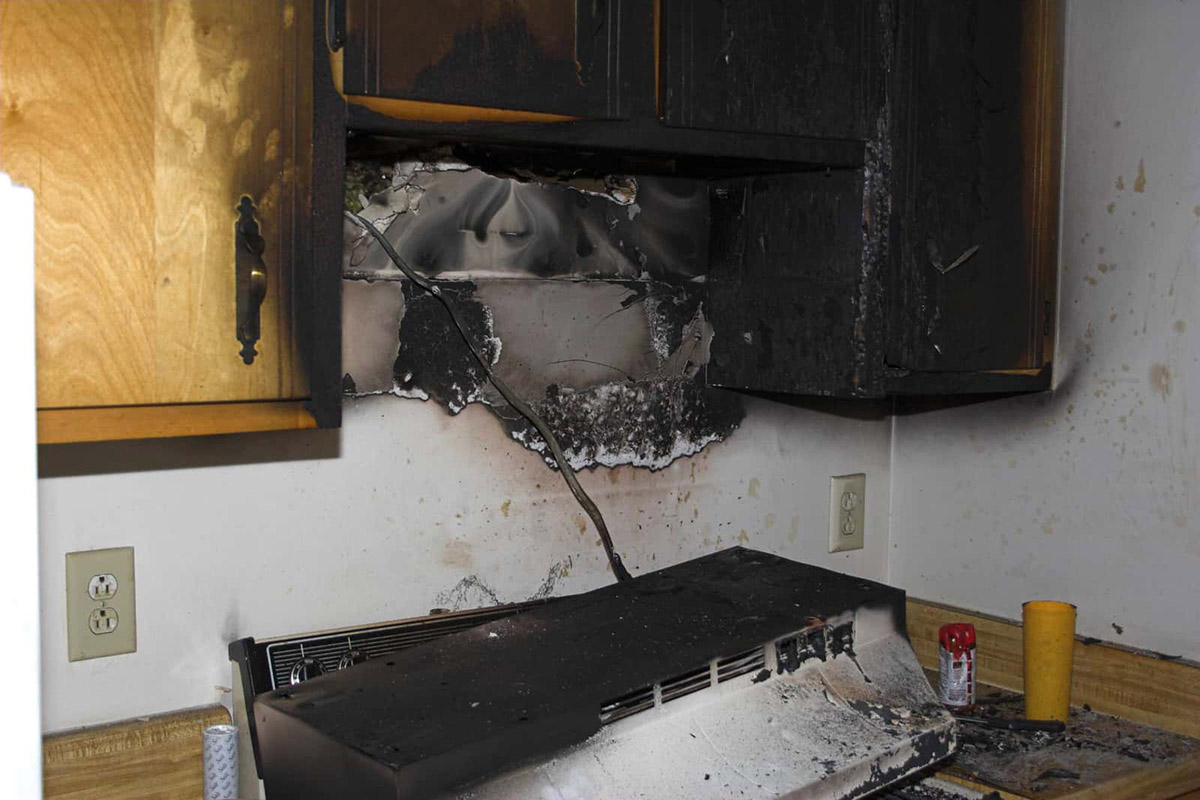
What Happens If You Put Water On A Grease Fire

Ever found yourself in the kitchen, perhaps with a sizzling pan of bacon or some deep-frying going on, and wondered, "What if this catches fire?" It's a slightly alarming thought, sure, but also a deeply human one rooted in curiosity. Our kitchens are often the heart of our homes, bustling with activity, and sometimes, a little too much heat. Understanding the dynamics of something like a grease fire isn't just about being prepared for the worst; it’s about satisfying that innate desire to understand the world around us, especially when it involves something as fundamental and fascinating as fire.
So, let's dive into a common "what if" scenario: What happens if you put water on a grease fire? You might think, "Water puts out fire, right?" And yes, for many types of fires, that's absolutely true. But a grease fire is a different beast entirely. Its purpose, in a curious sense, is to show us how different elements react under extreme conditions, offering invaluable insights into basic chemistry and physics. The benefit of understanding this isn't just about avoiding a catastrophe; it’s about gaining a deeper respect for the power of fire and the specific ways to manage it, transforming a potentially terrifying situation into one you can approach with knowledge, not just panic.
The science behind it is surprisingly dramatic. When you introduce water to burning grease, you're essentially pouring a relatively cool liquid (water) into super-heated oil. Grease fires often burn at hundreds of degrees Celsius, far above water's boiling point. As the water hits the hot oil, it instantly sinks to the bottom because water is denser than oil. There, it rapidly boils and turns into steam. This process is incredibly fast and violent. Water expands exponentially when it turns into steam—about 1,700 times its original volume! This sudden expansion creates a powerful upward force, carrying tiny droplets of burning oil high into the air, effectively turning a contained pan fire into a terrifying, flaming shower or even a miniature explosion. It's a spectacular, albeit dangerous, demonstration of a phase change reaction.
Must Read
This dramatic reaction isn't just a party trick for science documentaries; it has real-world applications in education and daily life. In chemistry classes, it's a vivid example of density differences, boiling points, and exothermic reactions. In culinary schools and home economics courses, it's a foundational lesson in kitchen safety, teaching future chefs and home cooks critical preventative measures. Fire departments regularly use demonstrations (safely, of course!) to educate the public during community safety events, making the abstract concept of fire safety tangible and unforgettable. In daily life, this knowledge arms you with the ability to react correctly if a small pan fire ever erupts, saving your kitchen, your home, and potentially your life. Knowing not to use water is as crucial as knowing what to do.
Now, how can you explore this fascinating topic without, you know, actually setting your kitchen on fire? The best and safest way to satisfy your curiosity is through observation and learning. Look up videos online—many fire departments and educational channels have excellent demonstrations of water on grease fires that illustrate the reaction perfectly. You might even find local fire departments hosting open houses where they perform controlled live demonstrations. Beyond that, cultivate good kitchen habits: never leave cooking unattended, keep flammable items away from heat sources, and always have a sturdy lid or a Class K fire extinguisher nearby. Understanding the "why" behind fire safety makes us all a little safer, and a lot smarter, one curious question at a time.