
What Does Prego Mean In Italian
Hey there, coffee buddy! Ever been chilling in Italy, maybe ordering a delicious pizza margherita (because, let’s be honest, who doesn't love pizza?), and heard someone say "Prego"? Or maybe you've seen it on a jar of pasta sauce and thought, "Hmm, what's the deal?"
Well, grab your biscotti, because we're about to unravel the mystery of "Prego!" It's not as complicated as you might think, I promise.
So, What's the Big Secret?
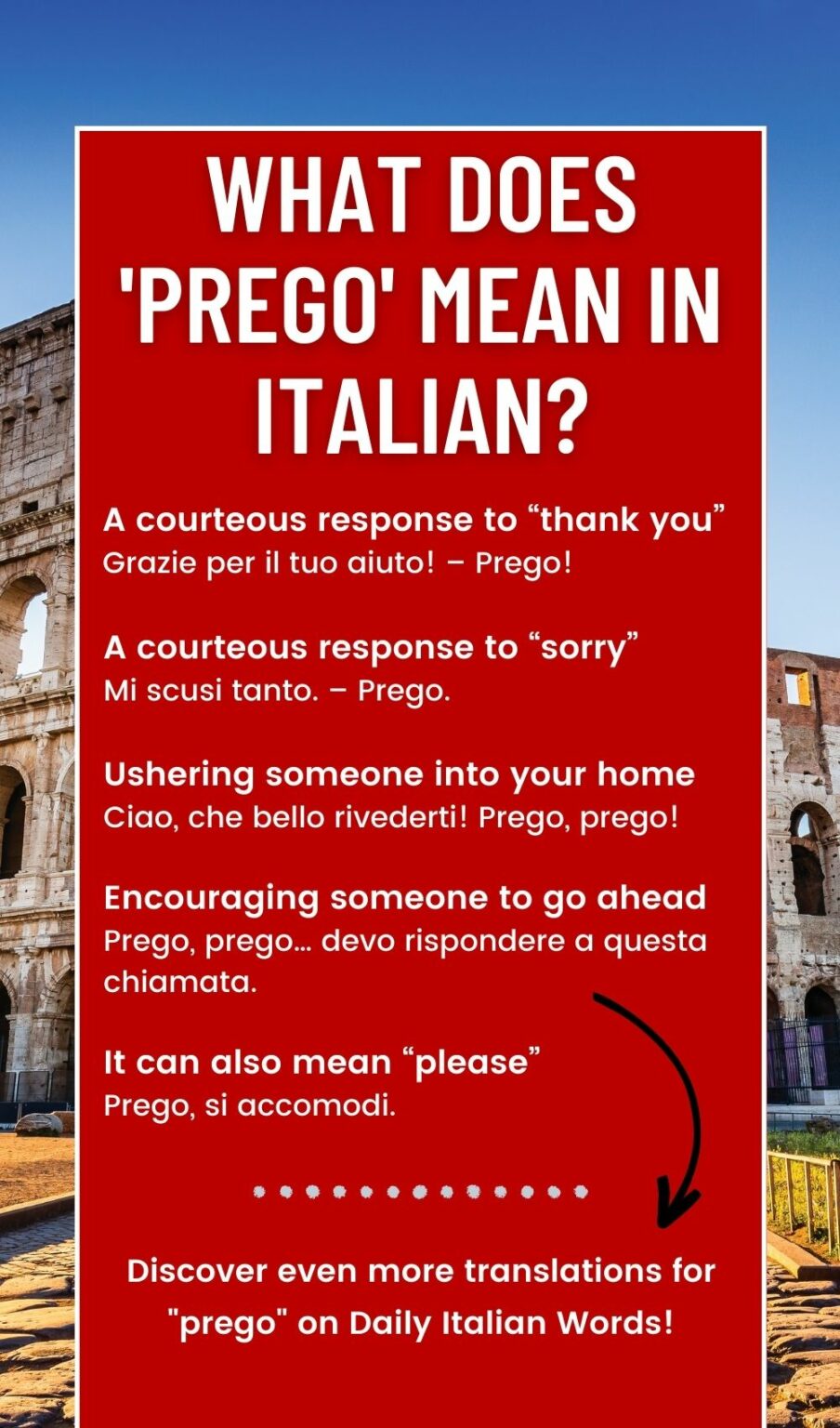
Here's the scoop: "Prego" is like the Swiss Army knife of Italian words. It's super versatile and can mean a bunch of different things depending on the situation. Think of it as the Italian equivalent of "You're welcome," "Please," "Go ahead," and even "Here you go!" all rolled into one little word. Pretty neat, huh?
Must Read
Think about it. If someone thanks you for holding the door, you could say "Prego!" Just like you'd say, "You're welcome."
Or imagine someone asking, "Can I sit here?" You could reply, "Prego!" meaning "Please do!" or "Go ahead!" It's like a little invitation to get comfy. Did I mention how amazingly versatile Italian is?
Breaking it Down: Prego in Action
Let’s get into some real-life scenarios, shall we? This will make things much clearer. Trust me.
Scenario 1: Post-Grazie

Someone: "Grazie mille!" (Thanks a million!)
You: "Prego!" (You're welcome!)
Easy peasy, right? Like responding to "thank you" with "no problem."
Scenario 2: Offering Assistance
Waiter: places your plate "Ecco a Lei!" (Here you are!)
You: "Prego!" (Thank you/Here you go! – in anticipation)
Here, it implies you're acknowledging their service and are ready to receive your food.
Scenario 3: Encouraging Someone

Someone: "Mi scusi, posso passare?" (Excuse me, can I pass?)
You: "Prego!" (Go ahead!)
Basically, you’re giving them the green light. Smooth, right?
Is There More To It? Absolutely!
Now, let's get a little fancy. "Prego" is actually the first-person singular present tense of the verb "pregare," which means "to pray" or "to beg." So, technically, when you say "Prego," you’re kind of saying "I pray you" or "I beg you" (in a polite, totally non-begging way!).
Don't worry; you're not actually begging anyone for anything when you say "Prego!" It's just a fun little etymological tidbit to impress your friends with. Imagine dropping that at your next dinner party! They'll think you're fluent for sure. (Even if you're not... yet!)
Prego vs. Per Favore: What's the Difference?
Okay, so you might be thinking, "Wait a minute, isn't 'per favore' also 'please'?" You're absolutely right! "Per favore" is definitely the more straightforward way to say "please" when asking for something. Like, "Un caffè, per favore!" (A coffee, please!).
But "Prego" is more about offering or responding. Think of "per favore" as the active "please," and "prego" as the more passive/reactive one. Clear as mud? I hope so! If not, grab another biscotti; we can go over it again!
So, the Next Time...
The next time you’re in Italy (or just pretending you are while stirring your pasta sauce), remember the magic of "Prego!" It's a small word with a big impact. Use it generously, and you'll be navigating Italian conversations like a pro.
Now, if you’ll excuse me, I think I hear the espresso machine calling my name… Prego! (You’re welcome to join me!)