
Wattage Of A Block Heater
Alright, grab a coffee (or a hot chocolate, it’s cold out there!) because we need to talk about something crucial, something that stands between you and a morning that starts with a whimper instead of a roar: the humble, often misunderstood, block heater. Picture this: it’s minus a bajillion degrees outside. Your car, bless its metallic heart, looks less like a sleek vehicle and more like a very sad, immobile Popsicle. You turn the key, and... click. Nothing. Just the mournful sound of a battery giving up the ghost. Sound familiar? That’s where our hero steps in!
The Unsung Hero: What Even Is a Block Heater?
Before we dive into the electrifying topic of wattage, let's quickly clarify what this contraption even does. Simply put, a block heater is an electrical heating element that warms up your engine’s coolant or oil before you start it. Think of it as giving your car a nice, warm mug of tea on a freezing morning. It thins out the oil, warms up the metal, and makes everything happy and ready to go. No more grinding, no more groaning, no more praying to the car gods.
It's like pre-heating your oven, but for your engine. And trust me, nobody wants to bake a cake in a cold oven, right? Same principle applies to your car engine!
Must Read
Wattage Wars: How Much Juice Does This Thing Need?
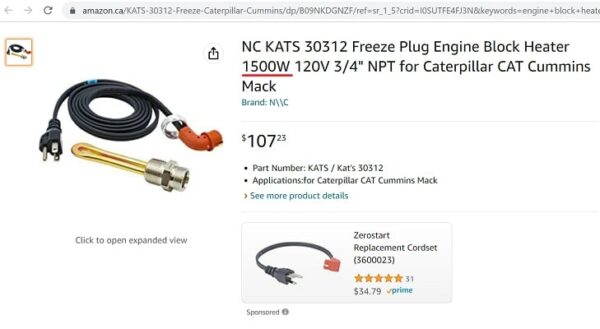
Okay, now for the main event: the wattage! This is where things can get a little murky, but fear not, I'm here to illuminate the path. Block heaters typically fall into a range from about 400 watts (W) to 1500 watts (W). That’s quite a spread, right?
To put that in perspective, a small, personal hairdryer might be around 1000-1200W. So, your block heater could be using as much power as a decent hairdryer, or even just a very modest one. Not exactly powering a small city, but definitely enough to get the job done.

So, What Determines the Wattage?
It's not just a random number! A few things play into it:
- Engine Size: This is the big one. A tiny, fuel-efficient four-cylinder engine in a compact car won't need nearly as much warming power as a massive diesel V8 in a heavy-duty truck. Bigger engine, more metal, more coolant = more watts needed. Makes sense, doesn’t it?
- Climate: If you live where "cold" means "below freezing sometimes," you might get by with a lower wattage heater. But if your winter is a proper Arctic expedition, where polar bears wear parkas, you’ll likely need something on the higher end of the spectrum.
- Specific Heater Design: Some heaters are internal (immersed in the coolant), others are external. The design can also influence the efficiency and required wattage.
Most passenger cars, we're talking about your average sedan or SUV, will hover in the 600W to 1000W range. If you've got a massive truck or live in the frosty tundra, you might see 1200W or even 1500W. These are the heavy hitters, the true gladiators of winter mornings!
"Is More Wattage Always Better?" (Spoiler: Not Necessarily!)
Ah, the classic "bigger is better" fallacy! While it might seem logical to just slap on the most powerful block heater you can find, it's not always the smartest move. If your car only needs 750W to be toasty warm, plugging in a 1500W heater is just overkill. It won’t necessarily heat it faster beyond a certain point, but it will suck up more electricity.
It's like using a flamethrower to light a candle. Effective, sure, but a bit much, and probably not the most efficient use of resources. The goal is to get your engine to an optimal temperature, not to melt the block!
How Do You Find Your Car's Specific Wattage?
Glad you asked! It’s not a guessing game. There are a few ways:

- Owner’s Manual: Your car’s bible will usually have the recommended wattage for an installed block heater.
- Look at the Heater Itself: Sometimes, the wattage is printed right on the heater element or the cord leading to it. You might need to do a little detective work under the hood.
- Online Search: A quick Google search with your car's make, model, year, and "block heater wattage" will usually yield answers from forums or parts suppliers.
The Cost of Warmth: Will This Break the Bank?
Now, let's address the elephant in the room: electricity consumption. Are you going to be slapped with an outrageous power bill just to keep your car from freezing its pistons off? The good news is, probably not!
Let's do some quick, napkin math. If you have a 750W block heater and you plug it in for, say, four hours before you leave for work (which is generally plenty of time, especially with a timer!), that's 0.75 kilowatt-hours (kWh) per hour. Over four hours, that's 3 kWh.
Depending on your local electricity rates (let's say 15 cents per kWh for a rough average), that's a grand total of... 45 cents. For a nice, warm, easy start! That's less than a cup of coffee. Less than most candy bars. Seriously, it's a bargain!

And here's the surprising fact: that small cost often pays dividends in reduced wear and tear on your starter, battery, and engine components. A cold start is tough on an engine, like asking an athlete to sprint without warming up. A block heater dramatically reduces that stress, potentially saving you far more in repairs down the line than you'll ever spend on electricity.
The Takeaway: Embrace the Heater!
So, the wattage of your block heater isn't just a random number; it's a carefully calibrated power output designed to keep your engine happy in the bitter cold. Whether it's 400W or 1500W, the important thing is that it’s the right wattage for your vehicle and your climate.
Don't fear the power bill; embrace the ease of starting, the reduced engine wear, and the almost instant warm air blasting from your vents. In the grand scheme of winter expenses, your block heater is perhaps the cheapest, most effective investment you can make for your car's longevity and your own morning sanity. Stay warm out there!