
Point Of Inflection Vs Critical Point
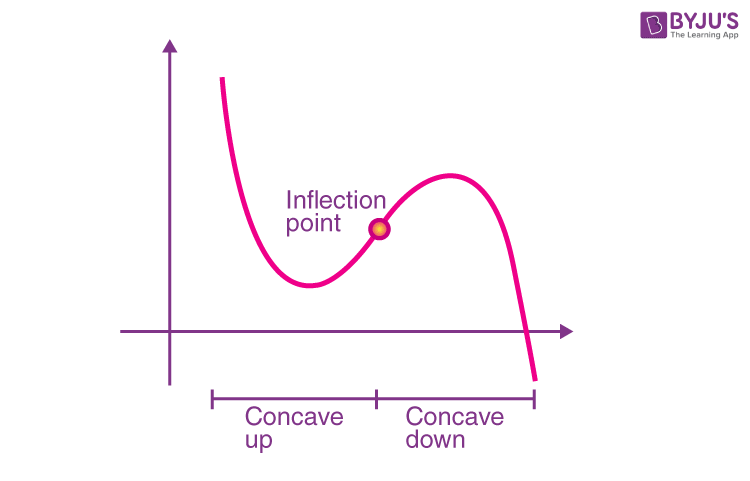
Alright, buckle up buttercup! We're diving into the wild world of calculus. Don't worry, it’s not as scary as your high school math teacher made it seem. Today's adventure: Point of Inflection vs. Critical Point. Think of it as a roller coaster ride for your brain!
What’s a Critical Point Anyway?
Imagine you're on a roller coaster. You’re climbing that first HUGE hill. You're gaining altitude, right? Then you reach the very top. For a split second, you're neither going up nor down. BAM! That's a critical point! Or, you are at the very bottom of a loop.
Essentially, a critical point is where the slope of a curve is either zero (flat) or undefined (like a vertical cliff, but in math terms). It's a place where the function’s doing something... well, critical!
Must Read
These points are crucial because they often indicate the maximum or minimum value of a function. Basically, the highest or lowest points on a graph (locally, at least). Think of it as finding the peak of Mount Everest, or the deepest part of the Marianas Trench (but in math!).
Critical points can be maximums, minimums, or even just plateaus. They're all about those places where the function hits pause on its upward or downward journey. Cool, right?
Enter: The Point of Inflection!
Now, imagine that same roller coaster. This time, you're going through a loop-de-loop. At some point in that loop, the direction you’re being pressed in changes. It goes from being forced down to forced up. That's kind of like a point of inflection!
A point of inflection is where the concavity of a curve changes. Concavity? Yeah, that's a fancy word for whether the curve is shaped like a smile (concave up) or a frown (concave down).
Think of it this way: imagine pouring water onto the curve. If the water pools, it's concave up (like a bowl). If the water slides off, it's concave down (like a hill). The point of inflection is where that "bowl" turns into a "hill", or vice versa.
Here's a fun fact: The second derivative is usually zero at a point of inflection. Derivatives might sound intimidating, but they're really just about rates of change. The second derivative tells you about the rate of change of the rate of change. Mind. Blown.

The Big Difference: Slope vs. Concavity
Okay, let's nail down the key distinction. Critical points are all about where the slope is zero or undefined. They tell us about where the function is "paused" in its climb or descent.
Points of inflection, on the other hand, are about where the concavity changes. They tell us about where the curve switches from "smiling" to "frowning" (or vice versa).
Think of it like this: A critical point is like finding the top or bottom of a hill. A point of inflection is like finding where the hill starts to curve the other way.
Why Should I Care? (Besides Nerd Cred)
So, why bother with all this calculus mumbo jumbo? Well, these concepts pop up all over the place in the real world!

Engineers use critical points to design structures that can withstand maximum stress. Economists use points of inflection to predict changes in market trends. Even artists use these concepts to create visually appealing curves in their designs!
Knowing the difference between a critical point and a point of inflection can help you understand and analyze data, optimize processes, and even make better decisions. Plus, you'll sound super smart at parties (or at least impress your math geek friends!).
Let's Get Visual!
Want to really drive this home? Grab a piece of paper and sketch some graphs. Draw a curve that has a maximum, a minimum, and a point where it changes from concave up to concave down. Label those points! This simple exercise can make all the difference.

Or, better yet, find a graphing calculator (online ones are readily available) and play around with different functions. See how changing the equation affects the critical points and points of inflection. It's like a science experiment, but with fewer explosions (hopefully!).
Final Thoughts: Embrace the Curve!
So there you have it: a whirlwind tour of critical points and points of inflection. They might seem a little abstract at first, but with a little practice and a healthy dose of curiosity, you'll be identifying them like a pro.
Remember, math isn't about memorizing formulas. It's about understanding concepts and using them to solve problems. So embrace the curve, explore the slopes, and have fun with it!
Now go forth and conquer those calculus problems! And remember, when in doubt, think of that roller coaster.