Molecular Weight Of Benzoic Acid
Ever baked a cake and wondered why the recipe calls for exactly one teaspoon of baking powder? Or perhaps you've noticed that cleaning products seem to have a secret formula for tackling grime? What if I told you that the invisible world of molecules and their weights plays a crucial role in all of this? Today, we're diving into a specific example: the molecular weight of benzoic acid. And trust me, even if you haven't heard of it, it's more interesting than it sounds!
So, why is knowing the molecular weight of benzoic acid important? Well, think of it like this: knowing the weight of a single apple is crucial if you're trying to fill a bag with exactly one kilogram of apples. In chemistry, instead of apples, we have molecules, and instead of kilograms, we use a unit called grams per mole (g/mol). The molecular weight of a substance tells us the mass of one mole (a huge number - 6.022 x 10²³ - of molecules) of that substance.
Benzoic acid, with its chemical formula C7H6O2, isn't some obscure laboratory chemical. It's a naturally occurring compound found in many plants and is even used as a preservative in foods and cosmetics! It's like a silent guardian, preventing unwanted bacterial and fungal growth. Knowing its molecular weight allows chemists and food scientists to use it effectively and safely.
Must Read
Now, how do we find this magical number? We simply add up the atomic weights of all the atoms in the benzoic acid molecule. You can find the atomic weights on the periodic table. Carbon (C) weighs approximately 12.01 g/mol, Hydrogen (H) weighs about 1.01 g/mol, and Oxygen (O) weighs around 16.00 g/mol.
So, let's do the math:
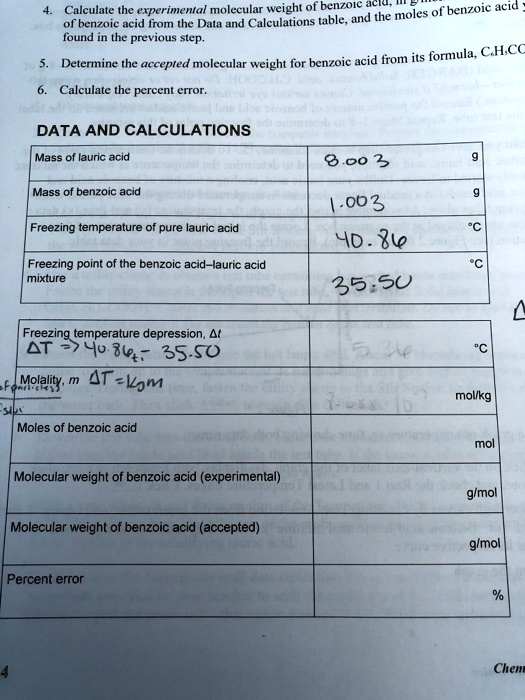
- 7 Carbons: 7 * 12.01 g/mol = 84.07 g/mol
- 6 Hydrogens: 6 * 1.01 g/mol = 6.06 g/mol
- 2 Oxygens: 2 * 16.00 g/mol = 32.00 g/mol
Adding these together: 84.07 + 6.06 + 32.00 = 122.13 g/mol.
Therefore, the molecular weight of benzoic acid is approximately 122.13 g/mol!
Why is this useful? Imagine you're a scientist trying to synthesize a new drug using benzoic acid as a starting material. You need to know exactly how much benzoic acid to use to get the right amount of your desired product. Or, suppose you're a food manufacturer wanting to add benzoic acid as a preservative. Knowing the molecular weight helps you calculate the correct amount to add to maintain food safety and prevent spoilage. It ensures the product does what it should, without causing harm.
So, while the molecular weight of benzoic acid might seem like a dry, technical detail, it's actually a vital piece of information that underpins many processes we rely on every day, from the food we eat to the medicines we take. It's a tiny number with a big impact!
![[ANSWERED] 26 The molecular weight of benzoic acid in benzene as - Kunduz](https://media.kunduz.com/media/sug-question-candidate/20200910121907170504-1864750.jpg?h=512)