Molar Mass Of Zinc Nitrate

Okay, let's talk about zinc nitrate! I know, I know, it sounds super nerdy, but trust me, understanding the molar mass of zinc nitrate is like unlocking a secret code that lets you understand how much stuff you're actually dealing with. It's surprisingly useful, and even kind of fun once you get the hang of it. Think of it as chemistry's version of counting your steps to feel accomplished!
So, why is this molar mass business important? Well, for beginners just starting their chemistry journey, figuring out molar mass is a foundational skill. It’s like learning your alphabet before you can write a sentence. Understanding it helps you grasp concepts like chemical reactions, solutions, and stoichiometry (which, despite the scary name, is just fancy math about chemicals). If you're into gardening or aquariums, knowing about zinc nitrate might be helpful. Zinc is a micronutrient for plants, and nitrate can be a source of nitrogen. Although using pure zinc nitrate directly in these areas is uncommon and requires caution (more on that later), understanding its composition is still valuable if you encounter it in fertilizers or water treatments. Even for families who are into cooking or home science experiments, understanding basic measurement concepts and chemical quantities is helpful and educational. Molar mass is essentially chemistry's way of counting!
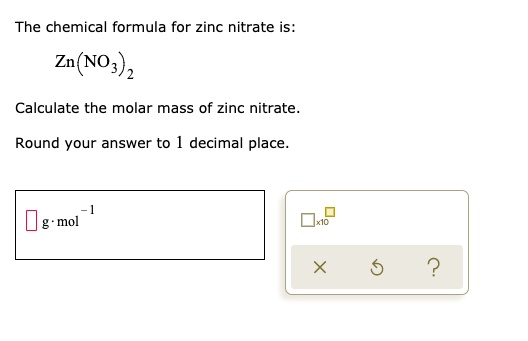
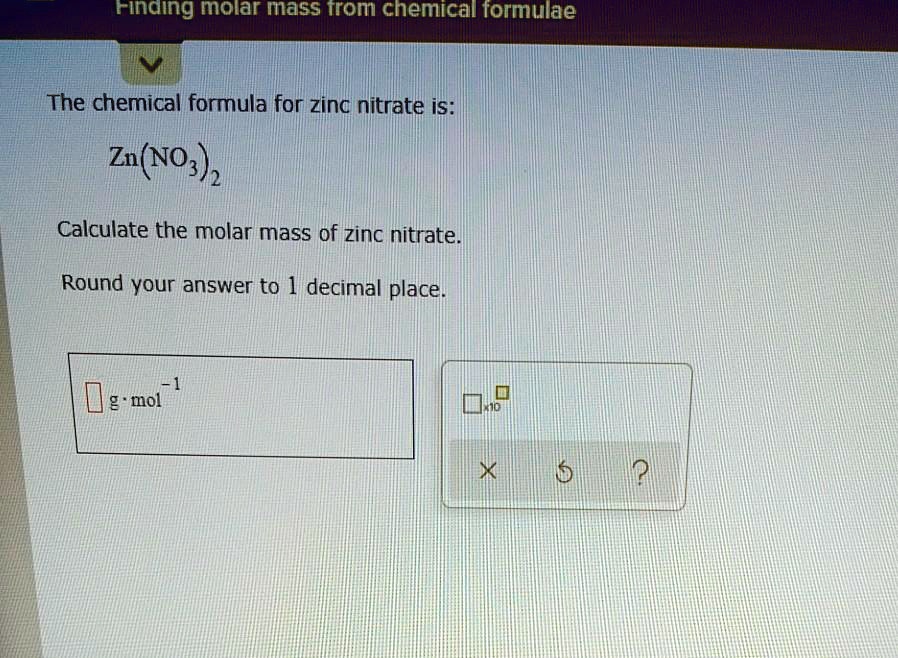
The chemical formula for zinc nitrate is Zn(NO3)2. That little subscript '2' means there are two nitrate ions (NO3) for every one zinc atom (Zn). To find the molar mass, we need to add up the atomic masses of all the atoms in the formula, which you can find on the periodic table. Zinc (Zn) has an atomic mass of roughly 65.38 g/mol. Nitrogen (N) is about 14.01 g/mol, and oxygen (O) is about 16.00 g/mol. So, the molar mass of NO3 is 14.01 + (3 x 16.00) = 62.01 g/mol. Since there are two NO3 groups, that's 2 x 62.01 = 124.02 g/mol. Finally, add the zinc: 65.38 + 124.02 = 189.40 g/mol. So, the molar mass of zinc nitrate, Zn(NO3)2, is approximately 189.40 g/mol. See, not so scary!
Must Read
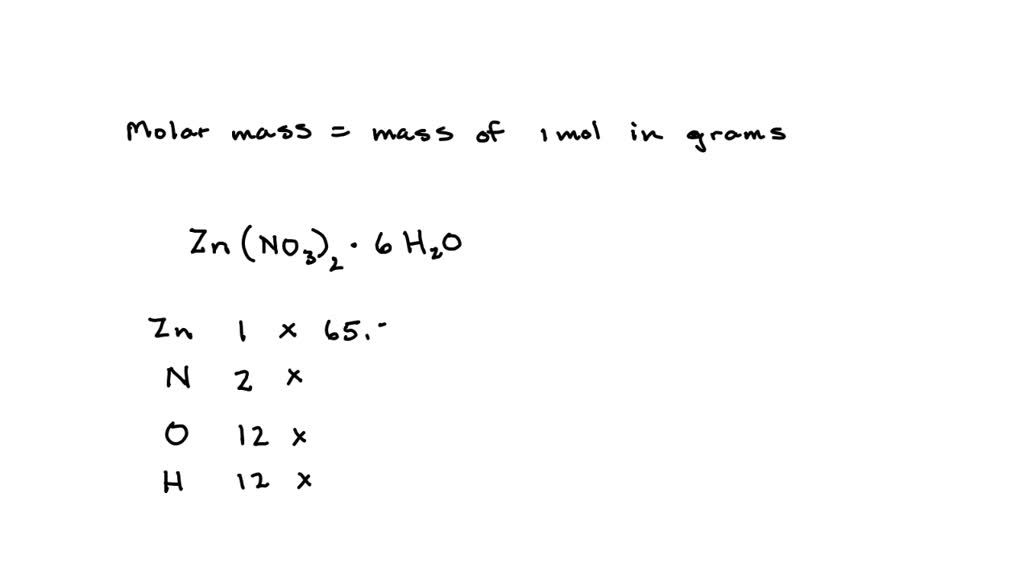
Variations can arise depending on whether the zinc nitrate is anhydrous (without water) or hydrated (with water molecules attached). Zinc nitrate often comes in hydrated forms, like zinc nitrate hexahydrate, Zn(NO3)2·6H2O. In that case, you would also need to account for the mass of the six water molecules (6 x 18.02 g/mol) and add that to the molar mass of the zinc nitrate itself.
![Zinc nitrate [Zn(NO3)2] Molar Mass (With Calculations)](https://knordslearning.com/wp-content/uploads/2022/08/zinc-nitrate-molar-mass.jpg)
Here are some simple tips to get started: First, grab a periodic table. It's your best friend for finding atomic masses. Second, practice breaking down chemical formulas into their individual atoms. Make sure you pay attention to the subscripts! Third, start with simpler compounds like water (H2O) or carbon dioxide (CO2) before tackling something like zinc nitrate. And remember, double-check your calculations! A small error can throw off the whole result.
Understanding the molar mass of zinc nitrate (or any chemical compound, really) opens the door to understanding the quantitative relationships in chemistry. While it may seem like a dry topic at first, appreciating how to count and relate atoms in compounds is extremely valuable. Plus, there's a certain satisfaction in knowing you can figure out exactly how much of something you have – it's like having a superpower for understanding the world around you. So, dive in, do some calculations, and enjoy the feeling of cracking the code!