Ever heard of sodium phosphate? Sounds a bit…sciencey, right? But trust me, it's surprisingly cool. We're going to talk about its molar mass. Yeah, I know, sounds intimidating. But think of it as finding out the exact weight of a whole bunch of sodium phosphate molecules. Like weighing a whole truckload of tiny, invisible oranges!
What's the Big Deal?
Okay, so why bother weighing imaginary oranges? Well, molar mass is super important in chemistry. It's like the secret code to understanding how much of something you need for a chemical reaction. Think of baking a cake. You need a specific amount of flour, sugar, and eggs, right? Too much or too little and the cake flops. Chemistry is the same! Molar mass tells chemists exactly how much sodium phosphate to use to get the reaction they want. No more chemical cake fails!
Sodium phosphate itself is pretty nifty. It's actually a family of compounds. They're all made of sodium, phosphorus, and oxygen atoms, but they're put together in slightly different ways. This means they all have slightly different molar masses. It's like having a family of oranges – some are a bit bigger, some a bit smaller, but they're all still oranges at heart.
So, how do you find the molar mass? It's like a chemical detective story! You need to look at the chemical formula of sodium phosphate. Let's take trisodium phosphate (Na3PO4) as an example. This is one particular type of sodium phosphate.
First, you need to know the atomic masses of each element in the formula. Sodium (Na) is around 22.99 grams per mole. Phosphorus (P) is about 30.97 grams per mole. And oxygen (O) is roughly 16.00 grams per mole. These are like the individual weights of each ingredient in our orange recipe.
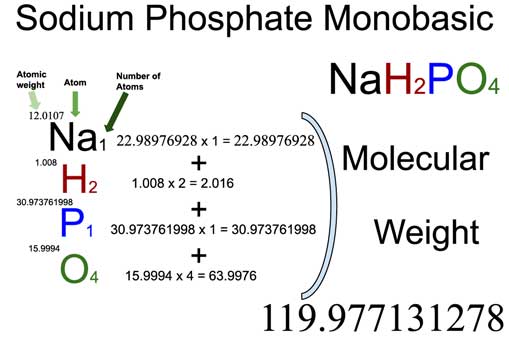
Now, the formula Na3PO4 tells us we have 3 sodium atoms, 1 phosphorus atom, and 4 oxygen atoms. Time for some math! We multiply each atomic mass by the number of atoms in the formula:
(3 x 22.99) + (1 x 30.97) + (4 x 16.00) = 163.94 grams per mole
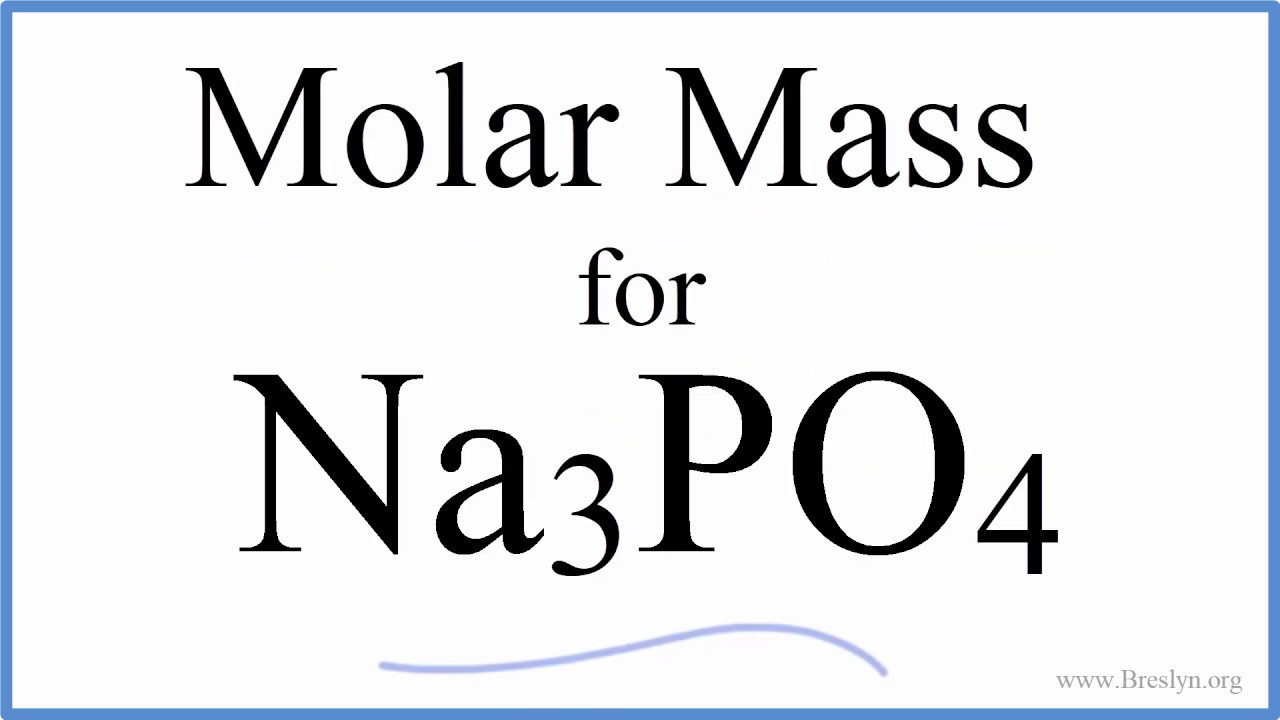
Na3PO4 (Sodium phosphate) Molar Mass (With Calculations)
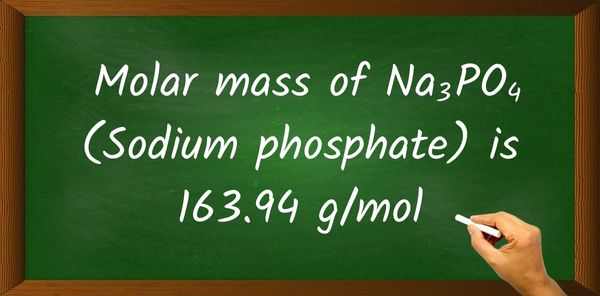
Voila! The molar mass of trisodium phosphate (Na3PO4) is about 163.94 grams per mole. That means one mole (a very large number!) of Na3PO4 weighs about 163.94 grams.
Why This Matters in Real Life
Okay, so we've done some math. But where does this actually matter? Sodium phosphates are used in tons of things! They're in detergents, cleaning products, and even some foods as preservatives. Knowing the molar mass helps manufacturers figure out exactly how much sodium phosphate to use to make their products work effectively and safely.
Na3PO4 (Sodium phosphate) Molar Mass (With Calculations)
Think about cleaning your clothes. The detergent uses sodium phosphate to soften the water and help remove dirt. Too much sodium phosphate and it could damage your clothes. Too little and your clothes won't get clean. It's all about getting the amount just right, and molar mass helps make that happen.
Even in medicine, sodium phosphates play a role. They're used in some medications and as laxatives. Again, the correct dosage is crucial, and molar mass is a key piece of the puzzle.
Math with Chemical Formulas - ppt download
So, What's So Entertaining About It?
Maybe "entertaining" is a strong word. But finding the molar mass is like solving a puzzle. You take a chemical formula, break it down into its individual atoms, and then use some simple math to find the weight of a whole bunch of those molecules. It's a little bit like being a chemical detective!
Plus, understanding molar mass opens up a whole new world of understanding about how chemistry works. It's the foundation for understanding chemical reactions, stoichiometry, and a whole lot more. It's like learning a secret language that lets you understand the world around you in a completely new way.
So, next time you see sodium phosphate listed on the ingredients of something, remember that there's a whole world of chemistry behind it, and the molar mass is a crucial part of that story. It might not be the most thrilling topic on the planet, but it's definitely interesting, important, and maybe, just maybe, a little bit entertaining!