
Molar Mass Of Calcium Hydroxide

Hey there, chemistry buddy! Ever find yourself staring blankly at a bottle of something and wondering, "What exactly is this stuff made of?" And more importantly, "How much does a whole bunch of it weigh?" Well, today we're diving headfirst (don't worry, we've got safety goggles!) into the wonderful world of calcium hydroxide and figuring out its molar mass. Ready for some chemical calculations? Let's go!
What IS Calcium Hydroxide, Anyway?
Okay, first things first. Calcium hydroxide. It’s also known as slaked lime or hydrated lime. Sounds kinda fancy, right? But trust me, it's not as intimidating as it seems. Think of it as calcium hanging out with some hydroxide ions. Its chemical formula is Ca(OH)2. See? Already, we're looking like chemistry pros! You’re practically Marie Curie already. 😉
So, why do we even care about this stuff? Well, it’s used in a bunch of things! From making mortar for buildings (pretty important, wouldn't you say?) to neutralizing acidic soil in gardens (hello, happy plants!), calcium hydroxide is a surprisingly versatile compound. Who knew?
Must Read
Finding the Molar Mass: The Great Atomic Weight Adventure
Alright, time for the main event: calculating the molar mass of Ca(OH)2. But what even is molar mass? Simply put, it's the mass of one mole of a substance. A mole is just a super handy chemist’s counting unit, like a dozen but much, much bigger (we're talking 6.022 x 10²³ particles!). Okay, back to molar mass!
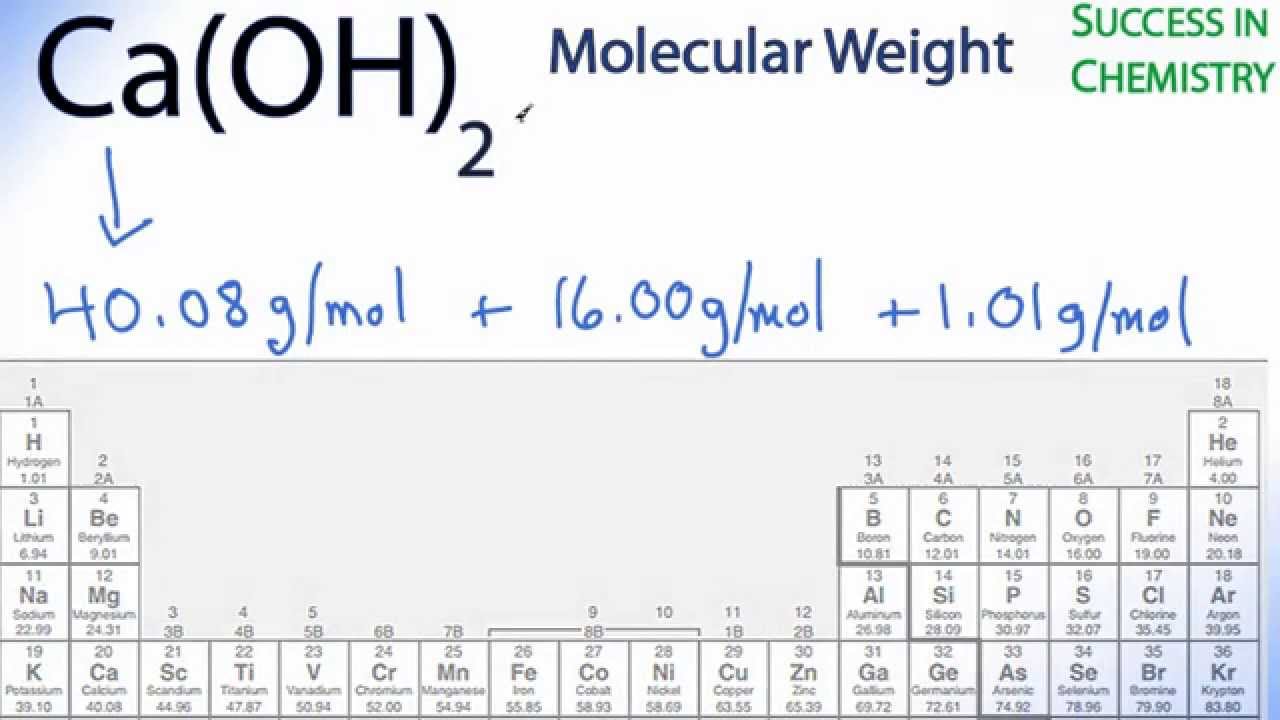
To find the molar mass, we need to consult our trusty periodic table. Think of it as our chemical roadmap! We need to find the atomic weights of each element in our compound: Calcium (Ca), Oxygen (O), and Hydrogen (H). Ready to play detective?
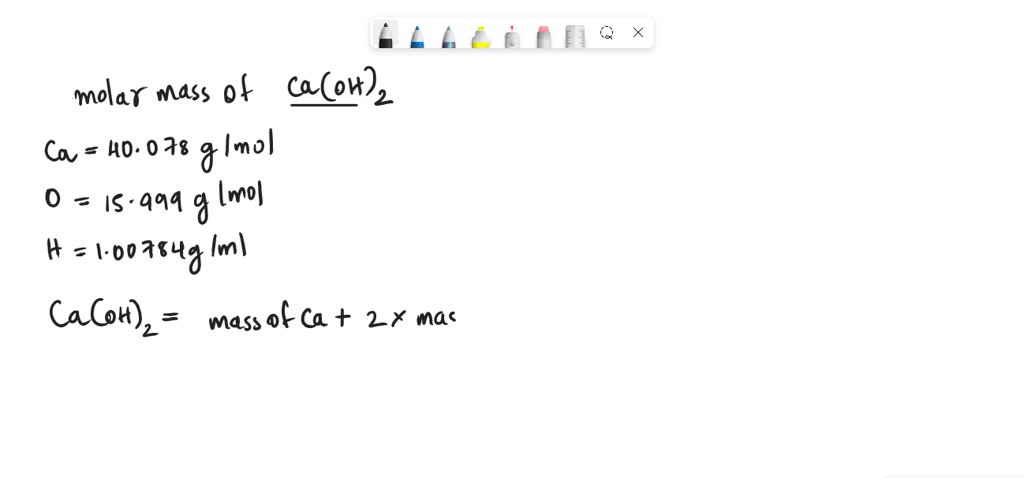
Grab your (metaphorical) magnifying glass and let's get searching! Here’s what we find:
- Calcium (Ca): Approximately 40.08 g/mol
- Oxygen (O): Approximately 16.00 g/mol
- Hydrogen (H): Approximately 1.01 g/mol
Great! Now that we have our building blocks, let's put them together. Remember that formula, Ca(OH)2? That little '2' outside the parentheses means we have two hydroxide (OH) groups. So, we have one calcium atom, two oxygen atoms, and two hydrogen atoms. Got it?

The Calculation: Math Time! (Don't Panic!)
Okay, time to unleash our inner mathematician! (It's okay if she's hiding – we'll coax her out with promises of coffee.)
Here's the breakdown:
- Mass of Calcium: 1 * 40.08 g/mol = 40.08 g/mol
- Mass of Oxygen: 2 * 16.00 g/mol = 32.00 g/mol
- Mass of Hydrogen: 2 * 1.01 g/mol = 2.02 g/mol
Now, all we have to do is add them all up! Drumroll, please!
40.08 g/mol + 32.00 g/mol + 2.02 g/mol = 74.10 g/mol
Ta-da! The molar mass of calcium hydroxide (Ca(OH)2) is approximately 74.10 grams per mole. You did it! You're practically a wizard with atoms now.

Why Bother? The Importance of Molar Mass
Now, you might be thinking, "Okay, cool, I can calculate molar mass. But why is this even important?" Well, knowing the molar mass allows us to convert between mass and moles. Why is that important? Imagine you’re trying to make a specific chemical reaction happen. You need to know exactly how much of each ingredient to add! Too much or too little can completely mess things up! It's like baking a cake – you can't just throw in random amounts of flour and sugar and expect it to taste good, right?
So, molar mass is crucial for accurate measurements in chemistry. It helps us figure out the amounts of different substances we need to get the reactions we want. Pretty neat, huh?
Alright, that's it for our deep dive into the molar mass of calcium hydroxide. You’ve successfully navigated the world of atoms and calculations! Now go forth and impress your friends (or at least understand what's going on when you read a label)! Until next time, happy chemistry-ing! Don’t forget to clean your lab coat… and maybe grab a celebratory slice of cake. You’ve earned it!