
Least Common Multiple Of 60 And 90

Have you ever planned a party where the pizza slices and soda cans just wouldn’t divide evenly amongst your guests? Or maybe you’ve tried coordinating two different types of chores, both requiring different schedules, and found yourself in a frustrating temporal tango? Well, my friend, you might have unknowingly stumbled into the wonderful world of the Least Common Multiple, or LCM!
Let's take the numbers 60 and 90. On the surface, they're just two numbers, hanging out, minding their own business. But hidden inside them is a secret, a mathematical sweet spot, a synchronicity waiting to be discovered.
Think of 60 as a super diligent baker who only bakes cookies every 60 minutes. And 90 is their slightly more laid-back baking buddy, who whips up a batch of brownies every 90 minutes. They both want to bake together. The question then becomes: when will they both be ready to serve their treats at the exact same time?
Must Read
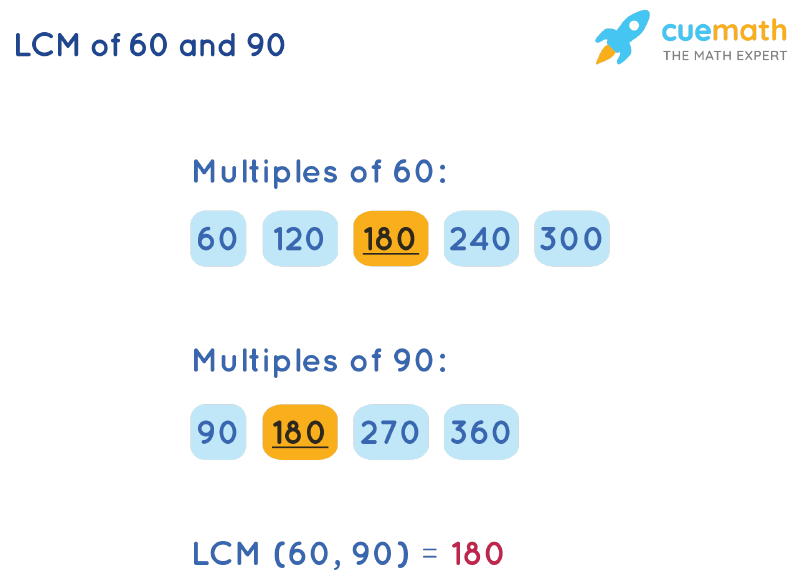
To figure this out, we need to find the LCM of 60 and 90. There are fancy mathematical ways to do this, involving prime factorization and all that jazz. But let's keep it simple. We can just list out the multiples of each number until we find one they share.
For 60, we have: 60, 120, 180, 240, 300...
For 90, we have: 90, 180, 270, 360...
Aha! See that 180 lurking in both lists? That's our LCM! It means that every 180 minutes (or 3 hours), our baking buddies, Baker 60 and Baker 90, will simultaneously present freshly baked goodies. Time for a party!

Now, you might be thinking, "Okay, that's kind of neat, but how does this apply to my real life?" Well, let me tell you a story about my attempt to train my two dogs, Princess Fluffybutt and Sir Barkington. Princess Fluffybutt needs a treat every 60 seconds to maintain her focus (she's easily distracted by squirrels). Sir Barkington, being the sophisticated gentleman he is, only requires a reward every 90 seconds. Giving them treat at the same time is the optimal situation. Can you guess the next steps to take? Yes, we will find their LCM!
Without the knowledge of LCM, I was frantically shoving treats into their mouths at random intervals, creating a chaotic and slobbery mess. It wasn't pretty. Once I realized I could apply the LCM, I knew I needed to give them both treats every 180 seconds. Suddenly, training became a breeze! Okay, maybe not a breeze, but definitely less chaotic and slobbery. Princess Fluffybutt still chases squirrels, but at least now she does it on a predictable treat schedule.
The beauty of the LCM isn't just about finding the smallest common multiple. It's about finding a rhythm, a point of connection, a shared experience. It's about understanding that even seemingly disparate things can align, like those pizza slices and soda cans finally dividing perfectly amongst your friends.
Think of it this way: imagine you’re running two different errands. One requires you to visit the grocery store every 60 days and the other needs you to go to the hardware store every 90 days. If you went to both stores today, when is the next time you will have to visit both on the same day?
So, the next time you're faced with a scheduling conflict, a division dilemma, or just a general feeling of mathematical unease, remember the LCM. It's not just a number; it's a solution, a synchronizer, a secret weapon against the chaos of everyday life. And who knows, maybe it'll even help you train your squirrel-obsessed dog.
"The LCM: It's not just math, it's magic!" - Some guy on the internet.
The LCM of 60 and 90 may seem like a simple math problem. But it highlights a very important concept. By understanding it, we can make our lives much easier. And with a little help from math, who knows what kind of harmony we can bring into the world?
One More Thing:
Don't forget to share your LCM stories! Have you ever used the LCM in a surprising or hilarious way? Let us know in the comments below!