
Least Common Multiple Of 24 And 48

Hey there, math whiz! Or, you know, math-curious friend! Let's chat about something super exciting… the Least Common Multiple (LCM)! Don't run away! I promise it's not as scary as it sounds. In fact, we’re tackling the LCM of just two numbers today: 24 and 48. Sounds manageable, right?
Think of the LCM like this: It’s the smallest number that both 24 and 48 can perfectly divide into. No remainders allowed! We're talking whole numbers, baby! No fractions invited to this party.
Finding the LCM: A Couple of Ways to Play
Okay, so how do we actually find this magical number? Well, there are a few ways. We're not going to get bogged down in super complex formulas. Let’s stick to the fun stuff.
Must Read
Method 1: The Listing Game!
This is probably the easiest way to wrap your head around the LCM at first. Simply list out the multiples of each number until you find a common one! It's like a number scavenger hunt!
Multiples of 24: 24, 48, 72, 96, 120… (and so on, and so forth)
Multiples of 48: 48, 96, 144, 192… (again, forever and ever)
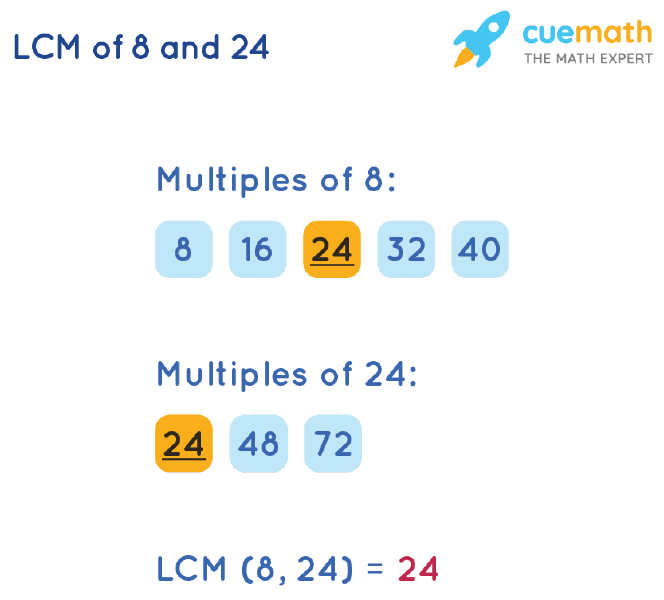
Did you spot it? The smallest number that appears on both lists is… 48! Ding ding ding! We have a winner!
Therefore, the LCM of 24 and 48 is 48. Easy peasy, lemon squeezy, right?
Method 2: Prime Factorization Fun!
Okay, this one is a little more involved, but trust me, it's worth knowing. Prime factorization basically means breaking down a number into its prime number building blocks. Remember prime numbers? Those are the numbers only divisible by 1 and themselves (like 2, 3, 5, 7, 11, etc.).
Let's break it down:
24 = 2 x 2 x 2 x 3 (or 23 x 3)
48 = 2 x 2 x 2 x 2 x 3 (or 24 x 3)
Now, to find the LCM, take the highest power of each prime factor that appears in either number. Sound complicated? It's not, I promise.

We have 2 and 3 as our prime factors. The highest power of 2 is 24 (from the 48). The highest power of 3 is just 31 (or just 3!).
So, the LCM is 24 x 3 = 16 x 3 = 48!
Ta-da! We got the same answer using a completely different method. Isn’t math cool? (Don't answer that if you don't think so! Haha!).
Why Do We Even Care About LCMs Anyway?
Good question! Why spend our precious time figuring out the LCM? Well, it's actually super useful in a bunch of different situations, especially when you're working with fractions. Like, adding fractions with different denominators? LCM to the rescue! It’s like the superhero of fractions!

Imagine you're trying to add 1/24 + 1/48. You need a common denominator, right? Guess what that common denominator is most likely going to be? You guessed it: the LCM of 24 and 48, which is 48!
Also, if you’re ever scheduling things that happen at different intervals (like, say, one friend visits every 24 days and another visits every 48 days) the LCM will tell you when they’ll both be there at the same time! Mind. Blown.
So, What Did We Learn?
We learned that the LCM of 24 and 48 is 48! We also learned that there are different ways to find the LCM, and that it's actually useful in the real world. Who knew? (Okay, probably you knew. But let me have my moment!).
Now go forth and conquer those LCM problems! And remember, even if you get stuck, there's always a friendly (or at least slightly sarcastic) math enthusiast cheering you on from the sidelines. You got this!
Keep practicing, and you'll be an LCM master in no time!