
Is Sih4 Polar Or Nonpolar

Hey there, chemistry curious friend! Ever wondered if that seemingly simple molecule, SiH4, is polar or nonpolar? Get ready for a fun dive into the world of chemical bonds and molecular geometry. Trust me, it's way more exciting than it sounds!
What Even IS Polarity, Anyway?
Okay, first things first: polarity! Imagine a tug-of-war, but with electrons. If one atom pulls harder on those electrons in a bond, that end becomes slightly negative (δ-). The other end? Slightly positive (δ+). That's a polar bond. Think of it like a tiny, atomic magnet.
But a molecule can have polar bonds and still be nonpolar! Confused? Don't be! It's all about the shape, baby!
Must Read
SiH4: Silicon's Sweet Symphony
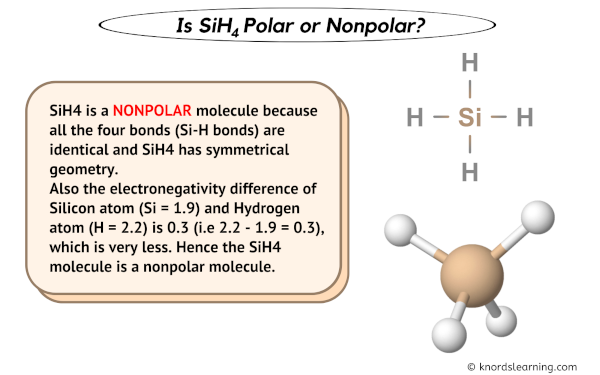
Let's zero in on SiH4, also known as silane. Silicon sits smack dab in the middle of the periodic table’s carbon crew. It's cozy bonded to four hydrogen atoms. Each Si-H bond has a slight electronegativity difference. So, are they all pulling electrons unevenly?
Yep! The electronegativity of Si is 1.90, and H is 2.20. So, hydrogen actually pulls a little bit stronger than silicon. Tiny imbalances, right? But remember, it isn’t just about the bonds; it’s about how they’re arranged.

Shape Matters: The Tetrahedral Tango
Here's where things get geometrically groovy. SiH4 adopts a tetrahedral shape. Picture a pyramid with a silicon atom at the center and hydrogen atoms at each of the four corners. This shape is super symmetrical.
Think of it this way: Imagine four equally strong people pulling on a rope tied to a central point. If they're spaced evenly, where does the central point go? Nowhere! Their pulls cancel each other out. That's exactly what happens with the bond dipoles in SiH4.
Because of this perfectly symmetrical tetrahedral arrangement, all those tiny Si-H bond dipoles cancel each other out. Boom! No net dipole moment.

Nonpolar Nirvana!
So, drumroll please... SiH4 is nonpolar! Even though each individual Si-H bond is technically slightly polar, the overall molecule is balanced and serene. No positive or negative end here!
It's like a perfectly balanced seesaw. No matter how much each side "wants" to tip, the symmetry keeps it level.
Why Does This Matter, Anyway?
Okay, so SiH4 is nonpolar. Big deal, right? Well, polarity influences how molecules interact with each other. It affects things like:
- Boiling point: Polar molecules tend to have higher boiling points.
- Solubility: "Like dissolves like." Polar stuff dissolves in polar solvents (like water), and nonpolar stuff dissolves in nonpolar solvents (like oil).
- Reactivity: Polarity can make a molecule more susceptible to chemical reactions.
Understanding polarity helps us predict how different substances will behave. It's like knowing the secret language of molecules!
Fun Facts About Silane (SiH4)
Ready for some quirky tidbits?
- Silane is a pyrophoric gas. That means it can spontaneously ignite in air! Whoa!
- It's used in the semiconductor industry to deposit thin films of silicon. Think microchips!
- Silane smells kind of nasty. Some say it's garlic-like, others say fishy. Yum?
- Unlike methane (CH4, which is also nonpolar), silane is more reactive. Silicon forms weaker bonds than carbon, making SiH4 more prone to breaking down.
Polar vs. Nonpolar: A Quick Recap
Let's nail this down once and for all:

- Polar Bond: Unequal sharing of electrons. One atom pulls harder.
- Nonpolar Bond: Equal sharing of electrons. Nobody's hogging them.
- Polar Molecule: Overall uneven distribution of charge. Has a positive and negative end.
- Nonpolar Molecule: Overall even distribution of charge. Perfectly balanced.
SiH4? Tiny, slightly polar bonds arranged so symmetrically that they cancel each other out. Therefore, it's nonpolar.
So, What's the Takeaway?
Hopefully, you now have a better grasp of why SiH4 is nonpolar. It's all about understanding the interplay of individual bond polarities and molecular shape.
And remember, chemistry isn't just about memorizing facts. It's about exploring the amazing world of molecules and how they interact. Keep asking questions, keep exploring, and keep the curiosity burning! Now go impress your friends with your newfound knowledge of silane!