Is Sicl4 Polar Or Nonpolar

Silicon tetrachloride, or SiCl4, might not be a household name like baking soda or vinegar, but delve into the fascinating world of chemistry and you'll find it's a popular subject, especially when discussing molecular polarity. It's a perfect example for understanding how molecular shape influences whether a molecule behaves as a polar or nonpolar entity. So, is SiCl4 polar or nonpolar? Let's unravel the mystery!
For artists, hobbyists, and casual learners, understanding molecular polarity might seem a far cry from creative endeavors. However, grasp the basic concepts, and you open doors to a deeper understanding of how different substances interact – from the way paint adheres to a canvas to how dyes bond with fabric. It's about understanding the underlying principles of the materials we use every day.
Why is polarity important? Polar molecules, like tiny magnets, have a slightly positive end and a slightly negative end, leading to stronger interactions with other polar molecules. Nonpolar molecules, on the other hand, have a more even distribution of charge. Understanding this allows you to predict how different substances will mix, dissolve, or react with each other. For example, if you're into crafting your own cleaning solutions, knowing which solvents (polar or nonpolar) will dissolve specific stains (also polar or nonpolar) becomes incredibly useful. It is essential to know if SiCl4 is polar or nonpolar for a good understanding of chemical interactions.
Must Read
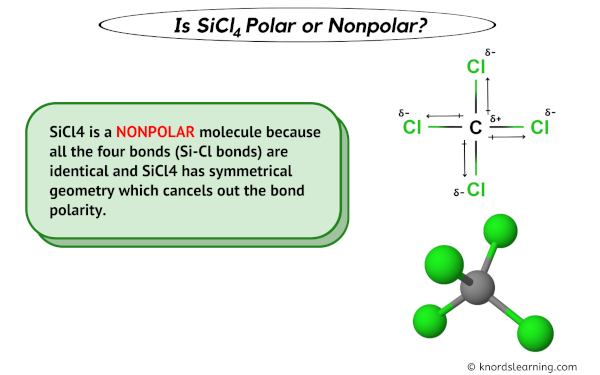
Back to SiCl4! The central silicon atom is bonded to four chlorine atoms. Chlorine is more electronegative than silicon, meaning it pulls electrons towards itself. This creates individual Si-Cl bonds that are polar. However, the key lies in the molecule's shape. SiCl4 has a tetrahedral shape. This perfectly symmetrical geometry means that the individual bond dipoles (the measure of the polarity of each Si-Cl bond) cancel each other out. Imagine four equally strong people pulling a rope tied to a central point in four different directions. Because the pulls are equal and opposite, the central point doesn't move. Similarly, the overall molecule has no net dipole moment. Therefore, SiCl4 is a nonpolar molecule.

While you won't be experimenting with SiCl4 at home (it's a corrosive liquid that reacts violently with water!), you can explore molecular polarity using readily available household items. For example, try mixing oil (nonpolar) and water (polar). Observe how they don't mix. Now, add a drop of dish soap (which has both polar and nonpolar parts) and see how it helps to emulsify the mixture, bringing the oil and water together. This simple experiment demonstrates the principles of polarity and how substances with similar polarities tend to mix.
Understanding the polarity of molecules like SiCl4 is enjoyable because it unlocks a new level of appreciation for the world around us. It's like having a secret key to understand how things work at a fundamental level. Whether you're a seasoned chemist, an avid artist, or simply a curious individual, grasping these basic concepts can be incredibly rewarding. You can visualize the unseen forces that govern molecular interactions, and the knowledge helps you better understand many aspects of daily life.