
Is 59 A Composite Or Prime Number
Hey there, friend! So, we're tackling a big question today, the kind that keeps mathematicians (and maybe you?) up at night. Is 59 a composite number? Or is it... dun dun DUN... prime?
Now, before you run screaming for the hills thinking back to high school math, let's break it down. In super-chill, coffee-sipping terms. Promise, no complicated equations! Well, maybe one... but I'll keep it cute.
Prime Time: The Definition
First, what's a prime number, anyway? Think of prime numbers as the cool loners of the number world. They're only divisible by 1 and themselves. No sharing allowed! Like, seriously, zero other whole numbers divide into them evenly. No remainder, no funny business.
Must Read
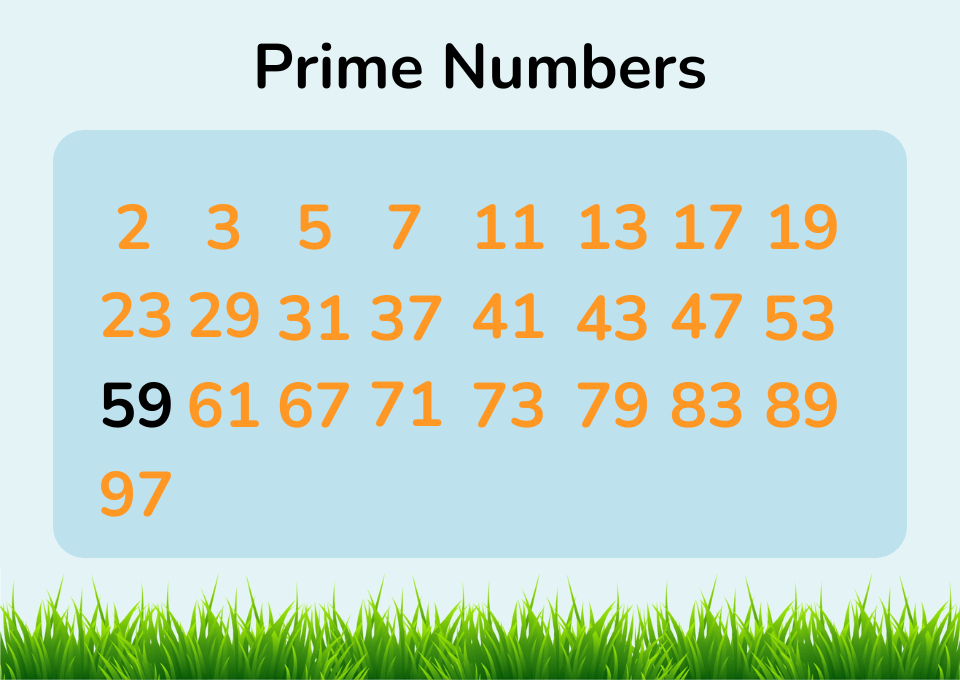
Examples? We got 'em! 2 (the only even prime, how quirky!), 3, 5, 7, 11... See the pattern? Or, more accurately, lack of a predictable pattern? That's the beauty of primes!
So, they only have two factors: 1 and themselves. Remember that, it's crucial!
Composite Numbers: The Social Butterflies
On the flip side, we have composite numbers. These are the social butterflies. They love to mingle! They’re divisible by more than just 1 and themselves. They have friends! They have...factors!
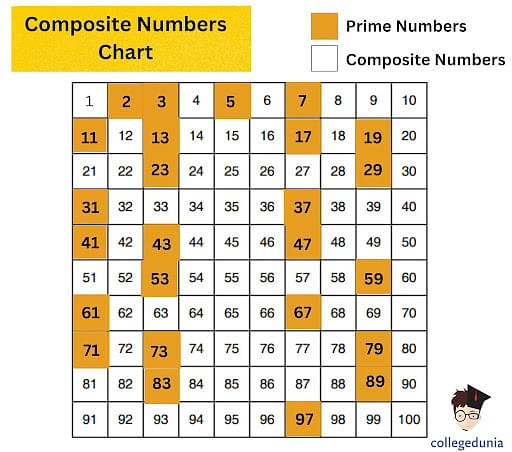
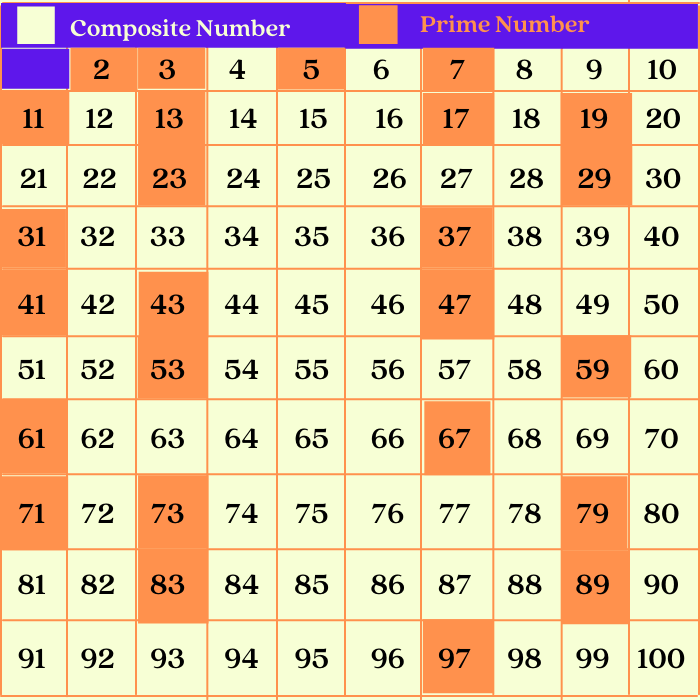
Think of 4. You can divide it by 1, 2, and 4. Bam! Composite! Or 6 (1, 2, 3, 6). Or 8 (1, 2, 4, 8). Get the idea? Basically, if it's got more than two factors, it's composite. It's simple, right?
So basically, the opposite of a prime number! They're like, polar opposites in the numberverse.
Let's Get to 59: The Investigation!
Okay, okay, enough with the definitions! Let’s put 59 under the microscope. Our mission? To see if it has any factors other than 1 and itself. Are you ready to become number detectives? I know I am!
We need to try dividing 59 by some numbers. Let's start small. Does 2 go into 59? Nope! It's an odd number, so definitely not. Bummer. Maybe 3?
To check divisibility by 3, we can add the digits of 59 together: 5 + 9 = 14. Is 14 divisible by 3? Negative! So 59 isn't either. We're on a roll! (A roll of eliminating factors, that is.)
How about 4? Nah. 5? Definitely not. 6? Nope. And so on, and so forth. Ugh, this is tedious. Maybe we should get a calculator?
Keep going! We only need to check up to the square root of 59 (which is roughly 7.68, give or take a decimal point or two). Why? Because if 59 did have a factor bigger than its square root, it also has to have a corresponding factor smaller than its square root. That's mathematical magic, baby!
So, we only need to check divisibility by 2, 3, 5, and 7. And guess what? None of them divide evenly into 59! Woohoo!
Spoiler alert: 59 is not divisible by 2, 3, 5, or 7. And that’s all we needed to check. High fives!

The Verdict: Prime Time, Baby!
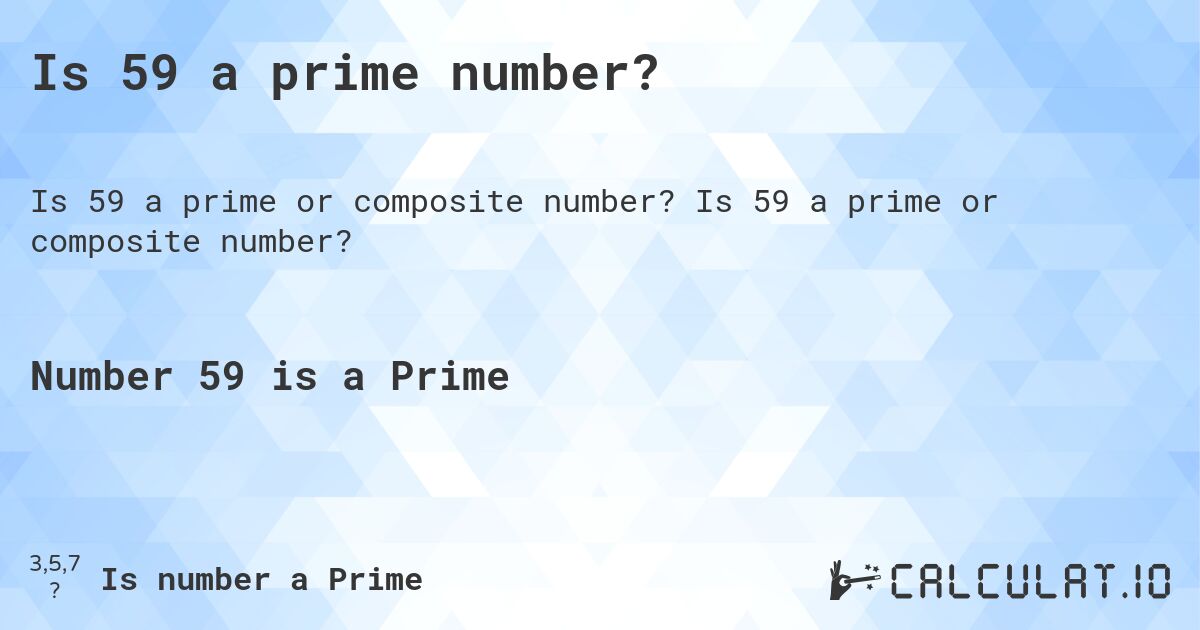
Drumroll, please! After our intense investigation (okay, maybe it wasn't that intense, but still!), we've determined that 59 is... a prime number! Ta-da!
It's only divisible by 1 and itself. It's a cool loner! A prime number, through and through! Go, 59! You’re a star!
So next time someone asks you if 59 is prime or composite, you can confidently say, "Prime! And let me tell you all about how I figured it out…" (They'll love that, I promise… okay, maybe not, but you'll know!).
Until next time, keep those numbers prime (or composite, whichever you prefer!). And enjoy your coffee!