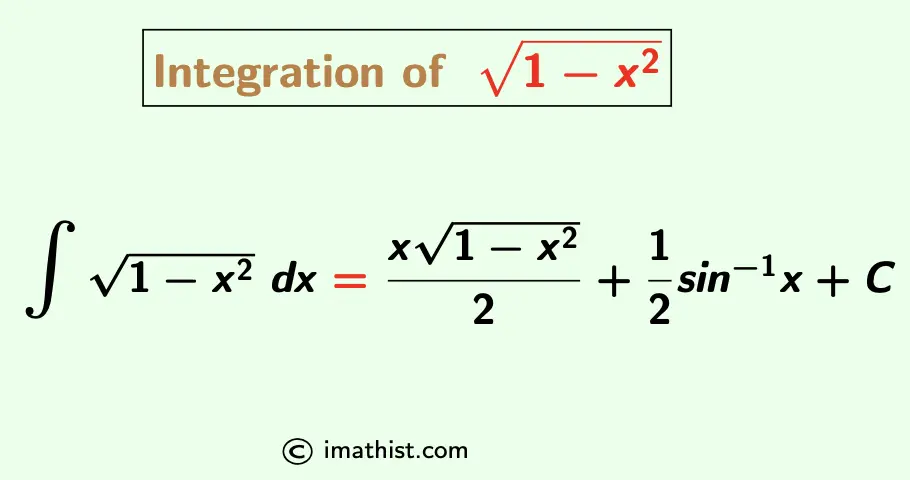
Integration Of Sqrt 1 X 2
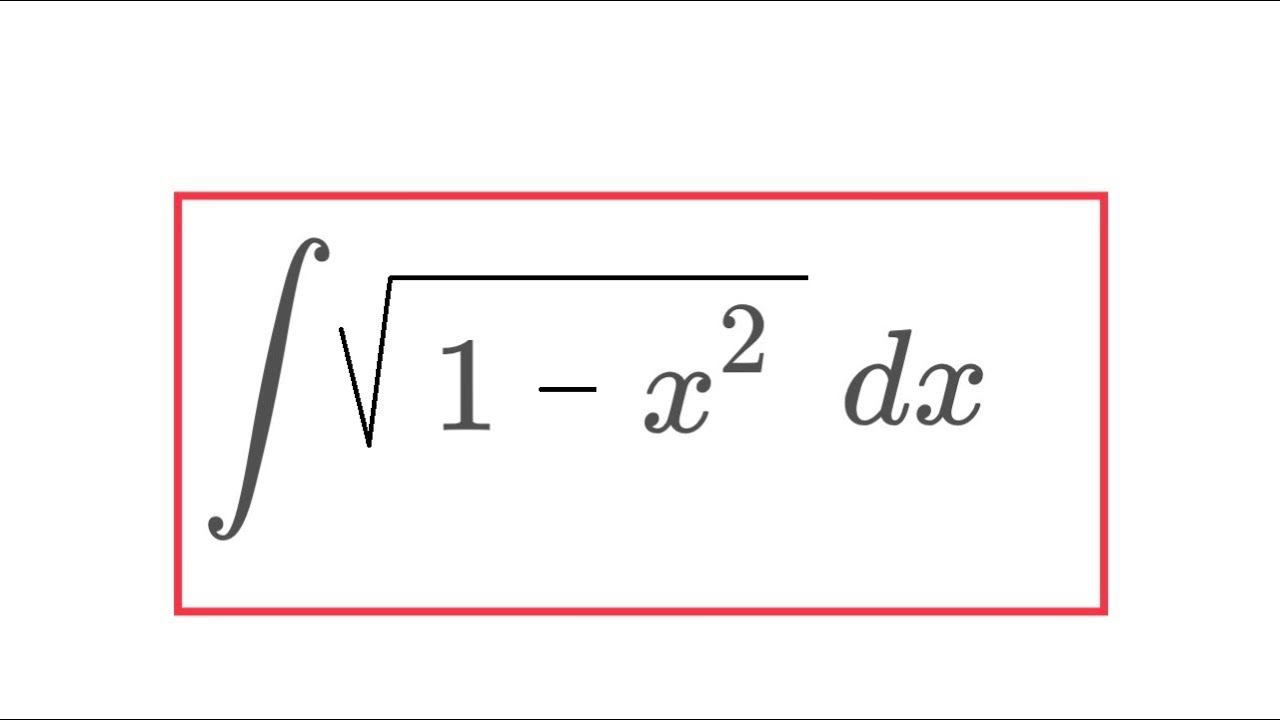
Alright, let's talk about something that might sound a little intimidating at first: integrating √(1 + x²). Don't let the square root and the integral sign scare you! Think of it like a puzzle, a brain-teaser that, once solved, unlocks a whole new level of mathematical understanding. Plus, it's surprisingly useful in a variety of real-world scenarios, from calculating arc lengths to understanding physics problems. Who knew math could be so adventurous?
So, what exactly is integration, and why do we even care about finding the integral of √(1 + x²)? Simply put, integration is the reverse process of differentiation. While differentiation finds the rate of change of a function, integration finds the area under a curve. In the case of √(1 + x²), we're trying to find a function whose derivative is √(1 + x²). This function will give us the area under the curve represented by that square root expression.
Why bother finding this area? Well, this specific integral pops up in several unexpected places. Imagine you're designing a suspension bridge. The shape of the cables needs to be calculated precisely, and guess what? The arc length formula involves integrating something very similar to √(1 + x²). Or maybe you're working on a problem in physics involving the motion of a particle. Again, this integral (or one very much like it) could come into play.
Must Read
Now, let's talk about how we actually solve this thing! While there's no single magic bullet, the most common approach is using a technique called trigonometric substitution. This involves replacing 'x' with a trigonometric function (like tan θ), which cleverly transforms the integral into something much easier to handle. It might seem strange, but it's like finding a secret key that unlocks the solution.
The process involves a few steps. First, we substitute x = tan θ. This means dx = sec² θ dθ. Plugging these into our integral, we get ∫√(1 + tan² θ) * sec² θ dθ. Remember the Pythagorean identity? 1 + tan² θ = sec² θ! So, our integral simplifies to ∫√(sec² θ) * sec² θ dθ, which is just ∫sec³ θ dθ.
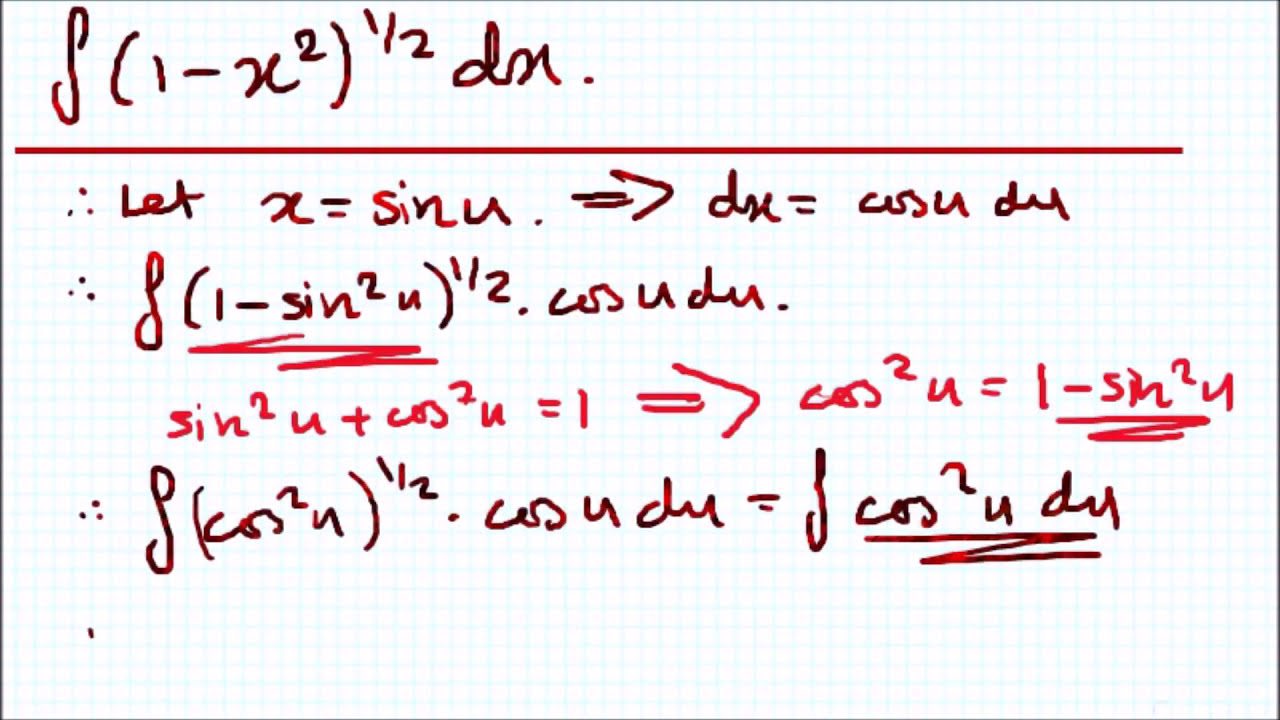
Okay, now we have to tackle ∫sec³ θ dθ. This one is a bit trickier and often involves integration by parts, another powerful integration technique. This involves breaking the integral into two parts and strategically applying the integration process. It's like a mathematical dance – a precise and elegant maneuver to get to the solution.
After applying integration by parts and some algebraic manipulation (which we won't go into excruciating detail here – you can find plenty of resources online!), you'll eventually arrive at a solution involving sec θ, tan θ, and natural logarithms. Don't forget to substitute back to express your answer in terms of 'x'! You'll need to use the relationships derived from our initial substitution (x = tan θ) to find expressions for sec θ in terms of x.

The final answer, after all the dust settles, will look something like: (1/2) * [x√(1 + x²) + ln(x + √(1 + x²))] + C. The "+ C" is important – it represents the constant of integration. Remember, integration is the reverse of differentiation, and the derivative of a constant is always zero. So, we need to include "+ C" to account for all possible solutions.
So, there you have it! Integrating √(1 + x²) might seem daunting initially, but by using clever techniques like trigonometric substitution and integration by parts, we can conquer this mathematical challenge and appreciate the power and beauty of calculus. It's not just abstract math; it has real-world applications and can help us understand the world around us in new and exciting ways. Keep practicing, and you'll become an integration master in no time!