Incircle And Circumcircle Of Equilateral Triangle
Geometry! The word alone might send shivers down the spines of some, but for others, it's a puzzle box filled with elegant solutions and surprising connections. And within the vast landscape of geometry, the interplay between an equilateral triangle, its incircle, and its circumcircle holds a particular allure. Why? Because it's a miniature world of mathematical harmony, easily visualized and packed with fundamental concepts that subtly influence our lives.
You might be thinking, "Circles inside and outside triangles? How does that possibly affect my everyday life?" Well, understanding the relationships between shapes, sizes, and proportions, which is at the heart of this geometric exploration, helps us in numerous ways. From designing aesthetically pleasing buildings to optimizing packaging efficiency, the principles derived from geometry are constantly at work behind the scenes. Even something as simple as choosing the right sized pan for baking relies on an intuitive understanding of area and volume, which are, in essence, geometric concepts.
Think about architecture. The golden ratio, closely related to geometric shapes, is frequently used to create visually appealing structures. Architects often consider how circles and triangles interact to ensure structural stability and visual balance. Bridges, buildings, and even furniture designs frequently utilize triangular support systems for their inherent strength. The efficient use of space in urban planning also leverages geometric principles, ensuring the maximum amount of usable area while minimizing waste. These are complex applications, of course, but the foundation lies in understanding basic shapes and their relationships, like the equilateral triangle, its incircle, and its circumcircle.
Must Read
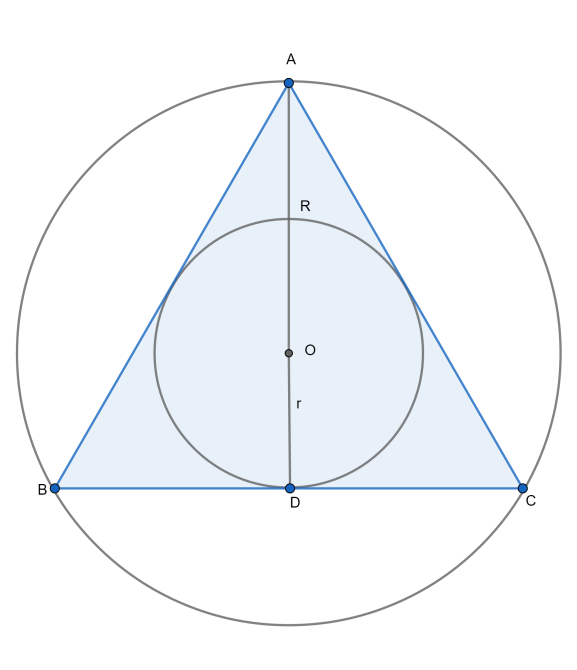
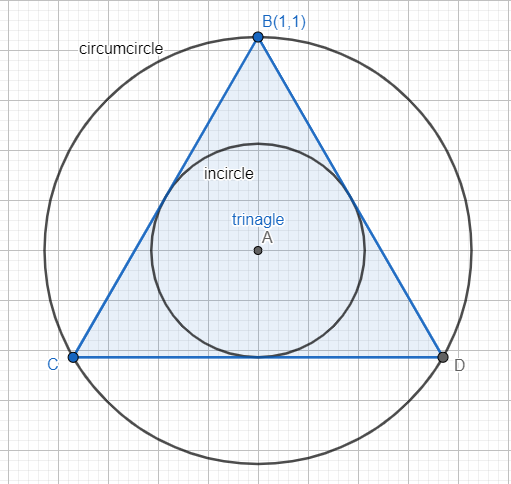
Now, how can you appreciate this geometric wonder more effectively? Firstly, don't be intimidated! Start with the basics. An equilateral triangle has three equal sides and three equal angles (all 60 degrees). The incircle is the largest circle that can fit inside the triangle, touching each side at exactly one point. The circumcircle is the circle that passes through all three vertices (corners) of the triangle. The key is understanding that for an equilateral triangle, the center of the incircle and the center of the circumcircle are the same point!
Secondly, draw it out! There's nothing like a visual representation to cement understanding. Use a compass and straightedge to construct an accurate equilateral triangle, and then carefully draw its incircle and circumcircle. Notice how the radius of the incircle is exactly half the radius of the circumcircle. This simple relationship is a powerful demonstration of mathematical elegance.

Thirdly, explore the formulas. While the visual is important, understanding the mathematical relationships deepens the appreciation. You can calculate the areas of the triangle, incircle, and circumcircle using simple formulas involving the side length of the triangle. This connects the geometric representation to the algebraic expression, offering a more complete understanding.
Finally, look for examples in the world around you. While perfectly equilateral triangles with incircles and circumcircles aren't exactly commonplace, spotting triangular shapes in architecture, design, or even nature can help you connect the abstract concept to tangible reality. The more you look, the more you'll see the subtle influence of geometry shaping the world we inhabit. So, embrace the equilateral triangle, its incircle, and its circumcircle – a gateway to a world of geometric beauty and practical applications!