
How To Work Out Watts Per Hour
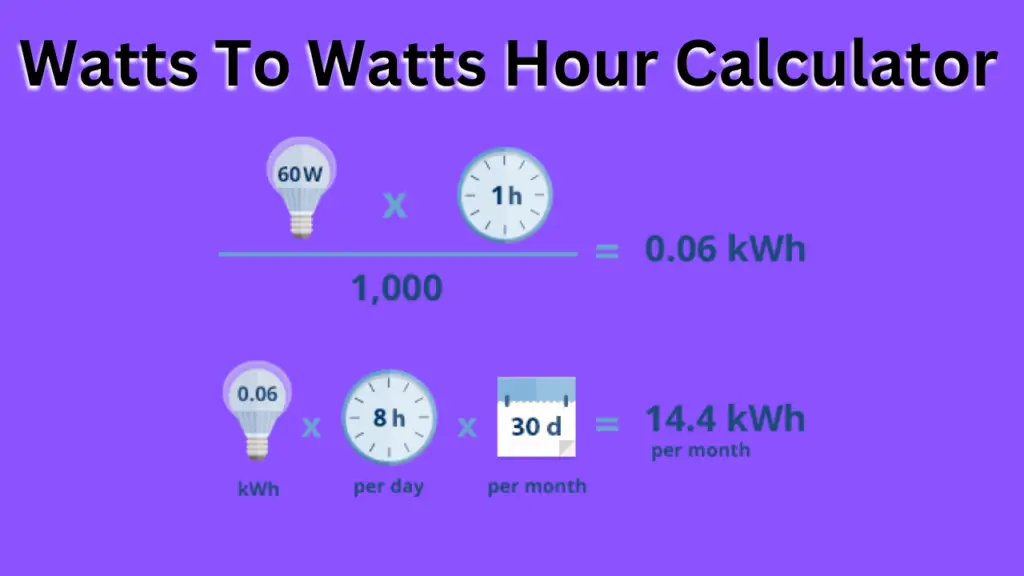
Hey there, energy explorer! Ever found yourself staring at a gadget, a charger, or even a light bulb, scratching your head and muttering, "How do I work out watts per hour?" Well, you're not alone! It sounds like a secret handshake among engineers, but I'm here to spill the beans (and maybe a few electrons) in the friendliest, most non-nerdy way possible.
First things first, let's clear up a tiny, almost adorable little misconception. When folks say "watts per hour," what they usually mean (and what your electricity bill is secretly calculating) is watt-hours. Think of it like this: you don't talk about "miles per hour per hour" when you're driving, right? You talk about "miles per hour." Similarly, watts measure power, and watt-hours measure energy consumed over time. It's like the difference between how fast you're running (watts) and how much ground you've covered in total (watt-hours). See? Easy peasy!
What's a Watt, Anyway? (Besides a Fun Word to Say)
So, let's start with the star of our show: the Watt. Named after James Watt (who was probably a super bright guy, pun intended!), a watt is a unit of power. It tells you how much electricity an appliance is using at any given moment. Think of it as the speed at which electricity is flowing to make something happen. A 100-watt light bulb uses power faster than a 60-watt bulb. It's like a car engine: a bigger engine has more horsepower (watts!), letting it do more work, faster.
Must Read
And yes, you can find the watt rating on most electronics. Look for a little label – it might say "W" or "watts." Sometimes it's hiding like a shy unicorn, but it's usually there!
And an Hour? (Spoiler: It's 60 Minutes)
Okay, this one's a bit less mysterious. An hour is... well, an hour! It's our trusty unit of time. We use it to measure how long something is switched on, humming along, or silently draining power while we scroll through cat videos.
No jokes here, folks. Time is serious business. Or at least, it's consistent!

Putting It Together: The Mighty Watt-Hour!
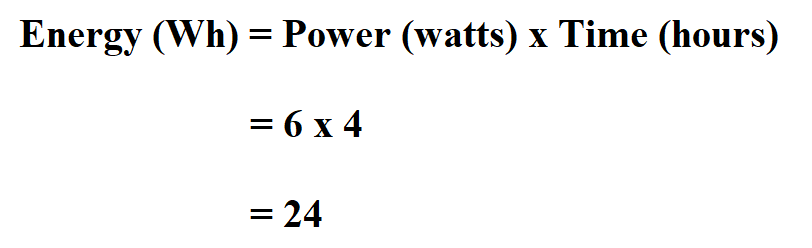
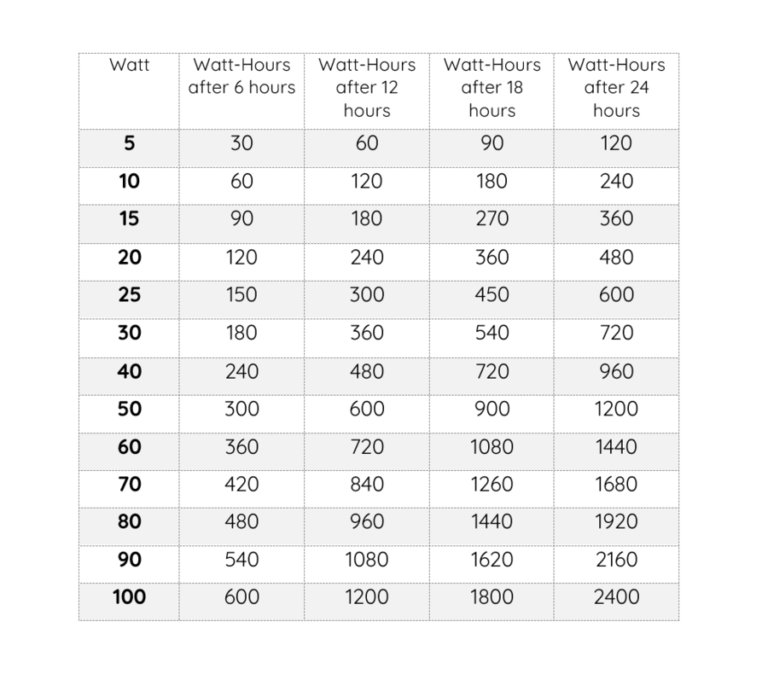
Now for the big reveal! To calculate watt-hours (Wh), you simply multiply the appliance's power in watts by the time it's used in hours. It's literally just a multiplication sum. No calculus, no fancy algorithms, just good old-fashioned multiplication. Your second-grade self would be so proud!
The formula looks like this:
Watts (W) × Hours (h) = Watt-hours (Wh)

See? It's not rocket science! More like, "light bulb science," which is equally important, if less explosive.
Why Do We Care About Watt-Hours?
Good question! Why bother with this number? Because watt-hours tell you the total amount of energy consumed. This is super handy for a few reasons:
- Your Electricity Bill: Your utility company bills you for kilowatt-hours (kWh), which are just 1,000 watt-hours. Knowing your Wh helps you understand why your bill sometimes feels like it's trying to buy a small island.
- Battery Life: Ever wonder how long your laptop or phone battery lasts? Battery capacity is often rated in milliamp-hours (mAh) or watt-hours (Wh). A higher Wh means more juice!
- Being an Energy Detective: You can figure out which appliances are the biggest energy hogs and start saving some dough (and the planet, yay!).
Let's Do Some Quick Math (Don't Panic!)
Ready for some real-world examples? Grab your imaginary calculator!
Example 1: The Trusty Light Bulb
Let's say you have an old-school 60-watt light bulb in your lamp, and you leave it on for 5 hours while you're deep into a fantasy novel (or, let's be real, doom-scrolling).
60 W × 5 h = 300 Wh
So, that bulb used 300 watt-hours of energy. Not too shabby!
Example 2: Charging Your Phone
Your phone charger might be rated at, say, 10 watts. If you leave your phone plugged in for 2 hours (because you forgot it was already at 100%, we've all been there!).
10 W × 2 h = 20 Wh
Yep, charging your phone uses significantly less energy than a light bulb. Phew! Your phone isn't secretly plotting to bankrupt you.
A Little Twist: Kilowatt-Hours (kWh)
Remember that electricity bill I mentioned? They don't usually deal in tiny little watt-hours. They use kilowatt-hours (kWh). "Kilo" just means a thousand. So, 1 kWh = 1,000 Wh. To convert watt-hours to kilowatt-hours, you simply divide by 1,000.
So, our 300 Wh light bulb usage from before? 300 Wh / 1,000 = 0.3 kWh. That's the number your utility company cares about. Now you're practically an accountant for your appliances!
Beyond the Numbers: The Bigger Picture
Understanding watt-hours isn't just about math; it's about empowerment! Knowing how to calculate energy consumption makes you more aware of your personal energy footprint. You can make smarter choices, save a few bucks, and even feel a little bit like a superhero for being energy efficient.
So, the next time someone asks you about "watts per hour," you can confidently (and with a charming, knowing smile) tell them, "Ah, you mean watt-hours, my friend!" Then you can enlighten them with your newfound wisdom. Go forth and calculate, you magnificent energy genius! Your devices, your wallet, and maybe even Mother Earth, will thank you for it.