
How To Say Lazy In Spanish

Okay, let's be honest. We all have those days. You know, the ones where the most ambitious thing we do is decide what to binge-watch next? I'm talking about peak lazy moments. And sometimes, you need to express this glorious state of being in another language.
So, How Do You Say "Lazy" in Spanish?
There are a few options, actually! Spanish, being the expressive language it is, offers various shades of "lazy." Ready to dive in?
The Classic: Perezoso/a
This is your bread-and-butter lazy. Perezoso/a is the most common way to say "lazy" in Spanish. Remember to adjust the ending depending on who you're calling lazy! (Perezoso for a guy, Perezosa for a girl).
Must Read
For example: "Él es muy perezoso hoy" (He is very lazy today). It's direct, it's simple, it gets the point across.
Level Up: Vago/a
Now we're getting serious. Vago/a implies more than just a lack of motivation. It suggests someone who avoids work entirely. This one has a slightly harsher tone.
Use it sparingly, unless you're aiming for drama. Like, "¡No seas vago! Lava los platos!" (Don't be lazy! Wash the dishes!).

A Gentler Approach: Flojo/a
Flojo/a is a softer way to describe someone who's feeling a bit…lax. It can mean "lazy," but also "loose" or "weak." Think of it as "sluggish."
You might say, "Me siento un poco flojo hoy" (I feel a little lazy today). It's a good way to express your own lack of energy without sounding too harsh on yourself.
The "Do Nothing" Description: Haragán/Haragana
This word implies someone is habitually idle. It's not just a temporary state of being, it's a lifestyle! Calling someone haragán/haragana suggests they are fundamentally work-shy.
So, “Eres un haragán” (you're a lazy bum) is going to sting more!

Adding Emphasis
You can amplify your laziness descriptor! Just like in English, adding "very" helps. You can use "muy" which means very in Spanish. It comes before the adjective. For example: "muy perezoso".
You can also use "más" to say "more lazy." As in, "Es más perezoso que yo!" (He's lazier than me!).
My Unpopular Opinion
Okay, here it comes. I think a little laziness is good for the soul. Hear me out!
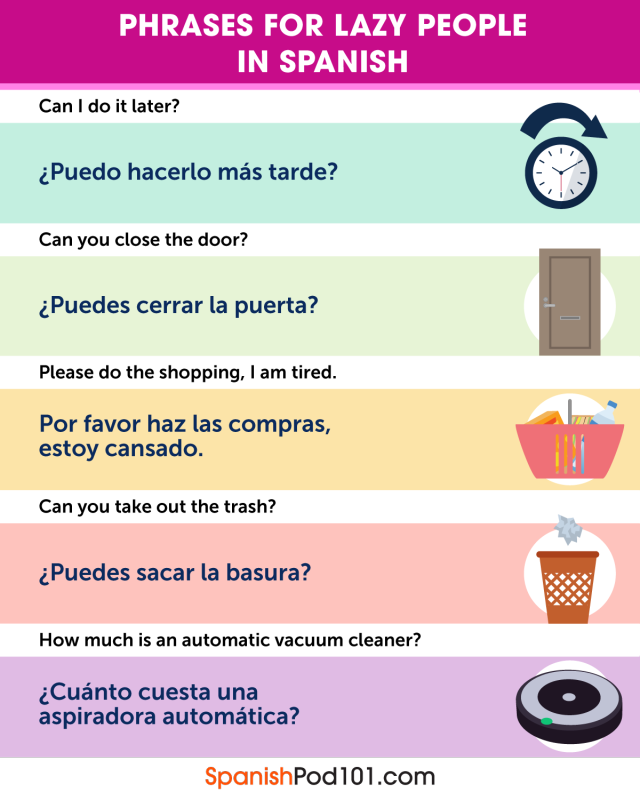
We live in a culture that glorifies being busy. Constant hustle, endless productivity, burnout is real! Taking time to relax, to do absolutely nothing, is essential for our well-being.
I'm not saying we should all become professional couch potatoes. But embracing the occasional perezoso day can actually make us more productive in the long run.
Sometimes the most productive thing you can do is relax.
Plus, learning how to say "lazy" in Spanish is a fun way to expand your vocabulary. You can subtly (or not so subtly) describe your current mood to your Spanish-speaking friends.

Imagine the possibilities! “Lo siento, no puedo. Estoy siendo perezoso.” (Sorry, I can't. I'm being lazy.)
Embrace Your Inner Perezoso
So, the next time you're feeling the urge to do absolutely nothing, don't fight it. Embrace it! Learn these words, practice them, and maybe even declare a "lazy day" in Spanish.
Who knows? You might just discover the secret to a happier, more balanced life. And if not, at least you'll know how to say "I'm too lazy to do anything" in another language!
And remember, the most important thing is to have fun with it! Languages are meant to be enjoyed, and even laziness can be a source of amusement. Now, if you'll excuse me, I think I'll go practice my "perezoso" skills. ¡Hasta luego!