How To Find The Volume Of A Composite Solid

Okay, let's talk about shapes! Not just any shapes, but the cool kind you get when you smash a bunch of simpler shapes together. We're diving into the world of composite solids, and learning how to figure out their volume. Why is this fun? Well, think about it: it's like being a mathematical detective, piecing together clues to solve a puzzle. And it’s incredibly useful in real life, far beyond the classroom. Seriously!
So, what’s the point of knowing this stuff? For beginners, understanding composite solids is a crucial stepping stone to more advanced geometry and calculus. It reinforces your grasp of basic shapes like cubes, cylinders, cones, and prisms, while teaching you problem-solving skills. Imagine building a crazy Lego creation out of basic blocks; this is the math equivalent! For families, figuring out the volume of something like a sandcastle, a uniquely shaped cake, or even an oddly-shaped swimming pool (before filling it!) becomes a fun and educational activity. It’s hands-on math that makes learning tangible. And for hobbyists, like woodworkers or model makers, knowing how to calculate the volume of composite shapes is essential for accurately estimating materials needed for projects and creating perfectly proportioned designs. Ever want to build a birdhouse that's part cube, part pyramid? This skill is your secret weapon.
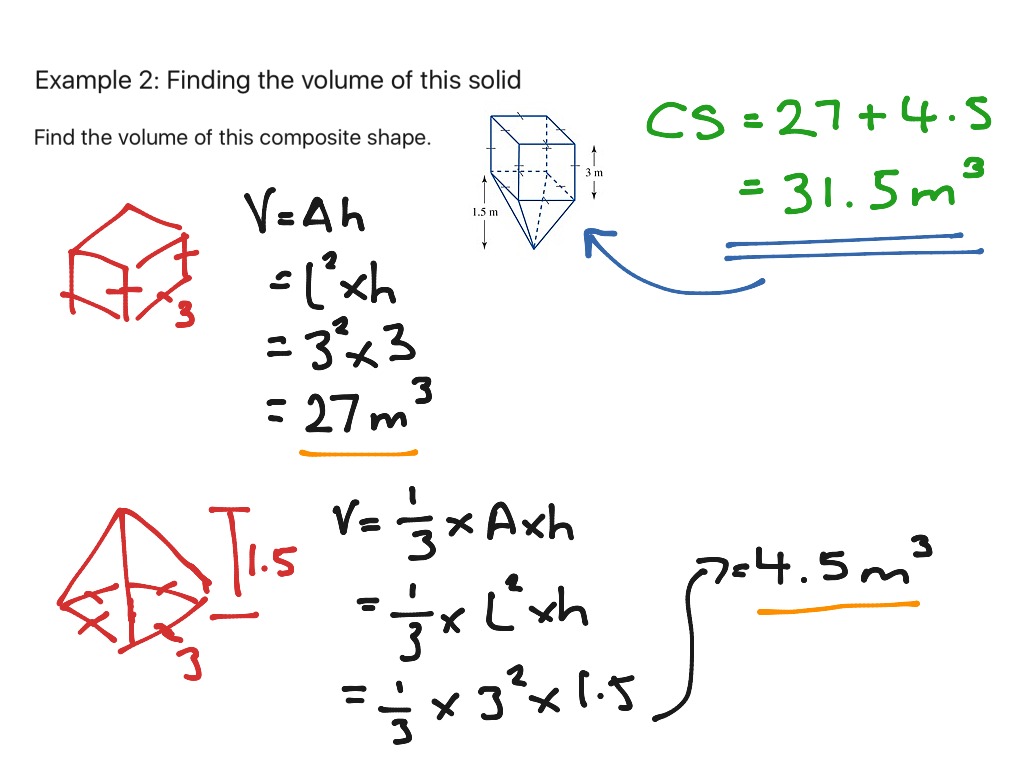
Let’s say you have a dog house. It's basically a rectangular prism (the main house) with a triangular prism on top (the roof). To find the total volume, you first calculate the volume of the rectangular prism: length x width x height. Then, you calculate the volume of the triangular prism roof: 1/2 x base of triangle x height of triangle x length of the prism. Finally, you add the two volumes together, and bam, you've got the total volume of the dog house. Another common example? An ice cream cone with a scoop of ice cream. You calculate the volume of the cone and the volume of the sphere (the ice cream scoop) and add them together.
Must Read
There are also variations where you might need to subtract volumes. For example, imagine a metal cube with a cylindrical hole drilled through the center. You'd calculate the volume of the cube, calculate the volume of the cylinder, and then subtract the cylinder's volume from the cube's volume to find the remaining solid's volume.

Getting started is easier than you think! Here are some simple tips:
- Break it down: The key is to identify the individual shapes that make up the composite solid. Draw lines to separate them if needed.
- Know your formulas: Make sure you have the formulas for the volume of basic shapes handy (cube, rectangular prism, cylinder, cone, sphere, etc.). A quick Google search will do!
- Label carefully: Label the dimensions of each shape clearly to avoid confusion.
- Double-check your work: Mistakes happen! Review your calculations to ensure accuracy.
So, there you have it! Finding the volume of composite solids might seem daunting at first, but with a little practice and a systematic approach, it becomes a fun and valuable skill. Remember to embrace the challenge, break down the shapes, and enjoy the satisfaction of solving the puzzle. Happy calculating!