
How To Find Diameter Of Field Of View

Hey stargazers and backyard explorers! Ever wondered how much of the sky you're actually seeing through your telescope or binoculars? It's all about the Field of View (FOV)! And today, we're diving deep (but not too deep, promise!) into finding its diameter.
Why bother, you ask? Well, imagine trying to find the Milky Way without knowing how much sky your binos are showing. It's like trying to find your keys in a messy room blindfolded! FOV helps you navigate the cosmos and pinpoint those celestial treasures. Plus, it's just plain cool.
What's Field of View, Anyway?
Think of it as the cosmic window your instrument provides. It's the angular size of the patch of sky you can see at any given moment. We usually measure it in degrees (like measuring angles!). A wider FOV means you can see a bigger chunk of the night sky. A narrower FOV? More zoomed-in, perfect for details!
Must Read
Did you know that the full moon is about 0.5 degrees wide? That's a handy visual benchmark! Keep that little nugget in your pocket.
The Obvious (But Important) Approach: The Specs!
First things first: check the specs of your telescope or binoculars! Manufacturers often list the FOV. Look for something like "Field of View: 7 degrees" or "Apparent Field of View: 50 degrees".
But… there's a catch! That "Apparent Field of View" number isn't the actual field of view you're seeing. It's a measure of how wide the image seems when you look through the eyepiece. We'll get to calculating the real deal in a sec.

The "Star Hopping" Method: A Cosmic Scavenger Hunt!
This method is practical and fun. It involves using star charts and known distances between stars to estimate your FOV. Ready for a cosmic scavenger hunt?
Here's the gist: find two stars that you can just fit across your FOV. Then, look up the angular separation between those stars on a star chart (or a handy astronomy app!). That separation is approximately your FOV.
Pro Tip: Start with a wide-field eyepiece (one that gives you a wider view) to make finding those stars easier. Then, try it with a higher-magnification eyepiece to get a more precise measurement.
It's not laser-precise, but it gives you a decent estimate! Plus, you get to practice your star-hopping skills. Think of it as celestial navigation training!

The Math-y Method: For the Number Crunchers!
Okay, deep breaths! We're going to do a little bit of math. Don't run away! It's easier than you think. Remember that "Apparent Field of View" we talked about?
The formula is: True Field of View = Apparent Field of View / Magnification
So, what's magnification? It's how much bigger your telescope makes things appear. You calculate it like this: Magnification = Telescope Focal Length / Eyepiece Focal Length
Let's break it down with an example:
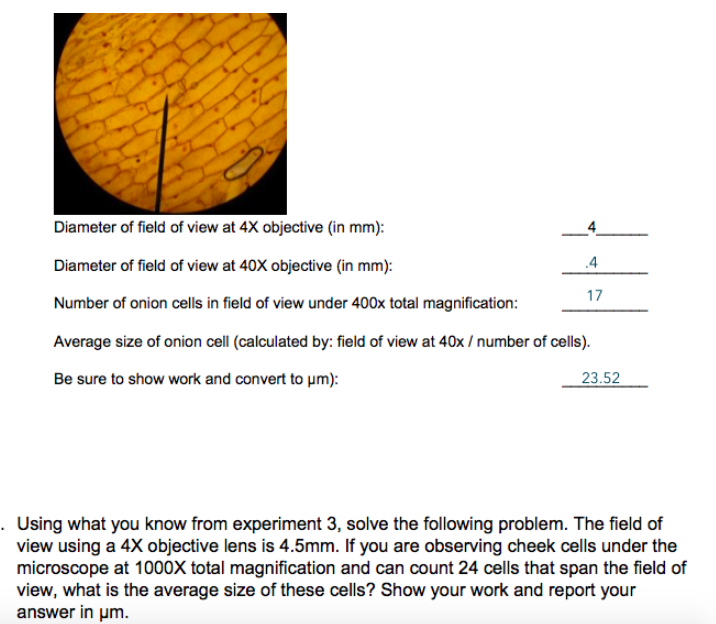
Imagine your telescope has a focal length of 1000mm. You're using a 25mm eyepiece. That means your magnification is 1000 / 25 = 40x.
Now, let's say your eyepiece has an apparent field of view of 50 degrees. Your true field of view would be 50 / 40 = 1.25 degrees. Voila! You've found your FOV diameter.
Seriously, don't stress the math too much. There are tons of online calculators that will do the heavy lifting for you. Just plug in the numbers and bam, FOV magic!
Eyepiece Field Stop: The Physical Boundary
Here's a quirky fact: your eyepiece has a physical boundary called the field stop. It's a metal ring inside the eyepiece that limits the size of the image you see. Think of it as a literal edge to your cosmic window.

The diameter of the field stop is directly related to the apparent field of view. Clever, huh?
Why Bother With All This?
Okay, so calculating FOV might seem like a trivial detail. But understanding it opens up a whole new level of appreciation for the night sky! You can:
- Plan your observing sessions more effectively.
- Accurately sketch celestial objects.
- Easily locate faint targets.
- Impress your friends with your astronomical knowledge!
Most importantly, it connects you more deeply to the universe. You're not just looking at the sky; you're understanding how much of it you're seeing, and that's pretty awesome.
So, grab your telescope, binoculars, or even just your eyeballs, and start exploring! The universe is waiting to be measured, one field of view at a time!