
How To Convert Ac To Dc Power

Ever stared at that little brick on your phone charger, or that slightly bigger one connected to your laptop, and just... wondered? You know, the one that makes your device magically power up from a wall socket? Well, my friend, that unassuming little box is a true superhero, quietly performing one of the most fundamental acts of electrical wizardry: converting AC power to DC power.
Sounds a bit like a secret agent mission, doesn't it? AC/DC! But trust me, once you get the gist, you’ll be nodding knowingly at every power adapter you see. And hey, it's pretty cool to understand a tiny bit more about the invisible forces that power our modern lives.
Meet the Players: AC vs. DC
Let's make this super simple. Imagine electricity flowing through wires.
Must Read
AC, or Alternating Current, is like a really enthusiastic party animal. It doesn't just flow in one direction; it keeps switching back and forth, vibrating, going positive, then negative, then positive again – very rapidly! Think of it like ocean waves constantly rolling back and forth, or a Slinky toy bouncing up and down.
This back-and-forth action is fantastic for sending power over long distances from big power plants to your house. It’s efficient for the grid, but sometimes, it's just a bit too much for our delicate little gadgets.
Then there's DC, or Direct Current. This is your calm, collected, one-way street of electricity. It flows steadily in a single direction, like a peaceful river always heading downstream.
Most of the small, portable electronics we adore – your smartphone, tablet, LED lights, that cute little USB fan – absolutely love DC power. They prefer a steady, predictable flow, not an energetic rollercoaster ride.
Why Do We Care About This Power Makeover?
This is where it gets fun! Imagine trying to give a baby a shot of espresso. Probably not a great idea, right? Our little gadgets are like those babies – they need a gentle, steady feed. Your wall socket, however, is blasting out that high-octane AC espresso.
So, that little brick on your charger? It's the equivalent of a super-talented barista who can magically turn a triple espresso into a warm, soothing cup of chamomile tea, perfectly suited for your device.

Without this conversion, plugging your phone directly into the wall would be... well, let's just say it wouldn't end well for your phone. Poof!
The Magic Behind the Brick: How It Works (Simply!)
Okay, no need for complicated diagrams or equations. Think of it like this:
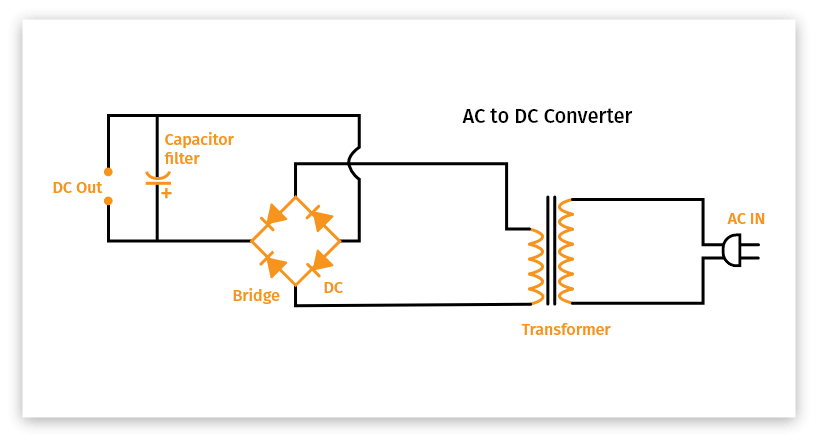
The AC power from your wall socket first enters the adapter. The first thing it usually hits is a component called a transformer. This is like a bouncer at a club, toning down the energy a bit. It takes the high-voltage AC and brings it down to a more manageable, lower-voltage AC. Still AC, but less intense.

Next, it meets our real hero: the rectifier. This is the part that does the actual "AC to DC" flip. Imagine the rectifier is a strict traffic controller that only allows traffic to flow in one direction. It essentially chops off or flips the "negative" half of the AC wave, turning it all into positive pulses.
Now you've got power that's all positive, but it's still a bit bumpy – like a series of small hills. This is where the capacitor steps in. Think of the capacitor as a tiny reservoir or a really good smoothing filter. It stores a bit of this bumpy power and then releases it steadily, ironing out those hills into a much flatter, smoother line. Voila! You've got glorious, steady DC power!
Finally, sometimes there's an extra part called a voltage regulator. This is like a diligent butler ensuring the power is precisely the right voltage – no more, no less – that your specific gadget needs.

Where Do You See This Everyday?
- Your Phone Charger: That chunky bit between the plug and the cable? That’s your AC-to-DC converter, making sure your phone gets its gentle DC hug.
- Laptop Power Cords: The larger "brick" on your laptop charger performs the exact same magic, just on a slightly larger scale for more powerful devices.
- LED Light Strips: Ever bought a cool LED strip for mood lighting? It probably came with a small adapter that looks suspiciously like a charger brick. Yup, converting AC to DC for those tiny, efficient lights.
- Anything with a USB Cable: Since USB is fundamentally a DC power standard, anything that charges or powers via USB is relying on some form of AC-to-DC conversion somewhere along the line.
So, Why Should YOU Really Care?
Because understanding this tiny bit of tech makes you a smarter consumer and helps you protect your beloved gadgets!
Knowing what that brick does means you understand why using the right charger matters. It’s not just about fitting the plug; it’s about giving your device the precise, gentle flow of DC power it was designed for.
It also helps explain why some things just run on batteries (DC!) and others need to be plugged into the wall (AC!). It's all about matching the power type to the device's preference.
Next time you plug something in, give a little nod to that humble power adapter. It’s silently working its magic, turning that wild AC energy from the wall into the calm, predictable DC power that keeps your digital world humming. Pretty neat, huh?