
How To Calculate Wattage Consumption
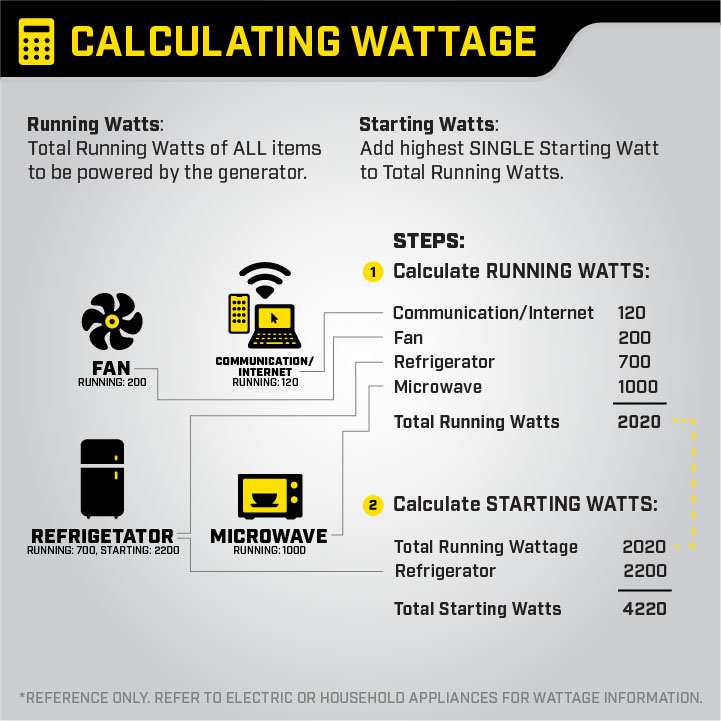
Alright, settle in, grab your imaginary coffee (or a real one, I won't judge), because we're about to tackle one of life's great mysteries: How to calculate wattage consumption. Sounds like something you'd need a lab coat and a degree in theoretical physics for, right? Wrong! Mostly. You just need a calculator, a willingness to squint at tiny labels, and maybe a small snack for moral support.
Ever stared at your electricity bill and wondered if a small, incredibly expensive gnomish village had set up shop in your wall sockets, running tiny, energy-hogging nightclubs? Well, understanding wattage is your first step to evicting those hypothetical gnomes and taking back control!
Why Bother with Watts, Anyway?
Good question! Are we just doing this for fun? (Mostly, yes). But also, knowing an appliance's wattage helps you figure out a few crucial things:
Must Read
- How much it costs to run: No more guessing if that electric heater is secretly funding a yacht for your utility company CEO.
- If you're going to trip a breaker: Imagine hosting a party, plugging in the karaoke machine, the disco ball, and the fondue pot, and suddenly... darkness. Knowing wattage can prevent such tragic events.
- Your environmental footprint: Less power, less impact. Simple.
So, let's dive into the magical formula that unlocks this power puzzle. Don't worry, it's not quantum mechanics, it's just plain old Ohm's Law, but applied to your toaster.
The Grand Reveal: Power, Voltage, Current!
The basic formula for electrical power (which is measured in Watts) is beautifully simple:
P = V * I
Sounds like a secret agent code, right? Let's decode it:
- P stands for Power. This is what we're looking for, measured in Watts (W).
- V stands for Voltage. Think of it as the electrical "pressure" in your outlets. In most of North America, this is typically 120 Volts (V). In many other parts of the world (Europe, etc.), it's usually 220-240V.
- I stands for Current. This is the "flow" of electricity, measured in Amperes, or Amps (A).
Imagine electricity like water flowing through a pipe. Voltage is the water pressure pushing it along. Current (Amps) is the width of the pipe – how much water is actually flowing. And Power (Watts) is the total oomph you get at the end!

Finding the Numbers: The Great Appliance Safari
Okay, so where do you find these mysterious 'V's and 'I's? It's usually printed on a tiny sticker or etched onto the back or bottom of your appliance. Sometimes it's on the power brick if it's a laptop charger. Look for words like "INPUT," "V," "A," or "Watts."
Scenario 1: The Easy Peasy Lemon Squeezy Appliance
Let's say you're looking at your trusty hair dryer. If you're lucky, it might just come right out and say, "1500 Watts!" Ta-da! You're done with that one. You've won the wattage lottery. But where's the fun in that?
What if it says: "Input: 120V, 12.5A"?
Aha! Now we can use our super-secret formula!
P = V * I
P = 120V * 12.5A

P = 1500 Watts
See? It matches! You're practically an electrical engineer now. Maybe don't start rewiring your house just yet, but you're getting there!
Scenario 2: The Slightly More Annoying Appliance (But Still Doable!)
What if your old-school blender only says: "Input: 10A"? And you know it plugs into a standard 120V outlet. No problem!
P = V * I
P = 120V * 10A

P = 1200 Watts
There you go! Your blender, for a glorious few minutes, is a 1200-watt beast. That's a lot of power just to make a smoothie. Suddenly, those kale smoothies seem a little more expensive, don't they?
Beyond Watts: Introducing Watt-Hours (and Your Bill!)
Knowing an appliance's wattage is great, but your electricity bill doesn't charge you for watts; it charges you for energy consumed over time. This is measured in Watt-hours (Wh) or, more commonly, Kilowatt-hours (kWh). Think of it this way: 100 watts for one hour is 100 Watt-hours. If you run that for 10 hours, it's 1000 Watt-hours, or 1 Kilowatt-hour.
Your bill usually shows you a rate, say, $0.15 per kWh. So, to figure out how much your blender costs:
1. Watts * Hours Used / 1000 = kWh
Let's say you use your 1200-watt blender for 15 minutes (0.25 hours) every day for a month (30 days).

Total daily hours = 0.25 hours
Total monthly hours = 0.25 hours/day * 30 days = 7.5 hours
Total kWh = (1200 Watts * 7.5 hours) / 1000 = 9000 Wh / 1000 = 9 kWh
Monthly cost = 9 kWh * $0.15/kWh = $1.35
Okay, so the blender isn't breaking the bank. But imagine if it was something you left on all the time!
Surprising Facts & Power-Saving Shenanigans!
- The Vampire Drainers: Did you know many electronics still suck a little power even when they're "off"? Your TV, phone chargers, gaming consoles – anything with a little light or a clock display. It's called "standby power" or "vampire drain," and it can account for 5-10% of your electricity bill! Unplug 'em! Or use a power strip with an on/off switch.
- The Mighty Toaster: Your humble toaster, for the 2-3 minutes it's on, can pull more power (around 800-1500W) than your huge LED flatscreen TV (often around 50-150W)! It just doesn't do it for long.
- The Fridge Never Sleeps: Your refrigerator is probably one of the highest consumers of energy over time, simply because it's always on. This is why energy-efficient models are such a big deal.
So, there you have it! You've successfully navigated the thrilling world of wattage calculation. You're no longer at the mercy of the unseen electrical gnomes. You now possess the power (pun intended!) to decode your appliances, understand your consumption, and maybe even save a few bucks. Go forth and measure, my friends! And remember, the less you use, the happier your wallet and the planet will be!