
How Much Watts Does A Fan Use

Alright, settle in, grab your imaginary coffee, because we're about to tackle one of life's great mysteries, right up there with "Where do all my socks go?" and "Why does toast always land butter-side down?" Today, we're diving headfirst into the electrifying (pun absolutely intended!) question: How much watts does a fan use?
Now, I know what you're thinking. "Oh great, another lecture about energy consumption." But fear not! This isn't a dry, dusty textbook entry. This is more like that wild story your eccentric aunt tells at Thanksgiving – full of surprises, a few laughs, and maybe, just maybe, you'll learn something useful.
Picture this: It's a sweltering summer day. The kind where your face feels like it's trying to melt off your skull. You flip on your trusty fan, and a wave of glorious, air-moving goodness washes over you. Ahhh. But then, a tiny, nagging thought whispers in your ear: "Is this thing secretly draining my bank account and powering a small nation?"
Must Read
The Great Wattage Revelation (or Lack Thereof!)
First things first, there's no single, universal answer. It’s like asking, "How many calories does a snack have?" Well, which snack? A single almond or an entire chocolate cake shaped like a pony? Fans come in all shapes and sizes, from the tiny desk warrior to the majestic ceiling spinner.
But here’s the utterly delightful, slightly scandalous secret: fans are shockingly efficient! Seriously, they're like the quiet, unassuming heroes of your energy bill. They don't get enough credit.

The Little Guy: Desk and Table Fans
Let's start with your desktop buddy, the one trying its best to save you from spreadsheet-induced heatstroke. These little dynamos are usually in the range of 10 to 30 watts. That's it! To put that in perspective, many modern LED light bulbs use around 9-12 watts. So, your fan is basically running on the same energy as a really bright light bulb. Or, you know, the energy it takes to keep your phone charger plugged in without a phone attached, just... judging you.
Imagine! You could probably power three of these bad boys for the same cost as one old-school incandescent bulb. It's almost scandalous how little power they draw for the comfort they provide. They're the silent, breezy ninjas of energy efficiency.
The Mid-Range Movers: Pedestal and Tower Fans
Stepping up a notch, we have the pedestal and tower fans. These are your slightly more serious air movers, capable of cooling a small room or at least preventing your cat from melting into a puddle. They typically consume a bit more, ranging from 30 to 70 watts.
Still, folks, we're not exactly talking about powering a small spaceship here. That's still less than many gaming consoles on standby, and certainly less than the wattage of a single hair dryer (which often hovers around 1500 watts – a true energy beast!). So, go ahead, let that tower fan oscillate to its heart's content. It’s doing its best, and it's doing it economically.
The Overhead Overlords: Ceiling Fans
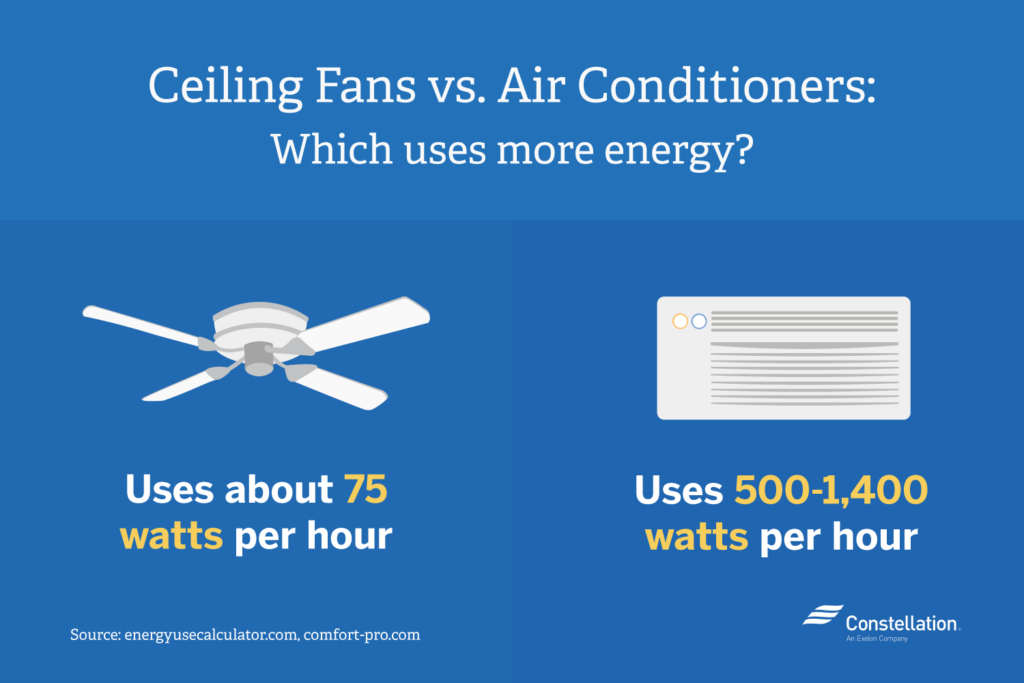
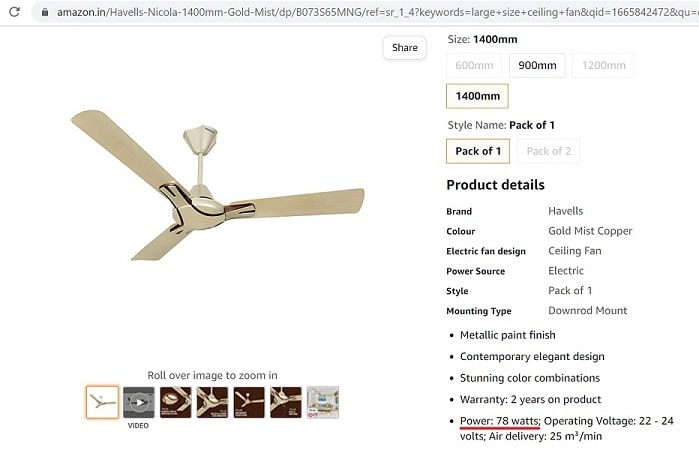
Ah, the ceiling fan. The grand old dame of air circulation. Many people assume these giants must be guzzling electricity like there’s no tomorrow. But prepare for another delightful surprise! Most ceiling fans, even on their highest settings, generally use between 15 to 90 watts.
Wait, what? A fan that big, moving all that air, for less than a light bulb on a low setting? Yes! The magic here is that they’re not cooling the air (that's AC's job), they're just moving it. And moving air feels cooler because it helps evaporate sweat from your skin. It's science, baby! And it's cheap science at that.
The Heavy Hitters (Relatively Speaking): Box and Floor Fans
Then we have the workhorses, the box fans and high-velocity floor fans. These are the ones you bring out when things get serious, or when you need to dry out a flooded basement (hopefully not the latter). These can range from about 50 to 100 watts, sometimes a little more for the really powerful industrial types.
They’re the loudest of the bunch, often sounding like a tiny airplane taking off in your living room. But even these robust air movers are still incredibly modest in their energy demands. Think of it this way: running one of these for an hour is roughly equivalent to running a handful of LED light bulbs. Not exactly bankruptcy material.
The Elephant in the Room: AC vs. Fan
Here's the real mic drop moment, the fact that will make you feel like a savvy energy guru: an air conditioner (AC) can consume anywhere from 700 to 3500 watts, depending on its size and efficiency. That’s not a typo. We’re talking about a difference of literally ten to one hundred times more energy than a fan!

So, the next time you're sweating bullets and debating whether to flick on the AC or brave it with a fan, remember this conversation. Your fan is practically a monastic ascetic when it comes to electricity consumption compared to its power-hungry cousin, the air conditioner. Fans don’t cool the air; they cool you. And they do it for pennies.
Finding Your Fan's Specifics
Want to know the exact wattage of your particular fan? Easy peasy! Just check the label on the fan itself, usually on the base, motor housing, or underside. It will often list the voltage (V) and amperage (A). Multiply those two numbers (V x A = Watts), and boom! You’ve got your answer.
So, the next time that little voice whispers doubts about your fan's energy habits, you can confidently tell it to zip it. Your fan is a lean, mean, air-moving machine, and it's barely making a dent in your energy bill. Now, if you'll excuse me, I'm going to go fire up every fan in my house, guilt-free, and pretend I’m living in a hurricane.