
How Much Power Does An Led Light Use

Ever flicked on a light switch and given zero thought to the magic happening behind the scenes? Most of us do! But in an era where we're all a little more conscious about our energy footprint (and those pesky utility bills), it’s natural to wonder about the little things. And what's smaller, yet more ubiquitous, than the humble light bulb? Specifically, the super-star of illumination: the LED.
We've all heard the buzz about LEDs being energy-efficient rockstars. But what does that actually mean for your home and your wallet? Let's dim the mystery and shine a light on just how much power an LED bulb truly sips.
The Big Reveal: LEDs Are Sip-Sip-Sippers, Not Guzzle-Guzzlers
Here’s the TL;DR: LEDs use remarkably little power. Like, surprisingly little. If traditional incandescent bulbs were gas-guzzling SUVs, and CFLs were sensible sedans, then LEDs are those sleek, hyper-efficient electric cars of the lighting world.
Must Read
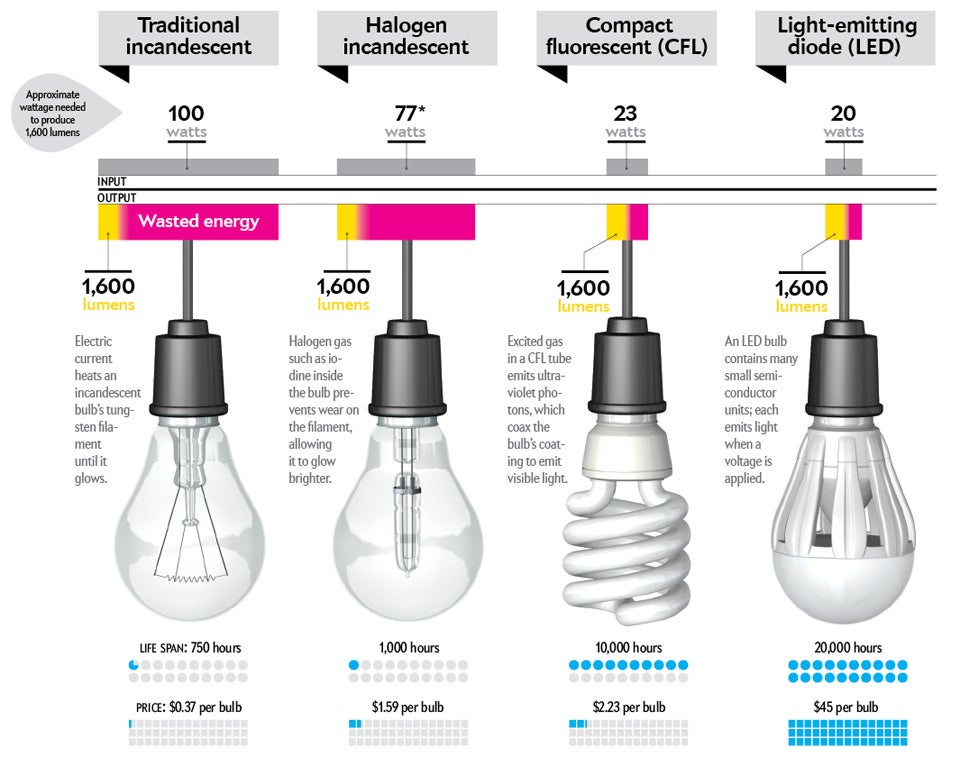
Think about it this way: a typical old-school 60-watt incandescent bulb needed, well, 60 watts of power to glow. To achieve the same amount of brightness (what we call lumens), an LED bulb usually only needs about 8 to 12 watts. That's a massive difference! Some can even do it with as little as 6 watts.
This isn't just a marketing gimmick; it's a fundamental difference in how they produce light. Incandescents heat a filament until it glows – a very inefficient process that wastes most energy as heat. LEDs, on the other hand, convert electricity directly into light through a semiconductor process, making them far more efficient and cooler to the touch.
Why Does Wattage Matter When Lumens Are the New Black?
For years, we associated "brightness" with "watts." A 100-watt bulb was brighter than a 60-watt bulb. Simple! But with LEDs, that old rule goes out the window. Now, you need to look for lumens. Lumens measure the actual brightness of the light output, while watts measure the power consumed. So, when you're buying an LED, you're looking for one that gives you, say, 800 lumens (the equivalent of a 60W incandescent) but only uses 10 watts.
It's like buying a speaker: you care about how loud it is (lumens), not how much electricity it uses (watts) to get that loudness, right?

What Affects An LED's Power Consumption?
While generally low, a few things can subtly influence how much power your specific LED bulb uses:
- Brightness (Lumens): The more lumens an LED produces, the more power it will draw. A 1500-lumen LED (equivalent to a 100W incandescent) will use more power than an 800-lumen one, but still significantly less than its incandescent counterpart.
- Quality: Believe it or not, not all LEDs are created equal. High-quality LEDs from reputable brands tend to be more efficient and last longer. Cheaper alternatives might consume slightly more power for the same light output.
- Color Temperature: While not a huge factor, warmer (yellower) lights sometimes have tiny differences in power draw compared to cooler (bluer) lights, but these are negligible for daily use.
- Dimming: If you have dimmable LEDs and use them at a lower setting, they'll consume even less power! Bonus savings!
Practical Tips & Fun Little Facts
Tip #1: Read the Box! When shopping for LEDs, always look for the lumens and the "wattage equivalent". This tells you exactly what kind of light you're getting and how much energy it will save. A typical "60W equivalent" LED will tell you it's actually using around 9-10 watts.

Fun Fact: LEDs have an insane lifespan. We're talking 25,000 to 50,000 hours! That means if you turn your light on for 3 hours a day, an LED could last you over 22 years. Imagine never changing a bulb in your lifetime for a specific fixture! That's almost a cultural shift from our parents' generation constantly replacing bulbs.
Tip #2: Do a Quick Calculation. Want to see the impact? Take a room where you have 5 lights. If they were 60W incandescents, that's 300W. Swap them for 10W LEDs, and now it's just 50W. Over time, especially with rising energy costs, those small numbers add up to significant savings – both for your wallet and the planet!

Fun Fact: LEDs aren't just for light bulbs! They're in your phone screen, your TV, your car headlights, traffic lights, and even those tiny indicator lights on your electronics. Their compact size and efficiency make them indispensable in modern tech.
A Brighter, More Conscious Future
So, how much power does an LED light use? Significantly less than anything that came before it. It’s not just a trend; it's a technological leap that's silently revolutionizing how we light our homes and cities. From reducing your carbon footprint to simply enjoying a lower electricity bill, making the switch to LEDs is one of those easy, impactful decisions that just makes sense.
In our busy lives, it's easy to overlook the small choices. But upgrading your lighting is a gentle, yet powerful, step towards a more efficient and brighter daily existence. So, next time you flip that switch, give a little nod to your energy-sipping LED. It's working hard, efficiently, and quietly, helping you live a little smarter, one lumen at a time.