How Many Watts In A Strand Of Christmas Lights

Stringing up Christmas lights is a holiday tradition as beloved as eggnog and questionable sweater choices. But amidst the festive cheer, a practical question often twinkles in the back of our minds: how much electricity are these sparkling strands actually using? Understanding the wattage of your Christmas lights isn't just about being a responsible homeowner; it can also save you money and potentially prevent a holiday-induced electrical mishap! So, let's dive into the wattage wonderland and demystify the power behind the twinkle.
Knowing the wattage of your Christmas lights is incredibly useful for several reasons. First and foremost, it helps you avoid overloading circuits. Plugging too many high-wattage items into a single circuit can trip a breaker (or worse, cause a fire hazard!). By knowing the wattage of your lights, you can calculate how many strands you can safely connect in a series or plug into a single outlet. This is especially important if you’re planning a Clark Griswold-level display!
Secondly, understanding wattage helps you estimate your energy consumption. While a single strand might not seem like much, those kilowatt-hours can add up over the holiday season. By knowing the wattage and the hours you leave the lights on each day, you can get a rough estimate of how much they're contributing to your electricity bill. This knowledge empowers you to make informed decisions, like switching to more energy-efficient options or setting timers to reduce usage.
Must Read
So, how do you figure out the wattage of your Christmas lights? The easiest way is to check the packaging or the strand itself. Look for a label that lists the wattage or amperage. If you only see amperage (amps), you can easily calculate the wattage using the formula: Watts = Volts x Amps. In most North American homes, the voltage is 120 volts.
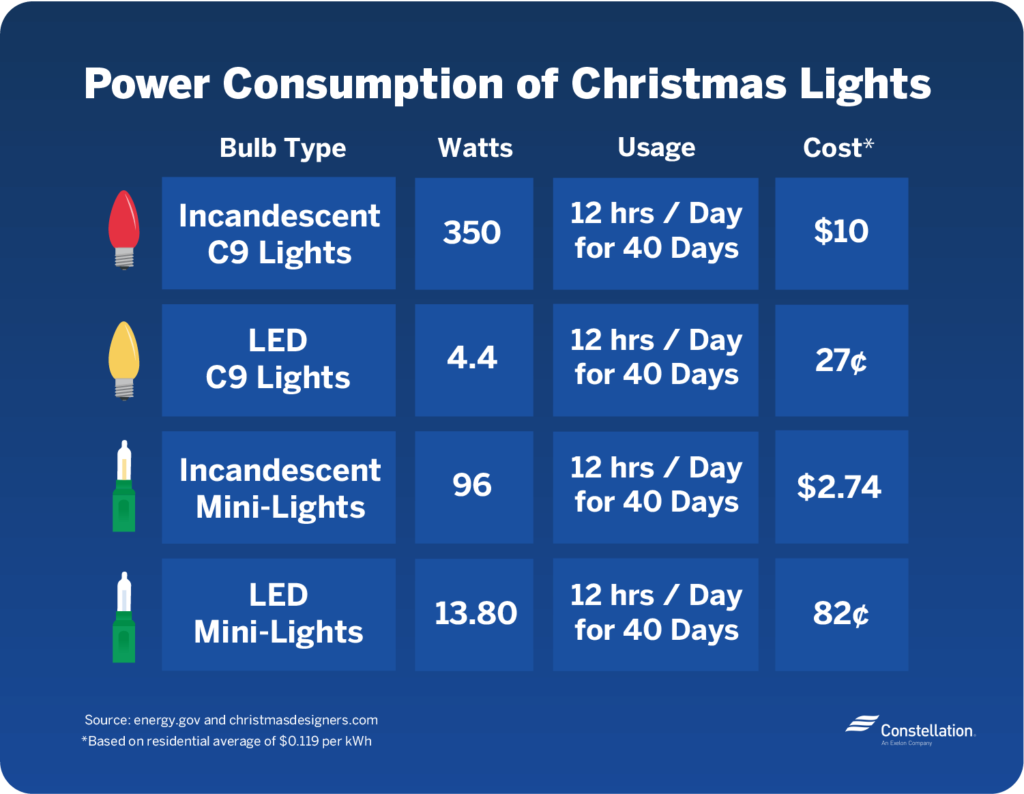
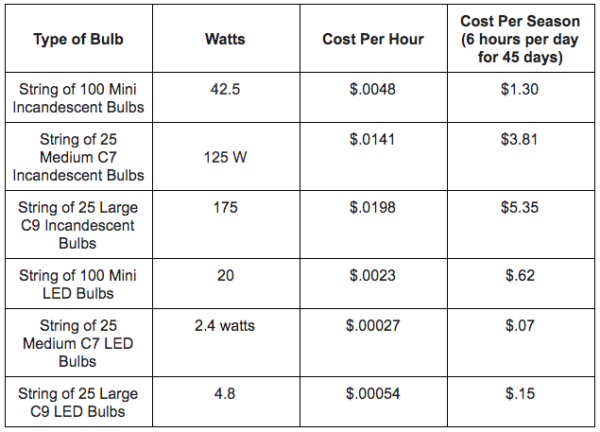
Now, let’s talk about the different types of Christmas lights and their typical wattages. Traditional incandescent Christmas lights are the older style and are significantly less energy-efficient. A single strand of 100 incandescent mini-lights can use anywhere from 40 to 60 watts! That's a hefty amount compared to their modern counterparts.
LED Christmas lights, on the other hand, are the reigning champions of energy efficiency. These little bulbs use a fraction of the power of incandescent lights. A strand of 100 LED mini-lights might only use around 2 to 10 watts. That’s a huge difference!
Why are LEDs so much more efficient? It’s all about how they produce light. Incandescent bulbs generate light by heating a filament until it glows, which wastes a lot of energy as heat. LEDs, however, produce light through a process called electroluminescence, which is far more efficient.
In conclusion, understanding the wattage of your Christmas lights is a small but important step towards a safer and more energy-conscious holiday season. So, before you deck the halls, take a moment to check the wattage and make sure you're not overloading your circuits. And consider switching to LED lights for a more sustainable and cost-effective holiday display. Happy decorating!