
How Many Volts Is A Fridge

Ever gazed at your trusty kitchen companion, the refrigerator, and wondered about its secret life? We often take these silent giants for granted. But lurking behind its cool exterior is a fascinating question: how many volts does it use?
It sounds like a super technical question, right? But trust us, understanding your fridge’s power needs is surprisingly fun. It’s like peeking behind the curtain of everyday magic.
Let's dive into this intriguing mystery. It's not just about numbers; it's about connecting with the very heart of your home.
Must Read
For most homes in North America, including the United States and Canada, the answer is delightfully consistent. Your fridge typically runs on 120 volts.
Isn’t that neat? It’s the same voltage that powers many of your other household gadgets. Think lamps, toasters, and even your phone charger.
This 120-volt standard is a big part of why our appliances just "work" when we plug them in. No fuss, no muss, just perfectly chilled food.
But wait, there's a whole world beyond North America! And this is where the plot thickens. Electrical standards vary wildly across the globe.
Imagine your fridge deciding to go on a grand international tour. What kind of power would it expect in Europe, Asia, or Africa?
In many of these exciting international locations, the standard household voltage is much higher. We’re talking about 220 to 240 volts!
That’s almost double the voltage you’d find in an average North American kitchen. It's a huge difference, and it makes you think about global connectivity.
This voltage difference is why you can’t just pack your favorite fridge in a suitcase and plug it in overseas. Well, you could try, but it wouldn't end well!

It's like trying to put square pegs in round holes, electrically speaking. Each country has its own unique electrical "language."
So, why is knowing your fridge’s voltage so entertaining? Because it makes you a savvy home explorer! You start to notice these details all around you.
It’s not just a big cold box anymore. It’s a piece of engineering connected to a vast power grid, humming along thanks to a specific electrical flow.
You might even find yourself glancing at the back of other appliances now. What voltage does your microwave use? Your washing machine?
Suddenly, your home becomes a treasure trove of electrical information. Every plug, every cord, tells a story about power and purpose.
The voltage number tells us how much "push" the electricity has. Think of it like water pressure in a hose. More volts mean more push.
For your fridge, this push helps power the compressor, the fan, and the lights. It’s a constant, tireless worker, keeping your food fresh day and night.
Some people might assume a big appliance like a fridge needs some super-special, ultra-high voltage. But for typical residential use, it’s quite standard.
It's not running off a miniature power plant in your kitchen! It's just a well-engineered machine designed for common household electricity.

Understanding this small detail helps demystify the magic of modern appliances. It turns a seemingly complex topic into something approachable and fun.
Imagine the engineers who designed your fridge. They carefully considered the voltage it would use, ensuring it was safe, efficient, and reliable.
They made sure it could handle the constant demand of keeping things cold. It's a testament to clever design and electrical science.
Knowing this voltage can also be genuinely useful. If you ever need to replace a part or buy a new appliance, this information is key.
It helps you ensure compatibility and safety. No one wants an electrical mishap just because they weren't curious enough to check!
So, what’s the big takeaway from our voltage adventure? Your fridge is an incredible piece of everyday technology.
And its power requirement, typically 120 volts in North America, is a fundamental part of its identity. It’s what makes it tick, or rather, hum.
Next time you grab a cold drink or a snack, give a little nod to your fridge. It’s quietly doing its job, powered by that specific voltage.
It’s a constant guardian of your groceries, a silent hero in your kitchen. And now you know a little more about its electrical heartbeat.
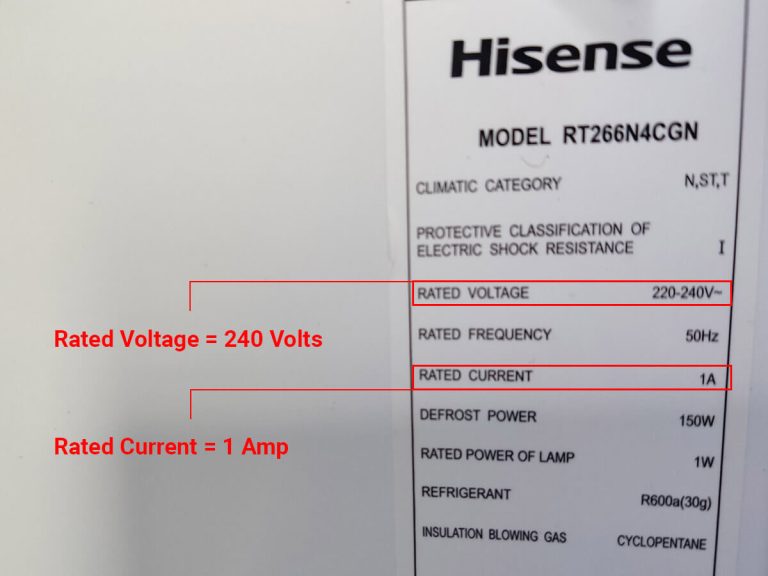
Feeling inspired? Why not embark on your own little household investigation? Most appliances have a label, often on the back or inside the door, listing their voltage.
It's usually a small sticker or plate, sometimes called a rating plate or data plate. It’s like finding a secret message from the manufacturer!
You might see things like "120V~" or "230V~". The "V" stands for volts, and the "~" means it uses alternating current (AC), which is standard for homes.
This tiny label holds a wealth of information. It's a quick and easy way to become more familiar with your home's electrical landscape.
Discovering your fridge’s voltage is just the beginning of a wonderfully curious journey. What other fascinating electrical facts await you?
It's a delightful way to feel more connected to the objects in your home. They're not just inert things; they're powered marvels.
So, go ahead, embrace your inner electrical detective! Your fridge is waiting to reveal one of its coolest secrets.
It's a simple number, yet it opens up a world of understanding about how our homes truly function. And that, we think, is pretty special.
![Mini Fridge Amps Revealed [1494+ Units | Startup & Lowest Draw]](https://ecocostsavings.com/wp-content/uploads/2023/04/mini-fridge-amperage-and-start-up-amps-example.jpg)
Understanding the volts behind your fridge is more than just a fact. It's an invitation to appreciate the intricate design of our modern world.
It sparks a curiosity that can lead to many more interesting discoveries about the technology we interact with daily.
So, the next time you hear that gentle hum, remember the 120 volts (or 240 volts if you’re abroad!) diligently working away.
It’s a testament to consistent power and clever engineering, keeping your food perfectly chilled without a single fuss.
This seemingly simple question about fridge voltage unlocks a broader appreciation for electricity itself. It's the silent force that makes our modern lives possible.
It's truly amazing how much goes into keeping our food fresh and our drinks cold, all thanks to a specific electrical standard.
From the power plant to your kitchen, the journey of those volts is a continuous, vital stream of energy. Your fridge is just one happy recipient.
So, there you have it! The not-so-secret secret of your fridge’s voltage. We hope you feel a little more connected to this everyday marvel.
And perhaps, just perhaps, you'll be inspired to peek at a few more appliance labels around your home. Happy voltage hunting!