
How Many Pi Bonds In A Triple Bond
.PNG)
Unlocking the Secrets of the Triple Bond: Pi Bonds Ahoy!
Ever stared at a chemical formula and felt a strange mix of awe and confusion? Don't worry, you're not alone! Chemistry can seem like a secret language, but cracking its code can be surprisingly fun.
Let's dive into something intriguing: the triple bond. It's not just any bond; it's like the VIP section of chemical connections!
What’s So Special About a Triple Bond?
Imagine atoms holding hands. A single bond is like a regular handshake. But a triple bond? That's like a super-strong, three-way grip, indicating a very strong attraction between the atoms!
Must Read
This super-grip is important. The atoms share six electrons instead of two!
Now, here's where it gets interesting: these six electrons aren't all created equal. This brings us to the concept of sigma (σ) and pi (π) bonds. They're like different types of handshakes within that super-grip.
Sigma vs. Pi: A Bond Breakdown
Think of the sigma bond as the foundational handshake. It's the first, the strongest, and the most direct connection between the atoms.
It's formed by the head-on overlap of atomic orbitals. Basically, the atoms are facing each other squarely.
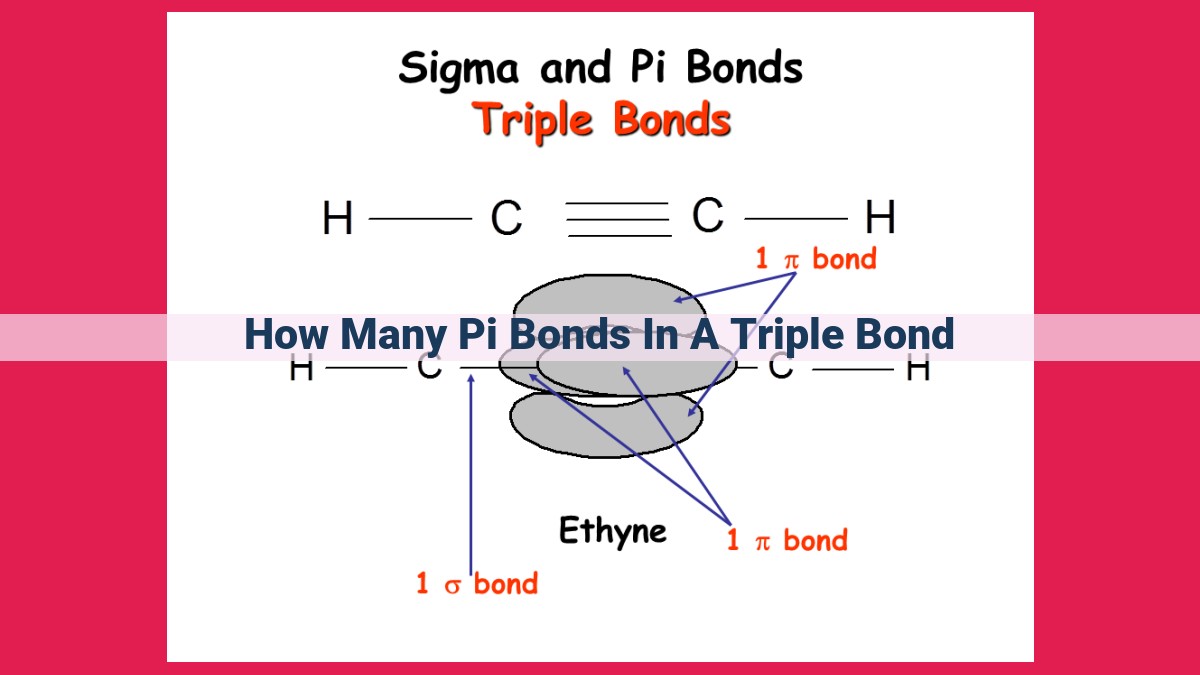
Pi bonds, on the other hand, are like the extra high-fives layered on top. They're formed by the sideways overlap of atomic orbitals.
These aren't as strong as sigma bonds, but they add extra reinforcement to the bond.
The Big Reveal: How Many Pi Bonds in a Triple Bond?
Okay, drumroll please! In a triple bond, there's one sigma bond (that foundational handshake). And then, the magic number... two pi bonds!
That's right, a triple bond has one σ bond and two π bonds. Isn’t that neat?
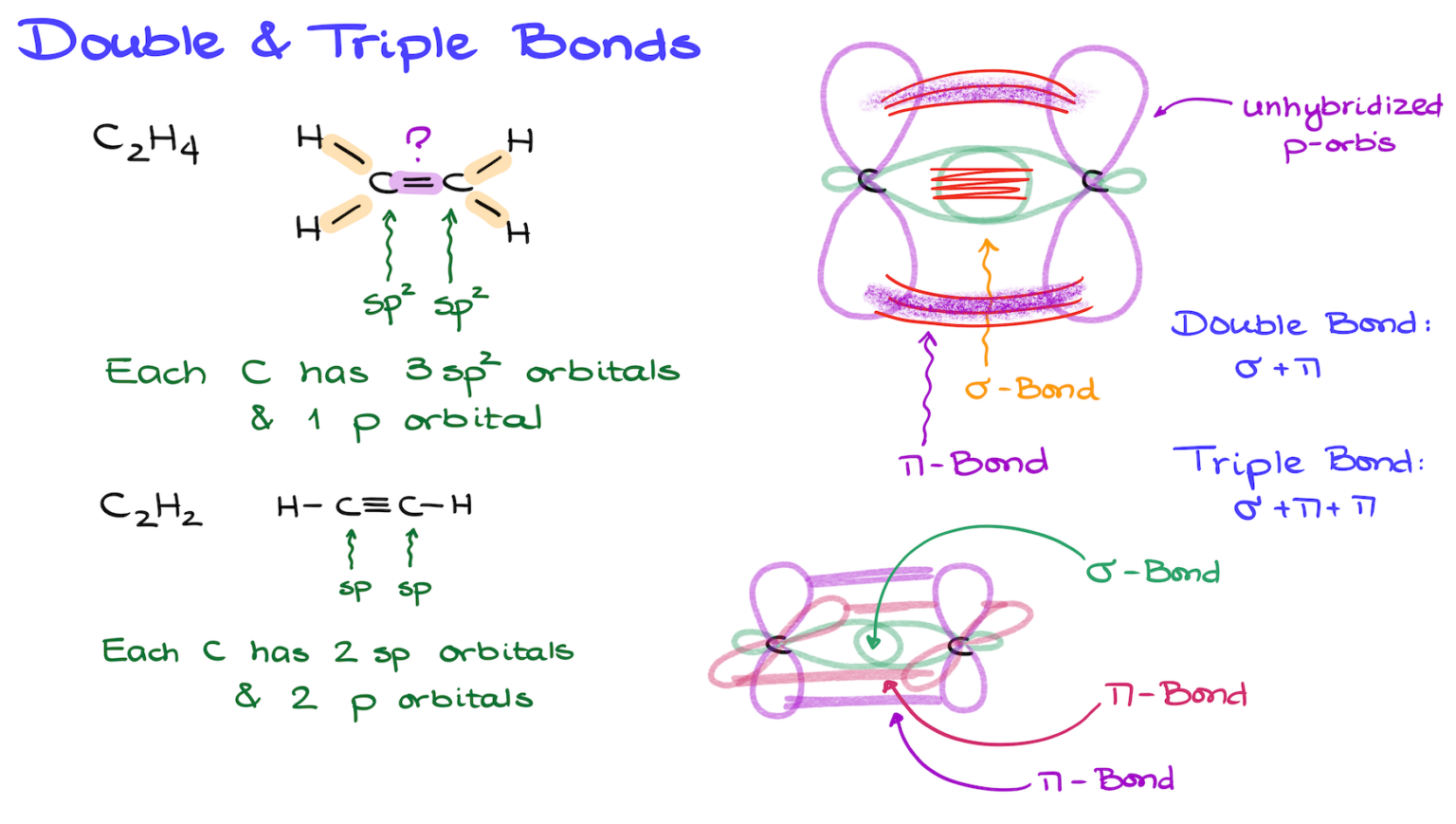
So, when you see a triple bond, remember that it's a combination of a strong sigma bond and two supporting pi bonds, all working together to hold those atoms tightly together. It is like teamwork in the molecular world!
Why Should You Care About Pi Bonds?
You might be thinking, "Okay, cool fact, but why does this even matter?" Well, pi bonds are the rockstars of chemical reactivity! They influence a molecule's shape, its ability to absorb light, and how it interacts with other molecules.
Think of the vibrant colors of the world around you. Pi bonds often play a role in creating those colors!
For example, molecules with many alternating single and double (which contain one pi bond) or triple bonds tend to be colorful because the electrons in the pi bonds can easily absorb light of different wavelengths.
Examples in Action
Let’s look at the example of ethyne (also known as acetylene). It's a simple molecule with a carbon-carbon triple bond (HC≡CH).

It's used in welding torches because it burns with a very hot flame. The triple bond is key to its high energy content.
Another example is nitrogen gas (N₂), which makes up most of the air we breathe. It has a nitrogen-nitrogen triple bond (N≡N).
This strong bond makes nitrogen relatively unreactive, which is great for keeping our atmosphere stable.
Digging Deeper: Molecular Orbitals
If you're feeling brave, you can even explore the concept of molecular orbitals. This describes how atomic orbitals combine to form bonding and antibonding orbitals.

Understanding molecular orbitals provides a more complete picture of how sigma and pi bonds are formed. It even explains why pi bonds are weaker than sigma bonds.
But even without diving that deep, knowing that triple bonds contain two pi bonds is a fantastic start. It helps unlock a deeper understanding of the chemistry all around us!
The Fun Continues!
Learning about pi bonds doesn't have to be a chore. It's like discovering a secret code that reveals the inner workings of molecules. It’s a way to understand how the world works on a fundamental level.
So next time you encounter a chemical formula with a triple bond, give it a knowing nod. You understand the sigma and pi bond dance! You've unlocked a small but fascinating piece of the chemistry puzzle!
Who knows, maybe this is your ticket to becoming a chemical detective. The adventure is just beginning!