
How Many Moons Fit In The Earth

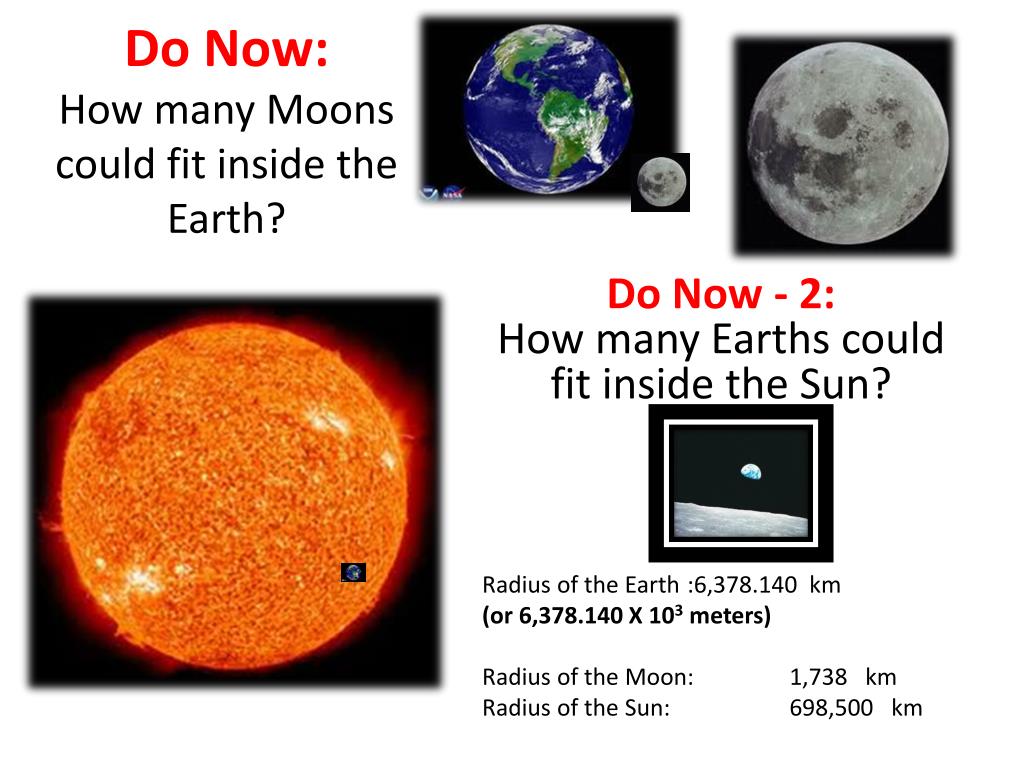
Ever looked up at the moon on a clear night and wondered just how big that silvery orb really is? We all have! It's a natural curiosity, like wondering how many slices are in a pizza or how many grains of sand are on a beach. But instead of pizza slices or sand, we're thinking bigger! We’re diving into a truly astronomical question: How many moons could you cram inside the Earth? It's a fun thought experiment that helps us grasp the sheer scale of our planet and its place in the cosmos.
Why bother asking this question? Well, for starters, it's just plain cool! It helps us appreciate the vastness of space and the relative sizes of celestial bodies. But more than that, it reinforces our understanding of volume and how it works. Thinking about fitting smaller spheres inside a larger one provides a tangible way to understand scale and density. Plus, it's a great conversation starter at your next stargazing party!
So, how do we even begin to tackle this question? The key is volume. We need to know the volume of both the Earth and the Moon. Think of volume as the amount of space something occupies. Fortunately, we don't have to go measuring planets with giant rulers! Scientists have already done the hard work for us. The Earth has a volume of approximately 1.08321 × 10¹² cubic kilometers. The Moon, on the other hand, has a volume of about 2.1958 × 10¹⁰ cubic kilometers.
Must Read
Now comes the relatively easy part: division! To find out how many Moons fit inside the Earth, we simply divide the Earth's volume by the Moon's volume: (1.08321 × 10¹²) / (2.1958 × 10¹⁰). The answer you get is approximately 49.33. But wait! Can we really squeeze 49.33 moons into the Earth?
The short answer is no. This calculation gives us a theoretical maximum, assuming we could perfectly pack spheres with no wasted space. In reality, spheres don't fit together perfectly. There will always be gaps between them. Think of trying to pack oranges into a box. You can't fill the box completely because of the round shape of the oranges.
Scientists estimate that the packing efficiency of spheres is around 74%. This means that about 26% of the space will be empty. To account for this, we need to multiply our initial result by 0.74. So, 49.33 multiplied by 0.74 equals approximately 36.5.

Therefore, the more realistic answer is that you could fit around 36 Moons inside the Earth. It's a significant difference from our initial calculation, highlighting the importance of considering real-world limitations. So, the next time you gaze at the moon, remember that you could theoretically fit dozens of them inside our home planet. Pretty mind-blowing, right?
This exercise demonstrates the power of simple math to unlock a deeper understanding of the universe. It's a reminder that even seemingly complex questions can be broken down into manageable steps, and that exploring the cosmos can be both fun and educational! Keep looking up and keep wondering!

