
How Many Lines Of Symmetry Does A Triangle Have
Hey there, math adventurer! Ever stop to think about how things balance? How some shapes just seem... right? Well, get ready to dive into the seriously fun world of symmetry, and specifically, how it applies to everyone's favorite three-sided friend: the triangle!
Forget boring textbooks and complicated formulas for a second. We’re talking about seeing the world in a new, symmetrical light. And trust me, once you start noticing symmetry, you'll see it everywhere.
So, the big question: How many lines of symmetry does a triangle have? Okay, okay, hold your horses! It's not a one-size-fits-all answer. The truth is, it depends on the triangle. Think of it like ice cream flavors – some are classic, some are wild, and all are delicious in their own way. (Okay, maybe not all ice cream flavors… broccoli ice cream? Yikes!).
Must Read
Equilateral Triangles: The Symmetry Superstars
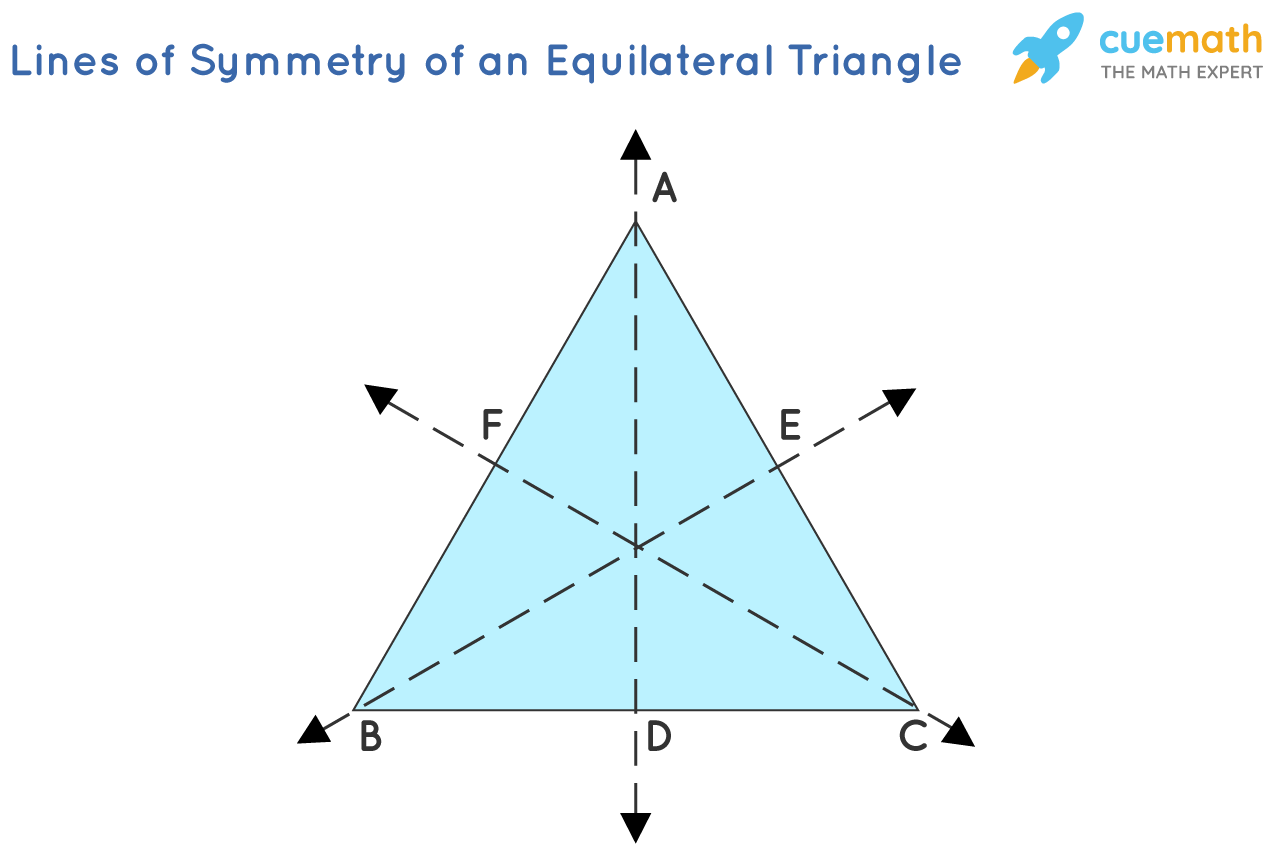
Let’s start with the rock star of the triangle world: the equilateral triangle. All three sides are perfectly equal, and all three angles are exactly the same (60 degrees each, in case you were wondering – quick geometry refresher!).
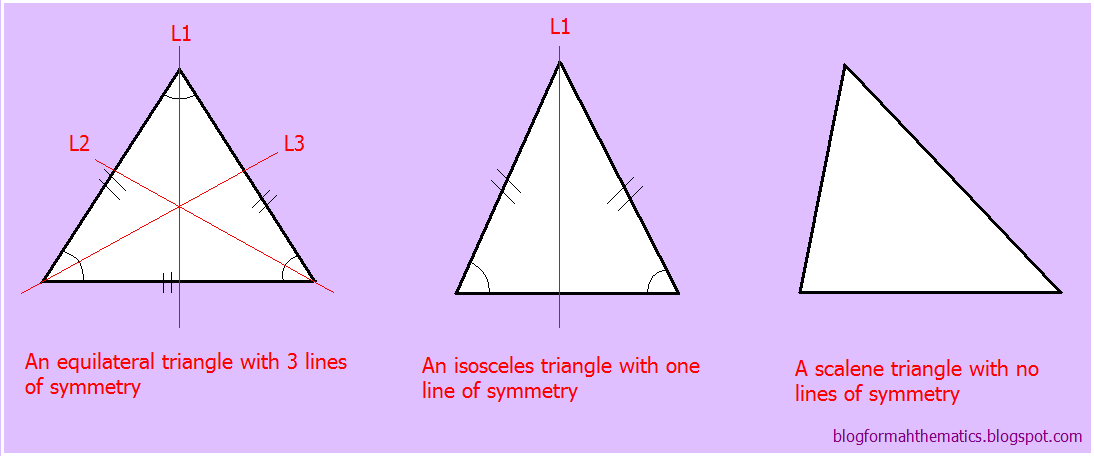
Because of its perfect balance, an equilateral triangle boasts a whopping three lines of symmetry! That's right, you can fold it along three different lines and have each half match up perfectly. Imagine drawing a line from each corner (vertex) to the midpoint of the opposite side. Boom! Symmetry explosion!
Think of it like perfectly splitting a pizza three ways – everyone gets a fair share, and everything just… aligns. Ah, the beauty of equilateral triangles.

Isosceles Triangles: A Bit More Selective
Next up, we have the isosceles triangle. These triangles are a little more… particular. They have two sides that are equal in length, and consequently, two angles that are equal. They’re not quite as “perfect” as equilateral triangles, but they still have their own special charm. Right?
An isosceles triangle usually (and I stress, usually!) has one line of symmetry. This line runs from the vertex where the two equal sides meet, straight down to the midpoint of the opposite side (the base). Fold it along that line, and you've got a symmetrical masterpiece (or at least, a symmetrical half-masterpiece!).
Now, here's a tricky bit. What if that isosceles triangle ALSO has three equal sides? Well, then it's an equilateral triangle in disguise! Sneaky, right? So, it would actually have three lines of symmetry.
Scalene Triangles: The Rebels of Symmetry
And finally, we come to the scalene triangle. This is the maverick, the rebel, the wild child of the triangle family. None of its sides are equal, and none of its angles are equal. It's the triangle that marches to the beat of its own drum. And… that’s okay!
Because of its lack of equal sides or angles, a scalene triangle typically has zero lines of symmetry. Zilch. Nada. You can try to fold it every which way, but you'll never get those halves to match up. Don't be discouraged, though! Scalene triangles are still triangles, and they’re still useful in all sorts of applications.
Think of it as a reminder that not everything needs to be perfectly balanced to be valuable and interesting. Embrace the asymmetry!

Why Does This Even Matter?
Okay, I hear you. You might be thinking, "This is all well and good, but why should I care about lines of symmetry in triangles?"
Well, for starters, understanding symmetry is a fundamental concept in geometry and math in general. It helps you develop spatial reasoning skills, which are super important for everything from packing a suitcase efficiently to understanding architectural designs.
But more than that, recognizing symmetry helps you appreciate the beauty and order in the world around you. You'll start seeing it in nature, in art, in architecture, and even in everyday objects. It's like unlocking a secret code to understanding how things are put together. Plus, it's a great conversation starter at parties. "Hey, did you know that the Parthenon is almost perfectly symmetrical?" Guaranteed to impress!

Don't underestimate the power of observation! Look around and notice the shapes and structures around you. How many lines of symmetry do you see?
So, there you have it! A whirlwind tour of triangle symmetry. Remember, equilateral triangles have three lines of symmetry, isosceles triangles generally have one (or three!), and scalene triangles typically have none. Armed with this knowledge, you're ready to go out into the world and find symmetry wherever it lurks!
Now go forth, explore, and embrace the symmetrical (and asymmetrical!) wonders of the world. And who knows, maybe you'll even discover a new type of triangle with its own unique symmetry properties. The possibilities are endless!
Ready to delve even deeper into the fascinating world of geometry? There are tons of resources online and at your local library just waiting to be explored. Keep asking questions, keep learning, and keep having fun with math!