
How Many Gallons Of Gas In A Barrel Of Oil
Alright, settle in, grab your imaginary coffee, because we're about to dive into one of those questions that sounds simple but quickly gets as slippery as... well, crude oil. You know the one. You hear about the price of a "barrel of oil" all the time, right?
And then you think, "Hmm, a barrel. Like, a big wooden whiskey barrel? And how much gas is even in there? Is it like, one fill-up for my SUV? Two? Does it just explode into gasoline when they crack it open?"
Let's just say, the truth is a little more fascinating, a lot less explosive (thankfully!), and involves a surprising amount of history and chemistry. Prepare for your mind to be gently, humorously blown.
Must Read
First, What Even Is a "Barrel" of Oil?
Here’s your first curveball, folks. When we talk about a "barrel of oil," we're almost never talking about a literal, physical wooden barrel anymore. Nope. It's a unit of measurement. Like how a "bushel" of apples isn't always sold in a giant woven basket.
So, how big is this mystical, invisible barrel? It's exactly 42 US gallons. Not 40. Not 50. Forty-two. And why 42, you ask? Because the universe loves a good numerical quirk, apparently. Actually, it dates back to the 1860s when Pennsylvania oil drillers decided on a standard size that was easy to transport and less prone to leakage than the random assortment of wine, whiskey, or fish barrels they were initially using. They needed something standard, and 42 gallons stuck.
So, next time you hear about a barrel of oil, picture 42 gallons of thick, black, gooey crude. Imagine trying to pour that into your car. It'd be like siphoning liquid tar. Not exactly highway-ready fuel, is it?

The Magical Refinery: Turning Goo into Go-Go Juice
This is where the fun begins! Because that 42-gallon barrel of crude oil isn't just a giant vat of gasoline waiting to happen. Oh no. It's more like a really intense, incredibly dirty, multi-layered cake batter. It's a complex mixture of hydrocarbons of all different shapes and sizes. And to get your precious gasoline out of it, you need to send it to the spa – I mean, the refinery.
Think of a refinery as a massive, industrial-sized kitchen where they separate ingredients based on their boiling points. They heat up that crude oil until it vaporizes, and then as it cools at different levels in a giant tower, different "fractions" condense back into liquid. The lighter stuff (like gasoline) rises higher, while the heavier, thicker stuff (like asphalt) stays lower.
It’s a bit like distillation, but on a truly epic scale. It’s also incredibly energy-intensive, which is a whole other fascinating rabbit hole we won't jump down today. We're here for the gasoline!
The Big Reveal: How Much Gasoline Do You Get?
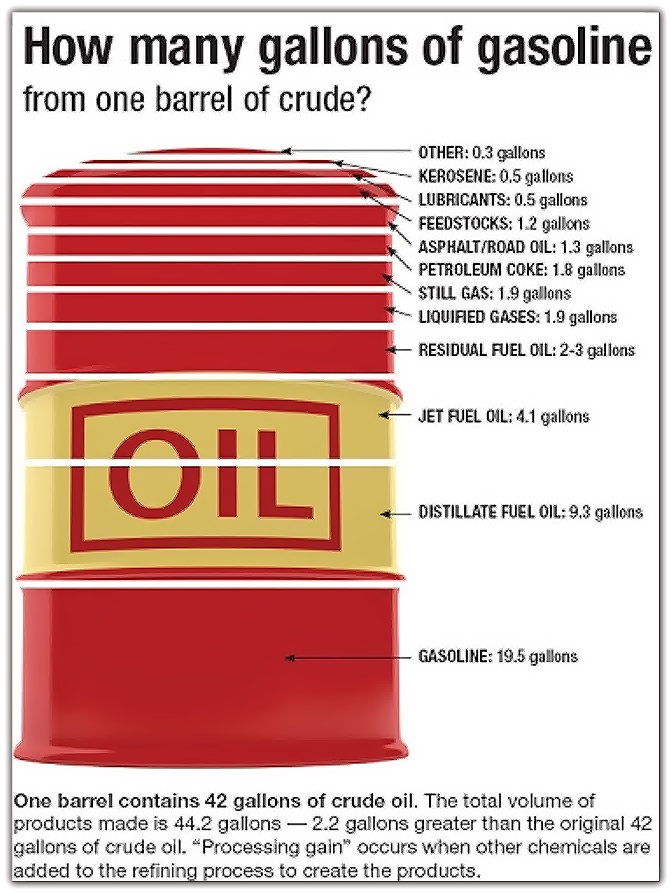
Alright, drumroll please! From that single 42-gallon barrel of crude oil, you don't get 42 gallons of gasoline. That would be too easy, wouldn't it? Instead, you typically get around...
19 to 20 gallons of gasoline.
Boom! There it is. Approximately half of that original barrel transforms into the fuel that powers your morning commute, your road trips, and your frantic dash for emergency snacks. It's not a 1:1 conversion, and that's a pretty important detail that often gets overlooked.

So, if you’re doing the math, that means about half of the barrel is still unaccounted for. What happens to the other roughly 22-23 gallons?
The Rest of the Barrel: A Petrochemical Wonderland!
This is where it gets even more amazing. That barrel of crude oil is like the ultimate multi-tasker. It doesn't just give us gasoline; it gives us a whole parade of products that touch almost every aspect of our lives. It's truly a marvel of modern chemistry and engineering.
From that same 42-gallon barrel, you also get:

- About 10 to 12 gallons of diesel fuel (for trucks, buses, and some cars).
- Around 4 gallons of jet fuel (for flying you off to your next vacation!).
- A couple of gallons of heating oil (to keep you cozy in the winter).
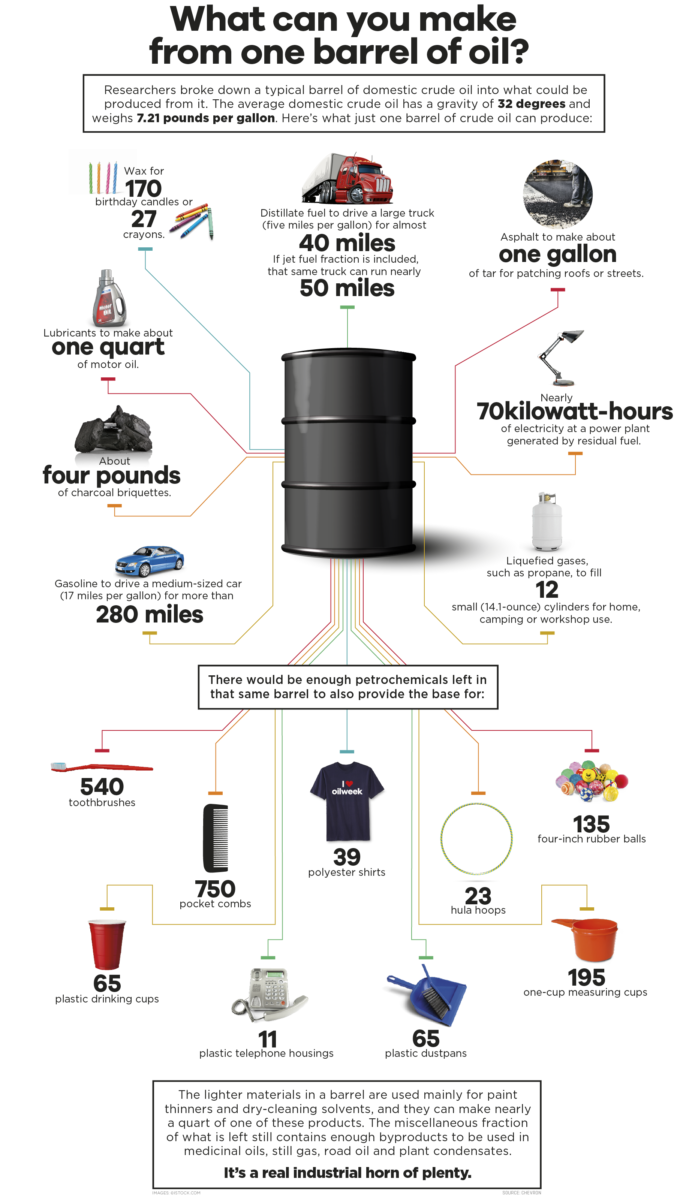
- And then, the really diverse stuff: petrochemical feedstocks for plastics, lubricants, waxes, asphalt (for roads!), solvents, and a whole host of other industrial products.
Basically, a single barrel of crude oil is like a clown car of petroleum products. It just keeps spitting out more and more stuff, far beyond just what you put in your tank. Your toothbrush? Made from oil. Your phone casing? Oil. The tires on your car? You guessed it – oil! It's kind of mind-boggling, isn't it?
The Takeaway: More Than Meets the Eye
So, the next time you hear about the price of a "barrel of oil" or lament how much it costs to fill up your tank, remember this:
That 42-gallon barrel of crude oil is not just a direct pipeline to your gas tank. It's a complex, multi-faceted resource that, after a lot of heat and science, yields roughly 19 to 20 gallons of gasoline. The rest becomes the invisible, ubiquitous components of our modern world.
It's a testament to human ingenuity (and our insatiable need for energy) that we can take this thick, black goo from deep underground and transform it into so many essential products. It makes you look at a gas station pump, or even a plastic bottle, with a whole new level of appreciation... or at least, a slightly funnier understanding of the wild journey from barrel to bottle. Cheers!