
How Many Electrons Are In Nickel

Okay, friends, let's talk nickel! That shiny, silvery-white metal that's probably in your pocket right now (as part of a coin, most likely). But have you ever stopped to wonder what's inside a tiny atom of nickel? Specifically, how many electrons are buzzing around in there?
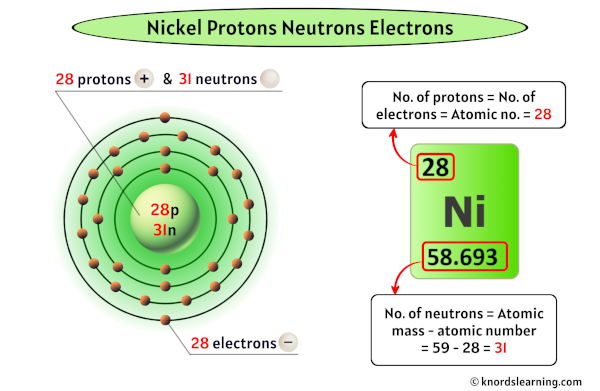
The answer, my friends, is 28. Nickel has 28 electrons. Boom! Mystery solved... or is it? Because honestly, just spitting out a number doesn't really tell the whole story, does it? Why is this interesting? Why should you even care? Well, let's dive in!
Why Electrons Matter (and Aren't Just Tiny Annoying Things)
Think of electrons as the tiny workers that determine how an atom interacts with the world. They're like the social butterflies of the atomic world, constantly buzzing around and forming connections. They dictate how an element behaves, its color, its conductivity... pretty much everything!
Must Read
The number of electrons an atom has dictates its properties. It determines which elements it likes to hang out with, what kind of bonds it will form, and basically dictates its personality in the periodic table. If nickel had, say, 27 electrons, it wouldn't be nickel anymore! It would be cobalt, a whole different beast with different characteristics.
Imagine if people were defined by how many shoes they owned. Someone with 28 pairs of shoes might be a stylish trendsetter, while someone with 27 might be more of a minimalist. It's kind of like that, but with electrons and atoms!
Shells and Orbitals: Where the Electrons Hang Out
So, where do these 28 electrons actually hang out? They don't just float around randomly like a swarm of bees. Instead, they're organized into specific energy levels, often called shells. These shells are kind of like seating levels in a stadium. The seats closest to the center (the nucleus) are the lowest energy level, and they can only hold a limited number of electrons.
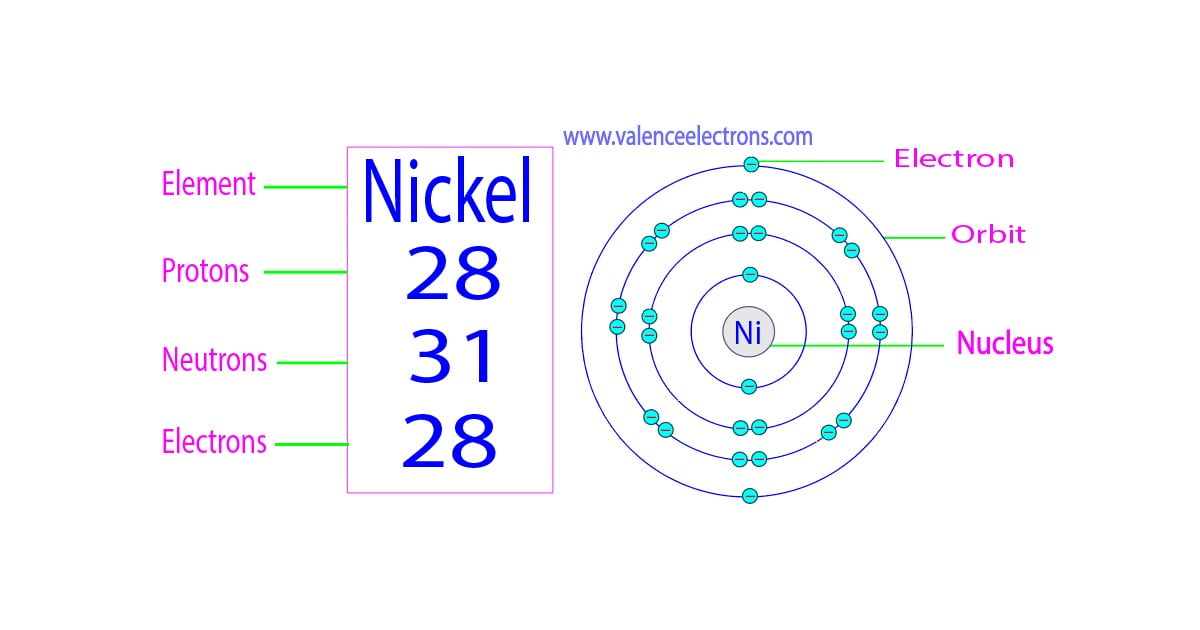
Think of it like a hotel. The first floor can only hold a limited number of guests. Once it's full, you have to move up to the second floor, and so on. Each "floor" (or electron shell) has a specific capacity. Nickel's 28 electrons fill up the shells according to a specific pattern:
- First shell: Holds up to 2 electrons
- Second shell: Holds up to 8 electrons
- Third shell: Holds up to 18 electrons
- Fourth shell: Holds up to 32 electrons (but Nickel doesn't need that many!)
So, in nickel's case, the first shell is full with 2 electrons. The second shell is also full with 8. That's 10 electrons accounted for. Then the third shell gets 16 more electrons, for a total of 26. And finally, the fourth shell gets the last 2 electrons. Voila! 28 electrons, all neatly organized. This configuration is often simplified as 2-8-16-2. Isn't that neat?
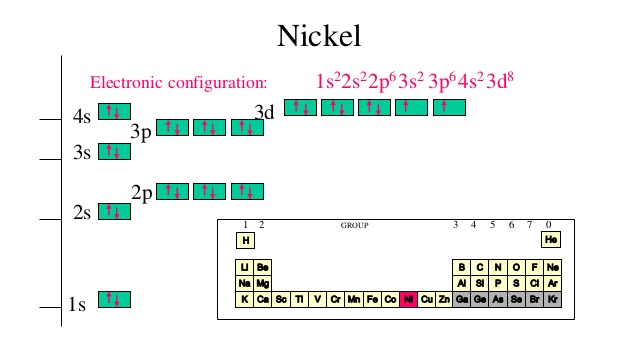
But wait, there's more! Within each shell are subshells called orbitals. These are more like specific rooms within the hotel, each with its own shape and energy. Don't worry, we won't get too deep into quantum mechanics here, but it's important to know that electrons aren't just orbiting the nucleus in neat little circles. It's a bit more complex and probabilistic than that.
Nickel's Electron Configuration and its Properties
The specific way nickel's electrons are arranged, its electron configuration, is what gives it its unique properties. The outermost electrons, called valence electrons, are the ones that primarily interact with other atoms. Nickel's valence electrons allow it to form strong bonds with other elements, making it a useful component in alloys like stainless steel (which is super strong and resistant to corrosion).
The electron configuration also influences nickel's magnetic properties. Nickel is a ferromagnetic material, meaning it can be magnetized. This is because some of its electrons have unpaired spins, creating tiny magnetic moments that align and reinforce each other. Think of it like a bunch of tiny compass needles all pointing in the same direction.
So, Why is Knowing the Number of Electrons Important?
Alright, so we know nickel has 28 electrons. But why does that even matter? Well, besides making you sound super smart at your next trivia night, understanding the number of electrons in an element helps us understand its behavior. It lets us predict how it will react with other elements, what kinds of compounds it will form, and ultimately, how we can use it in various technologies.
From making rechargeable batteries to plating jewelry, nickel plays a vital role in many aspects of our modern world. And all of that is thanks to those 28 little electrons buzzing around its nucleus. Who knew something so small could be so powerful?
So, the next time you see something made of nickel, remember the 28 electrons dancing around in each atom, giving it its unique properties. It's a tiny universe of activity happening right before your eyes!