
How Long Does A Tennis Match Last

Ever sat glued to your TV, watching a thrilling tennis match, and wondered just how long you'll be captivated? Or maybe you're planning a friendly game and need to know how much time to block off. Understanding the duration of a tennis match is more than just satisfying curiosity; it's about planning your day, understanding the strategic ebb and flow of the game, and appreciating the sheer physical endurance of the players. So, let's dive into the factors that influence a tennis match's length!
The purpose of understanding match duration is twofold. First, it helps you, the spectator, manage your time. No one wants to miss dinner plans because a match is unexpectedly long! Second, for players, knowing the potential length of a match is crucial for stamina management and tactical planning. You wouldn't want to burn out all your energy in the first set, would you?
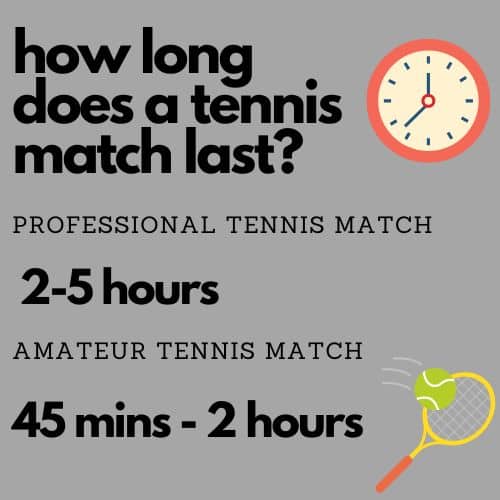
So, what determines how long a tennis match lasts? The biggest factor is the format. Professional men's matches at Grand Slam tournaments (Australian Open, French Open, Wimbledon, US Open) are played in a best-of-five sets format. This means a player needs to win three sets to win the match. This can lead to incredibly long matches, sometimes stretching beyond five hours! Remember that epic Isner-Mahut match at Wimbledon? That went on for over 11 hours!
Must Read
On the other hand, most other professional tournaments, including the ATP and WTA tours, and all women's Grand Slam matches, use a best-of-three sets format. This significantly shortens the potential match duration, typically averaging between one and a half to three hours. A quick, decisive match might be over in just an hour, while a closely contested three-setter can easily creep past three hours.

Beyond the set format, several other factors influence match length. The players' styles of play are a major contributor. Players with aggressive, serve-and-volley styles tend to have shorter points and, consequently, shorter matches. In contrast, players with defensive, baseline-oriented games often engage in long rallies, leading to longer matches.
The court surface also plays a role. Clay courts, like those at the French Open, tend to produce slower ball speeds and higher bounces, leading to longer rallies and longer matches. Grass courts, like those at Wimbledon, are faster, resulting in quicker points and potentially shorter matches. Hard courts fall somewhere in between.
Finally, player fitness and mental fortitude are essential. A physically and mentally strong player is more likely to endure long rallies and tough sets, potentially extending the match. Weather conditions, like extreme heat or humidity, can also affect player performance and match length. Remember, players need breaks to cool down and rehydrate!
In summary, while there's no definitive answer to how long a tennis match lasts, understanding the set format, playing styles, court surface, and player fitness provides a good framework for estimating the duration. So next time you tune in to watch a match, you'll be better equipped to plan your viewing schedule and appreciate the complex factors that contribute to the game's length. Enjoy the match!
![How Long Do Tennis Matches Last? [Updated in 2024] - Tennis Pursuits](http://tennispursuits.com/wp-content/uploads/2023/04/How-Long-Do-Tennis-Matches-Last-3.webp)