How Is A Typhoon Different From A Hurricane

So, you're watching the news, seeing swirling satellite images, and hearing meteorologists toss around terms like "hurricane" and "typhoon." You might be thinking, "Wait, aren't those the same thing? Just big, blustery bullies trying to ruin everyone's vacation?" Well, you’re not entirely wrong about the ruining vacations part, but there’s a fun little geographical twist to this meteorological drama!
Imagine the Earth as a giant bouncy castle (because why not?). Now, picture some cranky weather systems forming over warm ocean waters. The kind of warm where you'd happily sip a piña colada while dipping your toes. These weather systems, fueled by the warm water, start spinning – think of it like a grumpy ballerina practicing pirouettes. The difference between a hurricane and a typhoon isn't about the dance moves; it's about where on the bouncy castle the performance is taking place.
Location, Location, Location!
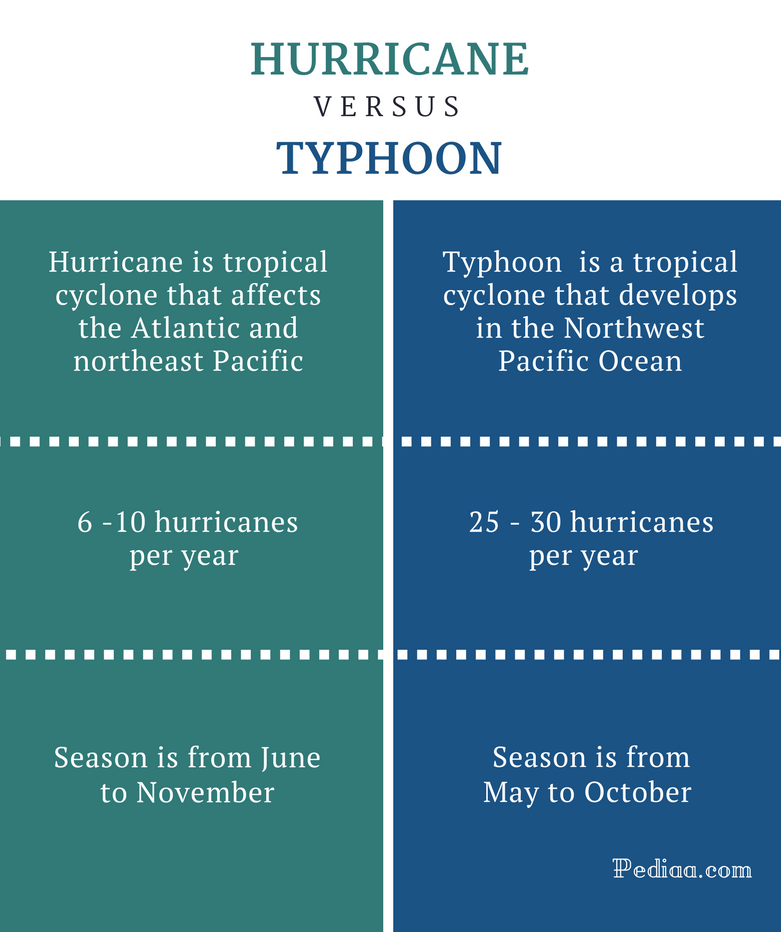
Here’s the simple secret: If this whirling dervish of wind and rain is performing over the Atlantic Ocean or the northeastern Pacific Ocean, we call it a hurricane. Think Florida getting a bit too much "vitamin sea," or maybe a Caribbean island having an unexpected pool party courtesy of Mother Nature. On the other hand, if our spinning weather system is showing off over the northwestern Pacific Ocean, we call it a typhoon. Places like Japan, the Philippines, and China are the unlucky audience members for this particular show.
Must Read
It's all about the region! The Atlantic and Northeast Pacific get hurricanes, while the Northwest Pacific gets typhoons. Think of it like this: If you're eating a taco in Mexico, you call it a taco. If you're eating the exact same taco in France, you don't suddenly call it a "baguette-taco," do you? No! It's still a taco, but the location is different. Same goes for these storms!
A Matter of Names (and a Little Bit of Drama)
Beyond location, there's the whole naming convention to consider. Both hurricanes and typhoons get their own special names – usually nice, normal-sounding names like "Hurricane Hazel" or "Typhoon Haiyan." But don’t let the friendly names fool you; these storms are anything but cuddly. The practice of naming storms helps people keep track of them, like giving each hurricane or typhoon its own personal brand. It’s like reality TV for the weather!

And speaking of drama, these storms can bring a lot of it. High winds, torrential rain, flooding, and storm surges can cause widespread damage and disruption. It’s serious stuff, and it’s why it's crucial to pay attention to weather warnings and take necessary precautions when a hurricane or typhoon is headed your way.
Wind Speed: How Fast is Too Fast?
Now, you might be wondering, "Okay, but what about the intensity? Is a typhoon automatically stronger than a hurricane?" The answer, as with most things in life, is… it depends! Both hurricanes and typhoons are classified based on their sustained wind speeds. The Saffir-Simpson Hurricane Wind Scale is used to categorize hurricanes, while different scales are used in different parts of the world for typhoons. But generally, both types of storms can reach incredibly powerful levels, capable of causing immense destruction.

It’s worth noting that the term “cyclone” is also used to describe these rotating storms, but mainly in the South Pacific and Indian Ocean. So, if you hear someone talking about a cyclone brewing in Australia, just remember it’s the same basic phenomenon as a hurricane or typhoon, just with a different name and postcode.
Bottom line: Hurricanes, typhoons, and cyclones are all the same type of storm, known as a tropical cyclone. The only difference is where they occur. It’s like calling a potato chip a “crisp” in England – same thing, different label!
So, next time you hear about a major storm brewing, remember the bouncy castle analogy. Is it twirling over the Atlantic? Then it’s a hurricane. Is it doing its dance over the Northwest Pacific? Then it's a typhoon. Now, go forth and impress your friends with your newfound meteorological knowledge! And maybe invest in some good storm shutters, just in case.