
How Does A Nuclear Power Plant Produce Energy
Ever been in a power outage? You know, the kind where you're suddenly fumbling for your phone's flashlight, the fridge goes silent, and the internet — gasp! — disappears? It makes you stop and really think about just how much we rely on that invisible current flowing through the wires.
For a significant chunk of the world, that juice often comes from something that sounds straight out of a sci-fi movie: nuclear power plants. But honestly, it’s not as mysterious or scary as some folks make it out to be. Think of it less like a doomsday device and more like a really, really sophisticated tea kettle.
The Super Simple Concept (Seriously!)
Okay, before your brain starts picturing glowing green goo, let's break down the absolute core idea. Most thermal power plants, whether they burn coal, natural gas, or biomass, work on a shockingly similar principle:
Must Read
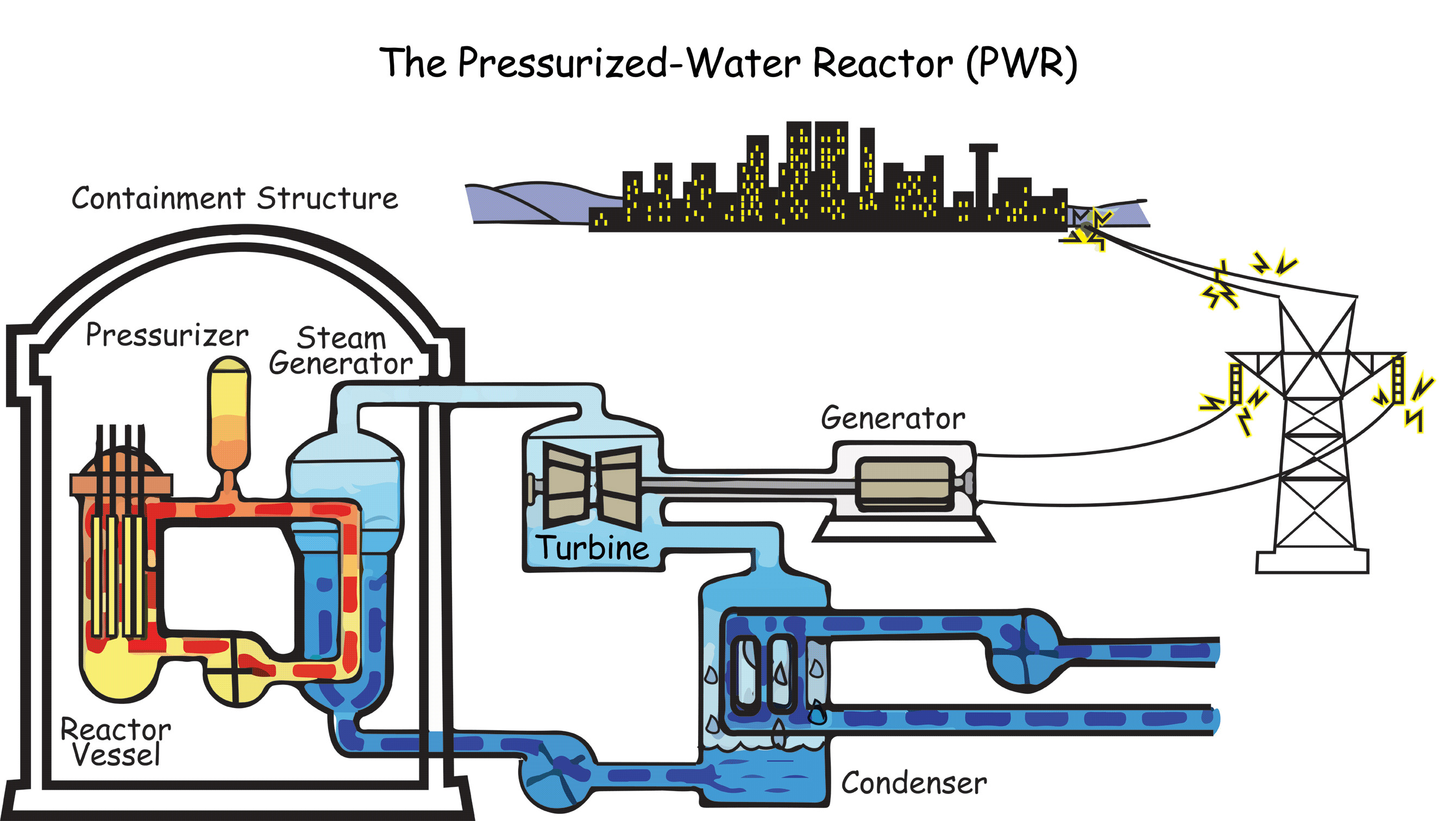
Heat water ➡️ Make steam ➡️ Spin a turbine ➡️ Generate electricity.
That's it! The big difference with nuclear power isn't the turbine or the generator; it's how they get that initial, incredible heat.
The Atomic Teakettle: Fission!
This is where the "nuclear" part comes in. Instead of burning fuel, nuclear plants harness nuclear fission.
Imagine a really unstable, heavy atom – usually Uranium-235. This atom is like a tiny, tightly wound spring. A tiny, invisible bullet – a neutron – zooms along and hits that uranium atom. Wham!
When it hits, the uranium atom splits into two smaller atoms, releasing an incredible amount of heat energy. Seriously, mind-boggling amounts.
It also spits out a few more neutrons, which then hit other uranium atoms, causing them to split, releasing more heat and more neutrons… This is called a chain reaction.
Keeping It Under Control (No Kabooms, Promise!)
"Chain reaction" sounds a bit dicey, right? But don't worry, my friend. Engineers control this!
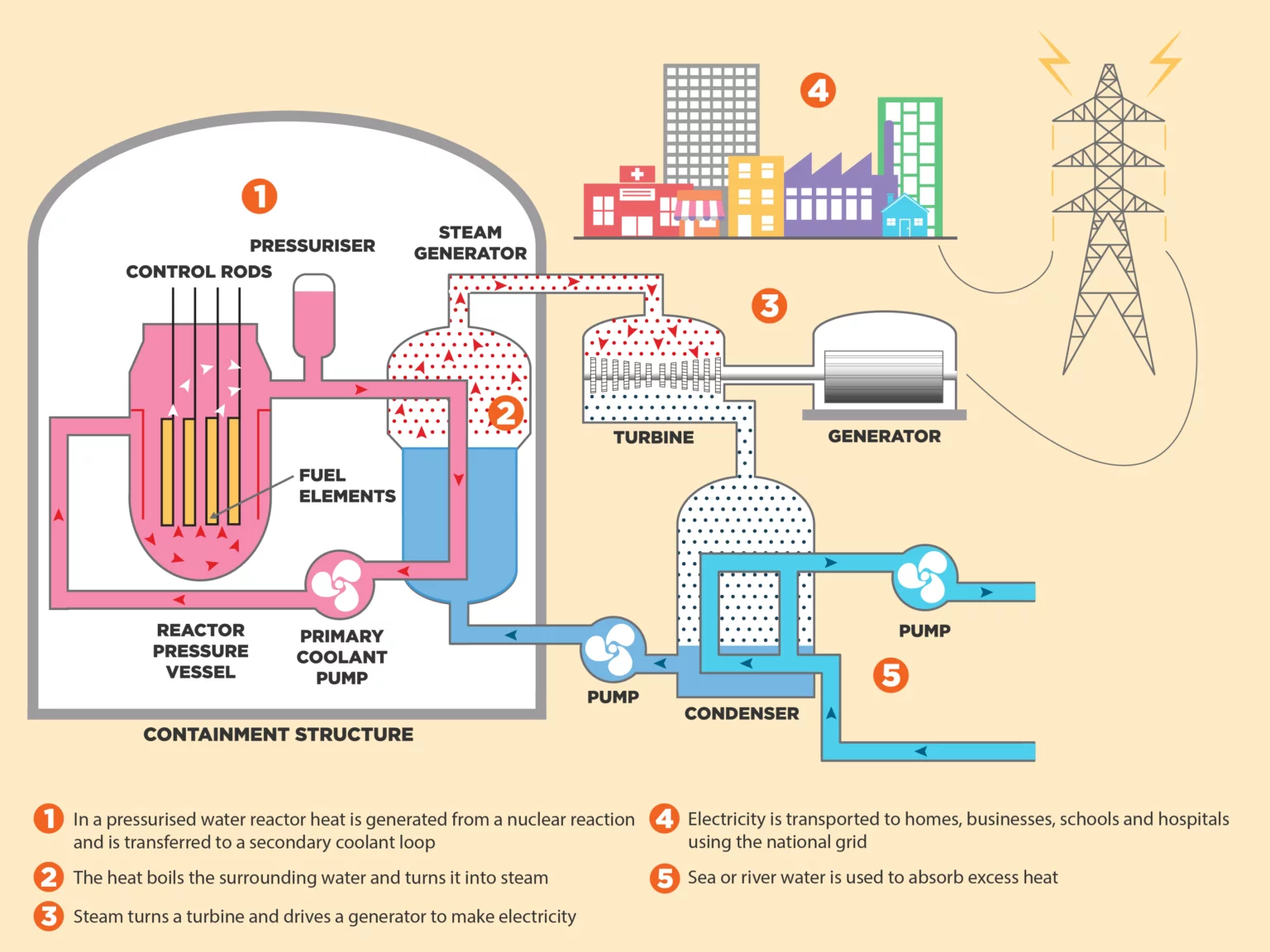
Inside the reactor core, these fission reactions are happening constantly. The uranium is packed into ceramic pellets, then stacked into long metal rods called fuel rods.
To keep the chain reaction from getting out of hand, special control rods (usually made of boron or cadmium) are used. These rods are excellent at absorbing those extra neutrons. Operators insert the control rods further into the core to slow or stop the reaction. It’s like a dimmer switch for atomic reactions!
The core is also surrounded by a moderator, typically water, which helps slow down the neutrons, making them more likely to hit another uranium atom, increasing efficiency.
From Atomic Blast to Boiling Water
So, you've got this controlled, super-hot fission reaction. What now?
All that intense heat warms up a special stream of water, kept under very high pressure to prevent boiling. This super-heated water then flows through a heat exchanger.
Think of the heat exchanger like a radiator. The hot, radioactive water (completely contained in its own loop, don't fret!) transfers its heat to a separate loop of non-radioactive water. This non-radioactive water, now super hot, turns into high-pressure steam.
The Grand Finale: Spinning and Shining
Remember our simple concept? Heat water, make steam…
Now we have an enormous amount of high-pressure steam. This steam is directed with tremendous force towards a massive set of blades: the turbine. The steam pushes against these blades, causing the entire turbine assembly to spin incredibly fast – imagine a gigantic, incredibly powerful pinwheel.
The spinning turbine is connected to a generator. And what does a generator do? It uses electromagnetic induction to convert that mechanical motion into… you guessed it! Electricity!
Once the steam has done its job, it's typically cooled back down into liquid water in a condenser (often with the help of those iconic cooling towers you see). This water is then pumped back to be reheated, completing the cycle. Efficient, right?
So, There You Have It!
From a microscopic neutron splitting an atom of uranium, creating a controlled burst of heat, to boiling water, making steam, spinning a turbine, and finally, firing up your kettle – that's the journey of electricity from a nuclear power plant.
It's a complex dance of physics and engineering, but at its heart, it's about transforming the incredible energy locked within atoms into the reliable power that lights up our homes and keeps our digital lives humming. Pretty cool, huh? And a lot less sci-fi horror, I hope!