
How Do You Convert Kwh To Watts
The Great Energy Mystery: Converting kWh to Watts (Or, Why Your Toaster Isn't That Complicated)
Ah, the electric bill. It arrives, perhaps with a slight sigh, full of numbers and terms that sometimes feel like ancient riddles. One of the biggest head-scratchers for many? That infamous unit: kilowatt-hour, or kWh.
And then there's its powerful cousin, the plain old Watt. You see it on your light bulbs, your coffee maker, even your phone charger. But how do these two energy titans relate?
Many folks fret, thinking there’s some secret, complex conversion formula. A hidden scroll, perhaps, guarded by an angry spreadsheet guru. But what if I told you it's actually... kind of straightforward?
Must Read
My slightly unpopular opinion? You don't always "convert" kWh to Watts in a simple, direct switcheroo. It's more like understanding a conversation between two very important friends.
Meet the Energy Squad: Watts and Kilowatt-hours
Let's introduce our main characters. First, we have Watts. Think of Watts as the "oomph" factor. It's the immediate power an appliance needs or uses right now.
It’s like asking, "How fast is that car going at this exact second?" A car uses horsepower (similar to Watts) to tell you its immediate capability.
Your microwave might be a mighty 1000 Watts. Your tiny LED bulb? Maybe a humble 10 Watts. This tells you their raw power hunger when they are actually on.
Then we have Kilowatt-hour, or kWh. This is the big picture storyteller. kWh tells you how much total energy has been consumed over a period of time.
It's like the total miles you've driven your car over a whole month. It’s not about how fast you were going at any single moment, but the accumulated journey.
Your electric company charges you for kWh, not Watts. They care about the total energy "story" your home tells each month.

The Not-So-Secret Decoder Ring: When Time Enters the Chat
So, how do you "convert" kWh back to Watts? Or, more accurately, how do you understand the relationship? The key ingredient, my friends, is time.
You see, Watts is power. Kilowatt-hours is power over time. If you know one, and you know the time, you can figure out the other.
It’s like knowing you drove 100 miles (kWh equivalent) in 2 hours. You can then figure out your average speed (Watts equivalent) was 50 miles per hour.
Let's simplify. One kilowatt is 1000 Watts. Always. Just a handy conversion for size.
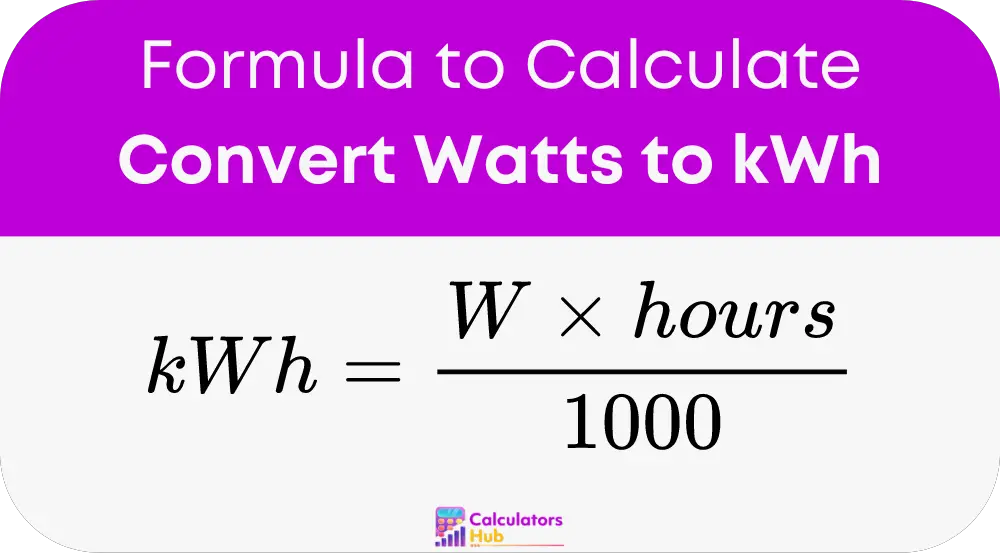
So, if an appliance uses 1 kilowatt (1000 Watts) for exactly one hour, it has consumed 1 kWh of energy. Simple as that.
What if that same 1000-Watt appliance runs for half an hour? Then it consumes 0.5 kWh. It’s about the duration of its power draw.
This is where the playful "unpopular opinion" really comes in. You're not converting kWh into Watts in a vacuum. You're trying to find out what constant Wattage would result in that kWh over a specific duration.

It's like asking, "If I ate 5 slices of pizza (kWh), how big was each slice (Watts)?" Well, you also need to know how many slices there were in total (the time you were eating!).
Unpacking Your Electric Bill with a Smile
Your electric bill proudly announces you used, say, 300 kWh this month. And you want to know "how many Watts was that?" That's a trick question without more info!
Because that 300 kWh is the sum total of all your appliances drawing various Watts for various lengths of time. Your fridge hums all day at low Watts; your oven blasts high Watts for a short burst.
To convert a total kWh number back to an average Wattage, you'd need to divide that kWh by the total hours it was accumulated over. For a monthly bill, that's typically 30 days * 24 hours/day = 720 hours.
So, 300 kWh / 720 hours = 0.416 kilowatts. Or 416 Watts. This tells you the average power draw of your entire home over the month.
It's not converting your total mileage back into a single speed. It's finding the average speed you maintained throughout your whole trip. Not quite as exciting as a single big Watt number, right?
The Appliance Detective: Finding Individual Watts from kWh
Let’s say you’re curious about a specific appliance, like your beloved gaming PC. You know its label says it draws a maximum of 500 Watts. And you used it for 4 hours today.

To figure out the kWh it used: 500 Watts * 4 hours = 2000 Watt-hours. Divide by 1000 to get kilowatt-hours: 2 kWh.
Now, if you only knew it consumed 2 kWh and ran for 4 hours, how do you find its Wattage? You reverse it!
2 kWh / 4 hours = 0.5 kilowatts. Multiply by 1000 to get 500 Watts. See? It's simply playing with time.
It's a delightful dance between instantaneous power (Watts) and total energy consumed (kWh). The secret ingredient is always time.
So, the next time someone asks you to "convert kWh to Watts," you can flash a knowing smile. You're not just converting; you're dividing by time to find an average power, or multiplying by time to find total energy.
Why This "Unpopular" Understanding Is Actually Powerful
Understanding this playful relationship empowers you. You can look at an appliance's Wattage and estimate its kWh usage if you know how long you'll use it.
Suddenly, that big 1500-Watt hair dryer doesn't seem so scary if you only use it for 10 minutes a day. That's a mere 0.25 kWh (1500 W * 0.166 hr / 1000).
On the other hand, a 100-Watt device left on for 24 hours a day? That's 2.4 kWh per day (100 W * 24 hr / 1000). Over a month, that adds up!
This isn't about complex math; it's about context. It’s about understanding what each unit represents in your daily life.
Think of it like this: your car's speedometer shows MPH (like Watts). Your odometer shows total miles driven (like kWh). You don't "convert" MPH to miles, you accumulate miles over time at a certain MPH.
The "conversion" is really just doing the division or multiplication with time. It's a simple relationship, not a mystical transformation.
So, next time you stare at that bill, don't just see a number. See a story. A story of how many Watts were used, for how long, accumulating into those total kWh.
And you, dear reader, now hold the secret to understanding that story. It’s less about a grand conversion and more about knowing when to bring time into the equation.
Go forth and demystify your electricity, one joyful Watt and one insightful kWh at a time!