
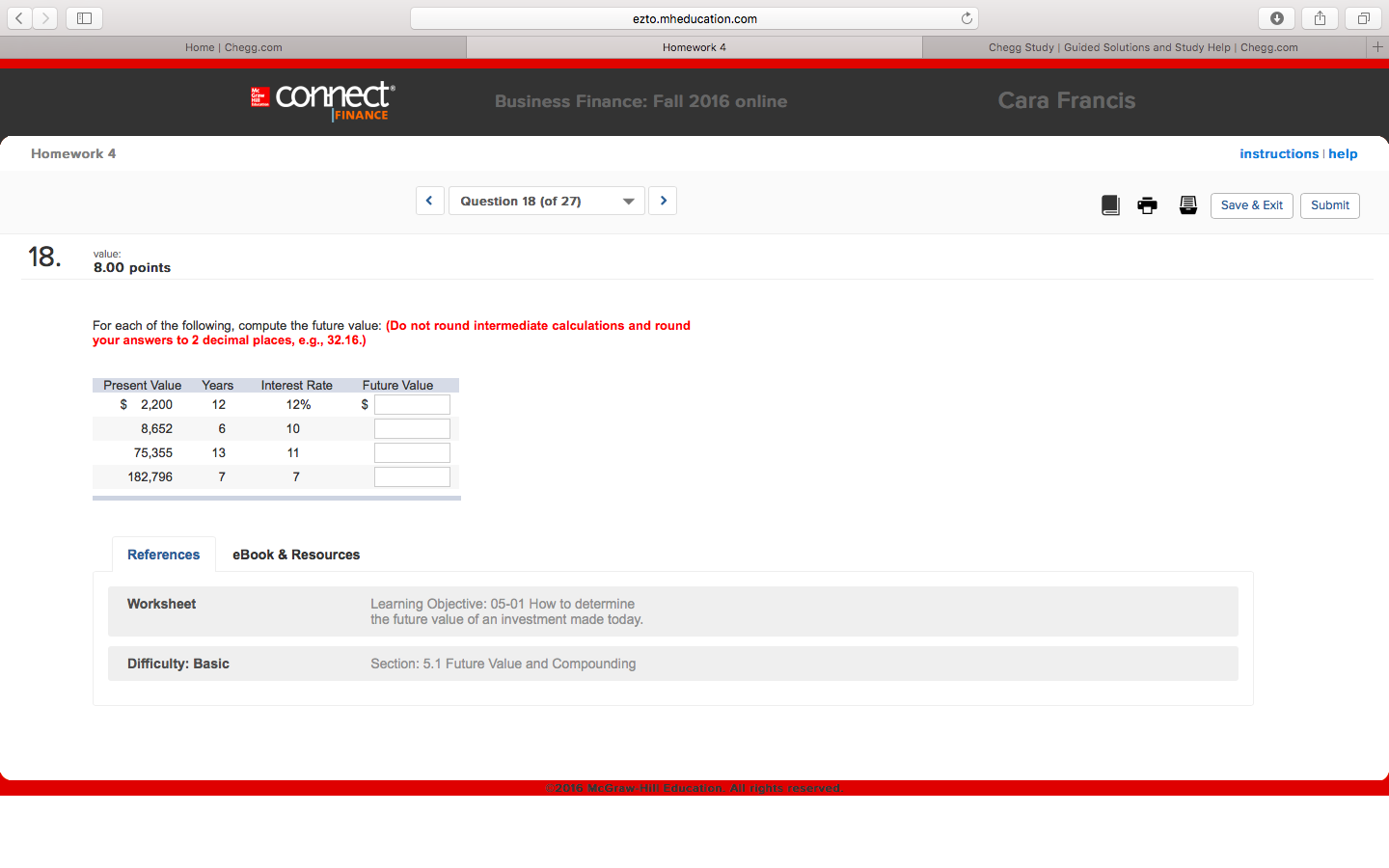
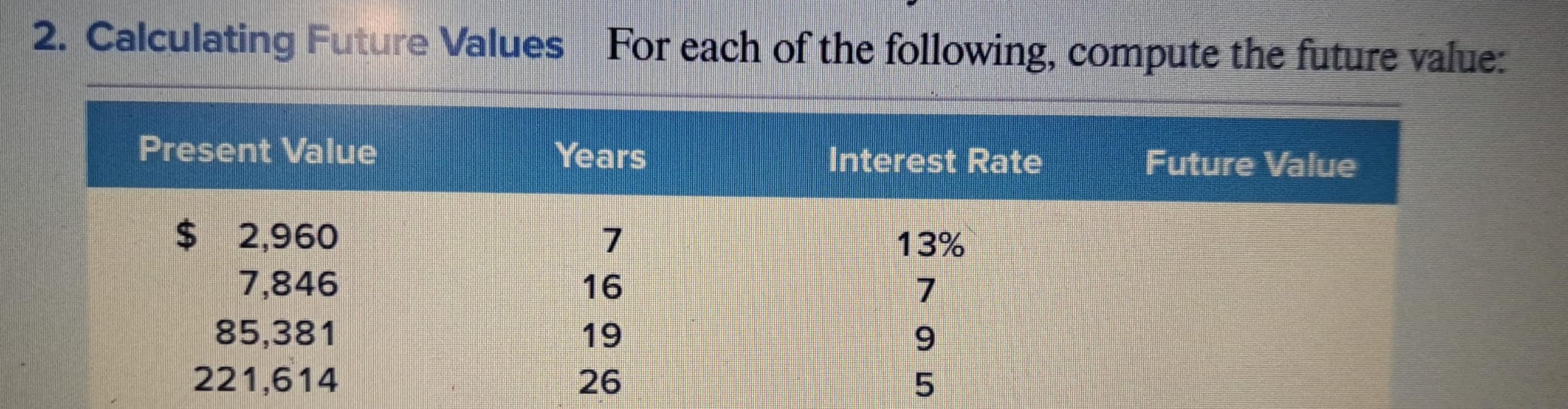
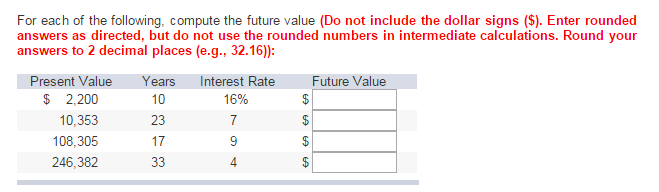
For Each Of The Following Compute The Future Value
Imagine you've buried a treasure chest in your backyard. Not gold doubloons, sadly, but maybe a few forgotten allowance dollars. Let's see how that pathetic treasure grows!
The Case of the Missing Tooth Fairy Money
Little Timmy lost his first tooth! The Tooth Fairy, bless her frugal heart, left him $5 under his pillow. He decided to invest it (well, hide it under his mattress) at a staggering 0% interest.
After one year, Timmy's mattress investment is still worth a whopping $5. He's not exactly swimming in cash, is he?
Must Read
The Future (Still $5!)
Ten years pass. Timmy's now a teenager, probably more interested in pizza and video games than dusty dollars. The fortune under the mattress? Still $5. The Tooth Fairy needs to take an economics class, pronto.
Grandma's Cookie Jar Investment
Grandma Betty, ever the optimist, slipped $20 into her cookie jar. She believed in the "power of cookies," which translates to a generous 2% annual growth due to… well, the sheer magic of Grandma.
After a year, that cookie jar holds $20.40. Enough for an extra cookie, perhaps?
After 10 years, the cookie jar boasts $24.38. That's enough for a small bag of mini chocolate chips, essential for superior cookies. Grandma’s onto something.
The Cookie Jar Legacy
30 years tumble by. The cookie jar, now a family heirloom, contains $36.21. Not enough to retire on, but certainly enough for a batch of her famous snickerdoodles.
Grandma's secret? The sheer joy of baking, and a little bit of compound interest. It's the sweetest investment strategy around.

Uncle Jerry's Risky Business
Uncle Jerry, a man who loves a gamble, invested $100 in a "sure thing" – a company that promised jetpacks for hamsters. (Spoiler alert: it didn’t work out). Let's assume, magically, that this investment somehow yielded 5% annually.
After one year, Uncle Jerry’s hamster jetpack fund is worth $105. He's probably already planning the Hamster Air Show.
Ten years later, it swells to $162.89. Maybe one hamster gets a small rocket-assisted boost after all.
The Hamster Jetpack Dream
30 years fly by. Uncle Jerry’s whimsical investment has grown to $432.19. Still no jetpacks in sight, but a decent retirement fund for a very pampered hamster.
The lesson? Even silly investments can grow over time, especially with a touch of imaginary compound interest. Never give up on your dreams, or the dreams of your imaginary, jetpack-wearing hamster.
Sarah's Smart Start
Sarah, ever the responsible one, put $500 into a savings account earning a respectable 3% interest. She dreams of a trip to Disney World (and maybe a sensible pair of shoes).
One year later, Sarah's Disney fund totals $515. She's one step closer to meeting Mickey Mouse.
After a decade, that account reaches $671.96. Enough for a park hopper ticket and maybe a character breakfast!
The Magic of Smart Saving
Thirty years later, Sarah's Disney fund sits at a comfortable $1,213.63. Enough for a deluxe resort stay and all the churros she can eat. Responsible saving pays off.
Who needs a fairy godmother when you have compound interest?
The College Fund Conundrum
Aunt Mildred, bless her heart, started a college fund for her nephew, using $1,000 as a starting point. The account averages a 7% annual return – a solid, sensible investment.
After the first year, the fund holds $1,070. A promising start for young scholars.
After ten years, the college fund amounts to $1,967.15. Textbooks are looking slightly less terrifyingly expensive.
A Brighter Future
Eighteen years pass, the traditional college-bound age. The account has grown to $3,379.93. A respectable chunk of change for tuition, books, and ramen noodles.
The takeaway? Investing in education is always a wise move, even if it only covers ramen for a semester.
The "I Found It!" Fortune
You stumble upon $250 in an old jacket pocket. Let's say you are really, really lazy and just leave it there and that old jacket magically earns 1% interest annually. It's a low number, but free money is free money!
A year goes by and the jacket pocket holds $252.50. Enough to buy a slightly nicer coffee.
After a decade, the jacket has $276.03 in its pocket. Perhaps a new, slightly less dusty, jacket can now be bought.
The Lazy Saver's Reward
Thirty years later, the accidental savings reach $336.85. Enough for a whole new outfit, and maybe even some matching shoes. Not bad for doing absolutely nothing.
The moral? Sometimes, being a bit forgetful can lead to surprisingly pleasant financial surprises. It's called passive income for the unintentionally savvy.
The Power of Pennies
Every day, you religiously save $1, finding it on the street. This accumulates at the staggering rate of 0.01% interest annually. Its a tiny interest, but it is something!
After a year, assuming no Sundays, you have $312. The interest is 3 cents. Yay! (It's the thought that counts).
After a decade, the street finds have $3,123. The total interest is $3.13. Still barely enough for a gumball, but progress is progress.
The Unexpected Treasure of the Streets
Thirty years later, the pocket lint fund comes to $9,369.58 with about $9.40 of interest. Enough for a small used car, fueled by the sheer grit of pavement scouring.
The message? Never underestimate the power of small, consistent efforts. Even pennies can add up to something significant over time. The world is full of surprises!