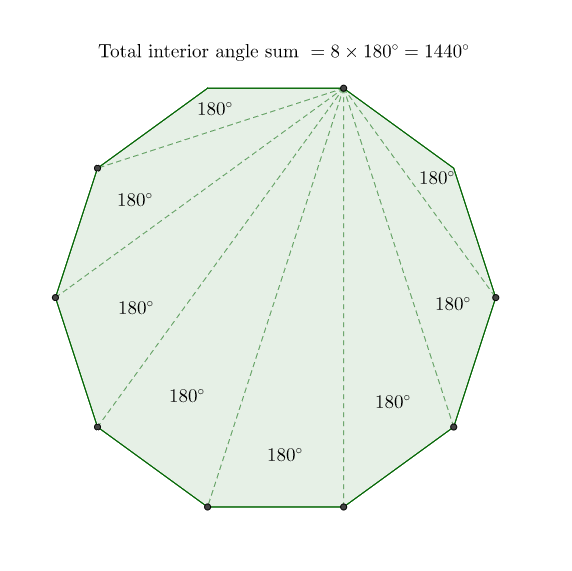
Exterior Angle Of A Decagon

Ever wonder how architects create those cool, multi-faceted buildings, or how nature designs snowflakes with their intricate patterns? Math, specifically geometry, is often at the heart of it! And while it might sound intimidating, exploring the angles of shapes can be surprisingly fun. Today, we're diving into the exterior angle of a decagon, a ten-sided polygon. Why a decagon? Because understanding it unlocks a bigger understanding of shapes in general, and that's pretty powerful.
So, what's an exterior angle anyway? Imagine you're walking around the outside of a shape. At each corner (or vertex), you have to turn. The amount you turn is the exterior angle. It's the angle formed between a side of the polygon and an extension of its adjacent side. What's the point? Well, the really cool thing is that no matter how many sides a polygon has, the sum of its exterior angles will always be 360 degrees. Think of it like completing a full circle as you walk around the shape!
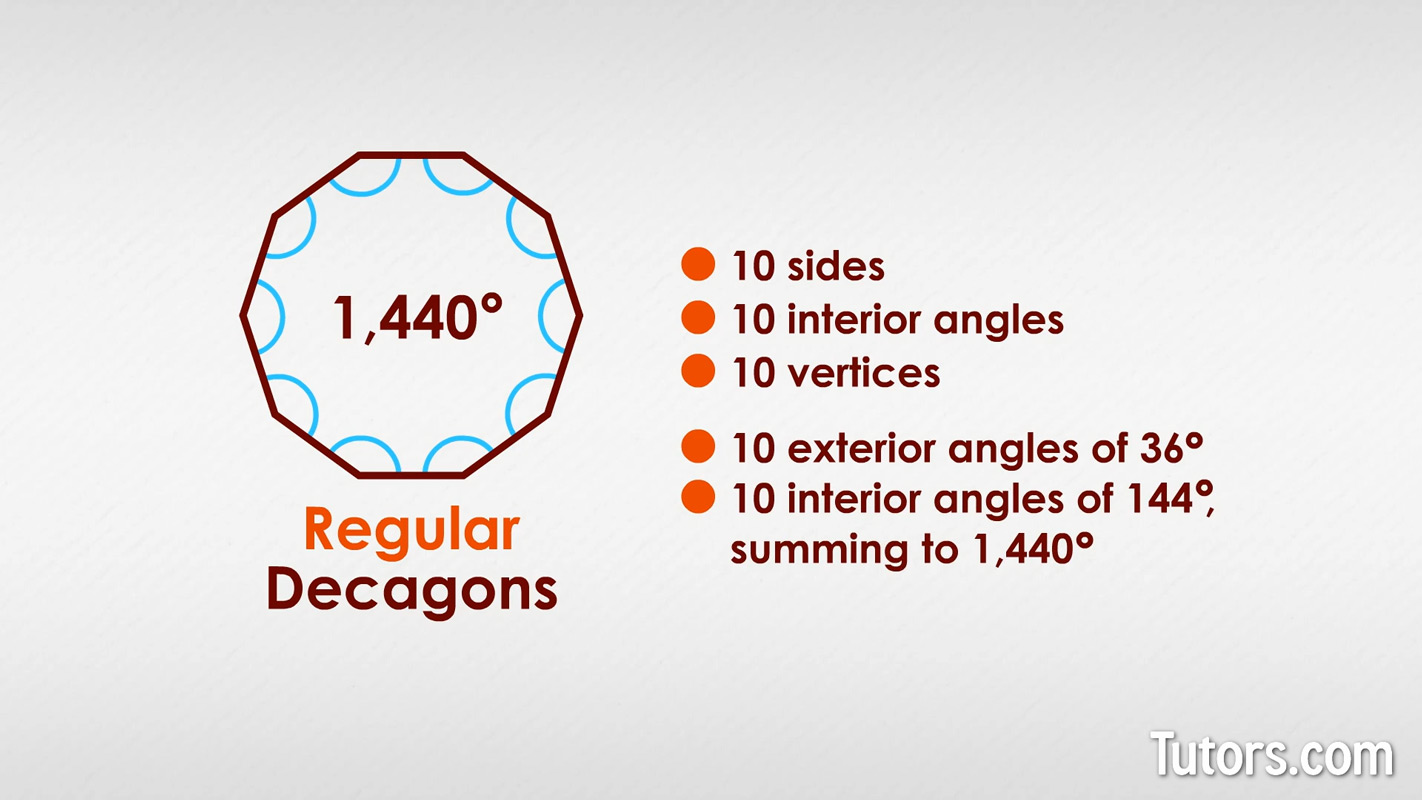
For a regular decagon (where all sides and all interior angles are equal), finding one exterior angle is incredibly simple. Since the sum of all exterior angles is 360 degrees, and a decagon has ten angles, each exterior angle is simply 360 degrees divided by 10. That gives us 36 degrees. So, for a regular decagon, each exterior angle measures 36 degrees. This is a fundamental principle in geometry!
Must Read
Why is this useful? In education, understanding exterior angles helps solidify your knowledge of polygons, angles, and geometric relationships. It builds a foundation for more advanced concepts in trigonometry and calculus. But it's not just for textbooks! Think about designing gardens. You might want to create a flower bed in the shape of a regular decagon. Knowing the exterior angle helps you accurately mark out the shape and ensure all sides are equal. Or consider tiling patterns. Understanding how angles fit together is crucial for creating aesthetically pleasing and structurally sound designs.
Even without realizing it, we use these principles daily. A stop sign, for instance, is an octagon (eight sides). Knowing about exterior angles allows us to understand why the stop sign appears the way it does, and how the angles contribute to its overall shape. Architects and engineers heavily rely on these concepts when designing buildings, bridges, and other structures. They ensure stability and create aesthetically pleasing designs by carefully calculating angles and shapes. Geometry is all around us!
Want to explore this further? Here's a simple activity: draw several polygons (triangles, squares, pentagons, hexagons, etc.). Extend each side to form the exterior angles. Then, using a protractor, measure each exterior angle and add them together. You'll find that the sum is always 360 degrees (or very close, allowing for slight measurement errors). You can also use online geometry tools to visualize polygons and their angles interactively. Try searching for "polygon angle calculator" or "geometry app." Another fun exercise is to look for decagons in everyday life. You might be surprised where you find them! Exploring the world of geometry is like unlocking a secret code to understanding the shapes that surround us. So, go ahead, explore, and have fun!