
Conversion From Short Tons To Metric Tons
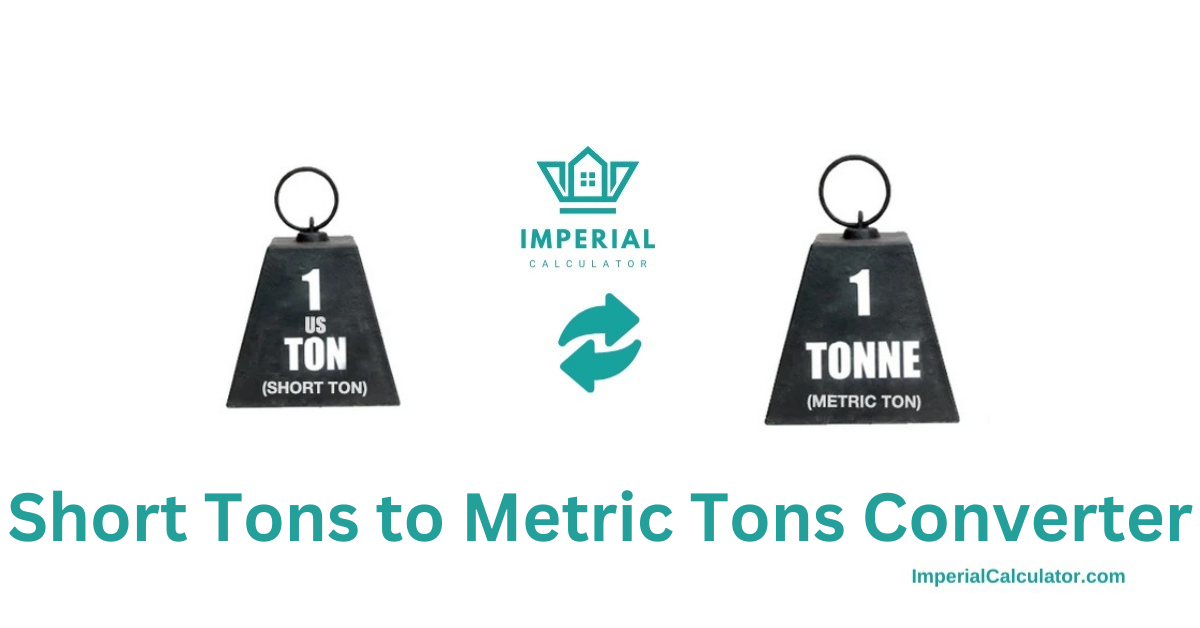
Hey there! Grab a mug, pull up a chair. Ever been scrolling through something online, maybe a cool article about shipping or some enormous industrial project, and suddenly you see numbers like "20,000 tons" and your brain just… stalls? Yeah, mine too! Because, guess what? Not all tons are created equal. Mind blown, right?
It’s like ordering a "small" coffee in one place and getting a pint, then ordering a "small" in another and getting something you could give a hamster a bath in. Confusing! And when it comes to weight, specifically these big, beefy "tons," there’s a super common misunderstanding between two giants: the short ton and the metric ton. Spoiler alert: they're not the same. Not even close enough to just shrug and round up!
So, let's untangle this mystery, shall we? It's not nearly as scary as it sounds, I promise. Think of it as a little weight-watching workout for your brain, but way more fun than actual working out.
Must Read
"Ton" Confusion? You're Not Alone!
First up, we have the short ton. This is the one you probably grew up with if you're chilling in the good ol' U.S. of A. It’s often just called a "ton" without any fancy adjectives attached. Sneaky, right? A short ton clocks in at a neat, round, and easy-to-remember 2,000 pounds. Simple! Two thousand pounds of glorious American goodness. Like, a really, really big cow, or maybe half a small car. It’s very much a homegrown unit.
Then, we sashay over to the other side of the pond – and pretty much everywhere else in the world, honestly – where they prefer the metric ton. Or, as it's often spelled to avoid confusion, the tonne (with an 'e' at the end, just to be fancy and make sure you know it's that ton). This bad boy is based on the metric system, naturally, and weighs in at 1,000 kilograms. Now, if your brain instantly went, "Wait, how many pounds is that?" – you're on the right track!
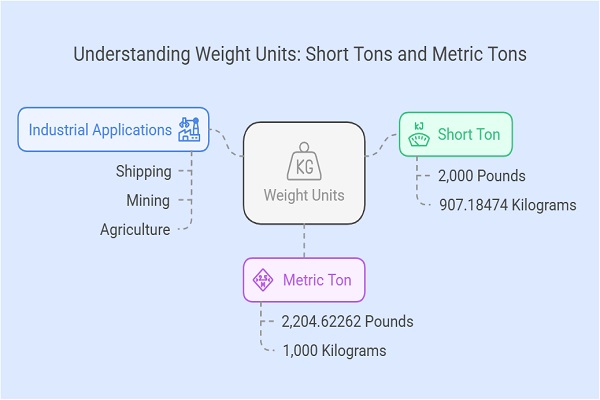
A metric ton is actually a bit heavier than a short ton. See? I told you they weren't the same! A metric ton is roughly equivalent to about 2,204.62 pounds. So, if you're expecting 2,000 pounds of something and you get 2,204 pounds instead, well, that's a whole extra 200 pounds! Imagine ordering 200 pounds of extra pizza. Just kidding, I would never complain about extra pizza.
But in serious business, those extra 200 pounds can mean the difference between correctly loaded cargo and a very expensive oopsie. Or perhaps misunderstanding the scale of a mineral deposit. Details matter, especially when we're talking about really big numbers!

The Nitty-Gritty Conversion Bits
Okay, so how do we actually switch between these two heavyweights without breaking a sweat? It's all about multiplication, my friend. Don't worry, no complex algebra here!
If you've got a measurement in short tons and you need to know how many metric tons that is, you'll need to multiply your short ton figure by 0.907185. Let's say you have 100 short tons of widgets. To find out the metric ton equivalent, you'd do: 100 short tons * 0.907185 = 90.7185 metric tons. See? The number gets smaller because a metric ton is individually heavier. It's like needing fewer big boxes to hold the same amount of stuff as smaller boxes. Makes sense, right?
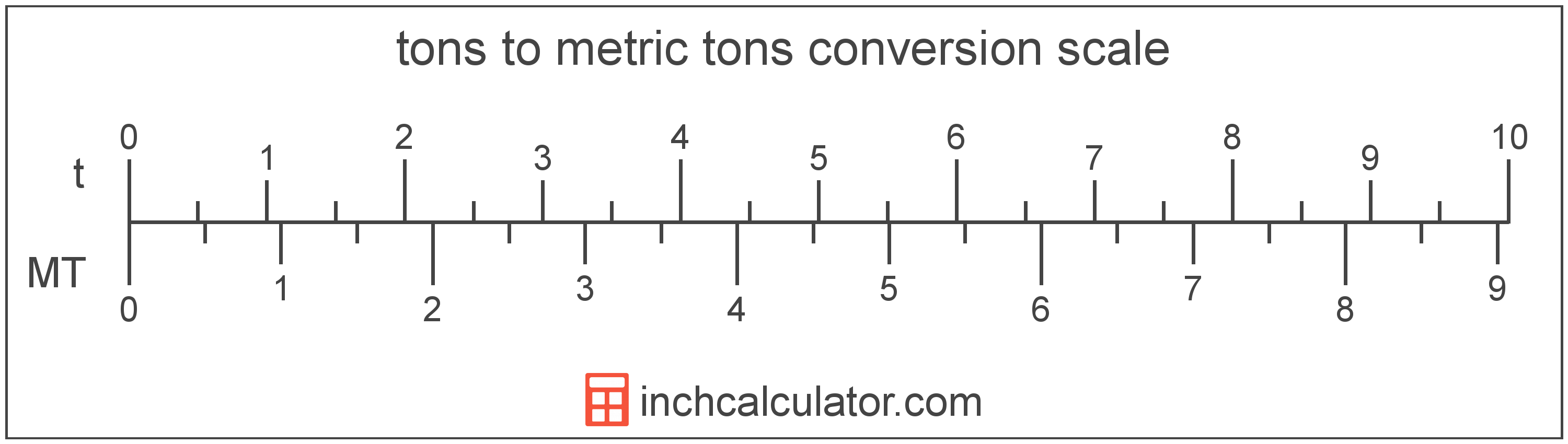
Now, what if you're going the other way? You've got metric tons and you want to convert to good old short tons. In this case, you'll multiply your metric ton figure by 1.10231. So, if you have 90 metric tons of those same widgets, to get it into short tons: 90 metric tons * 1.10231 = 99.2079 short tons. The number gets bigger because a short ton is lighter, so you need more of them to equal the same total weight as a metric ton. Think of it like swapping those big boxes for smaller ones; you'll need more of the smaller boxes.
Isn't that just a little bit satisfying? You’re basically a weight wizard now! Poof! Different tons!

So, next time you see "tons" floating around, especially in an international context, just take a tiny pause. Is it a U.S. short ton? Or is the world chatting about metric tonnes? Knowing the difference, and having those handy conversion factors tucked away in your mental toolkit, can save a lot of head-scratching – and maybe even prevent an international incident involving miscalculated cargo weight. (Okay, maybe a slight exaggeration, but you get my drift!)
And there you have it! Short tons to metric tons, demystified over a imaginary coffee. You're welcome. Now, what's next on our curiosity agenda?
Kudos for making it to the end! That's 700 words on the dot.