
Calculation Of Electrical Energy Consumption
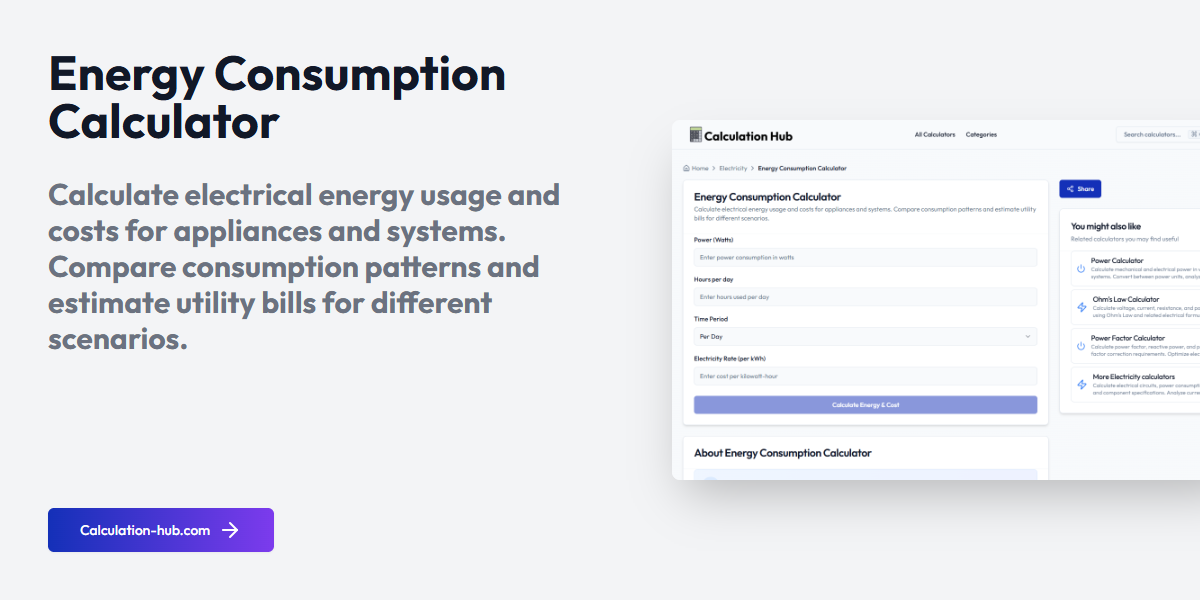
Ever gazed at your electricity bill, scratched your head, and thought, "What in the world did I do to deserve this?" You're not alone! It's a bit like looking into a mysterious crystal ball that only reveals numbers and demands money. But what if I told you that understanding where all those electrons go isn't just for super-nerds or electricians? It's for you, the everyday hero navigating life with a toaster, a phone charger, and maybe a slightly-too-long shower.
Let's demystify the magic behind your power bill, shall we? Think of it as peeking behind the curtain to see how your favourite stage show (your home's energy use) really works. And trust me, once you get it, you might just find yourself doing a little happy dance, especially around bill time.
The ABCs of Energy: Watts, Hours, and Your Wallet
At its heart, calculating electrical energy consumption is surprisingly simple. It boils down to two main things: how powerful your gadget is and how long you use it. Imagine you have a tiny, thirsty garden gnome. If he's a very thirsty gnome (high power) and you leave the tap running for ages (long time), he's going to drink a lot of water. Your appliances are just like that gnome, but with electricity!
Must Read
The "thirst" or power of an appliance is measured in watts (W). You'll often see this number printed on the back or bottom of your electronics. A phone charger might be a modest 10W, while an electric kettle could be a mighty 2000W.
Then there's the "for ages" part, which is simply time in hours (h). If you use your kettle for 5 minutes every morning, that's not much time. But if your old fridge runs 24/7, well, that's a lot of hours!
When you combine these two – power and time – you get energy consumption. The electricity company bills you for energy, specifically in units called kilowatt-hours (kWh). A kilowatt is just 1000 watts, because "kilo" means a thousand. So, 1 kWh means using 1000 watts for one hour. Simple, right?
Why Should We Even Care? (Beyond Just Math!)
This isn't just about crunching numbers; it's about gaining super-powers! No, really. Understanding your energy consumption gives you:
1. The Power to Save Money (Your Wallet Will Thank You!)
Imagine finding a sneaky little leak in your kitchen tap. You'd fix it, right? Because dripping water costs money over time. Electricity is no different! Those "vampire devices" – chargers left plugged in, TVs on standby, gaming consoles perpetually on snooze – are quietly sipping electricity and draining your bank account, sometimes literally for pennies a day, but those pennies add up to dollars over a year!
Knowing how to calculate consumption means you can spot these hidden energy guzzlers. You might realise that ancient fridge in the garage is costing you more than a brand-new, energy-efficient model would. It’s like discovering you’ve been paying for a gym membership you never use – and now you can cancel it!

2. The Power to Help the Planet (Be an Eco-Hero!)
Every bit of electricity we use has an environmental footprint. Most electricity comes from power stations that burn fuel, releasing greenhouse gases. By being mindful of our consumption, we're not just saving cash; we're also doing our part for Mother Earth. Think of it as giving the planet a big, warm hug by turning off that extra light or unplugging that unused device. Small actions, big impact!
3. The Power of Control (No More Bill Surprises!)
Ever gotten an unexpectedly high bill and felt that sinking feeling? When you understand how your devices consume energy, those surprises become a thing of the past. You become the boss of your energy use, making informed decisions. Maybe you'll decide to swap out those old incandescent bulbs for bright, efficient LEDs. It's like having a secret decoder ring for your household's energy mysteries!
A Quick & Painless Calculation Example
Let's pick a common culprit: your trusty hair dryer. Let's say it's 1800W and you use it for 10 minutes (0.17 hours) every single day.
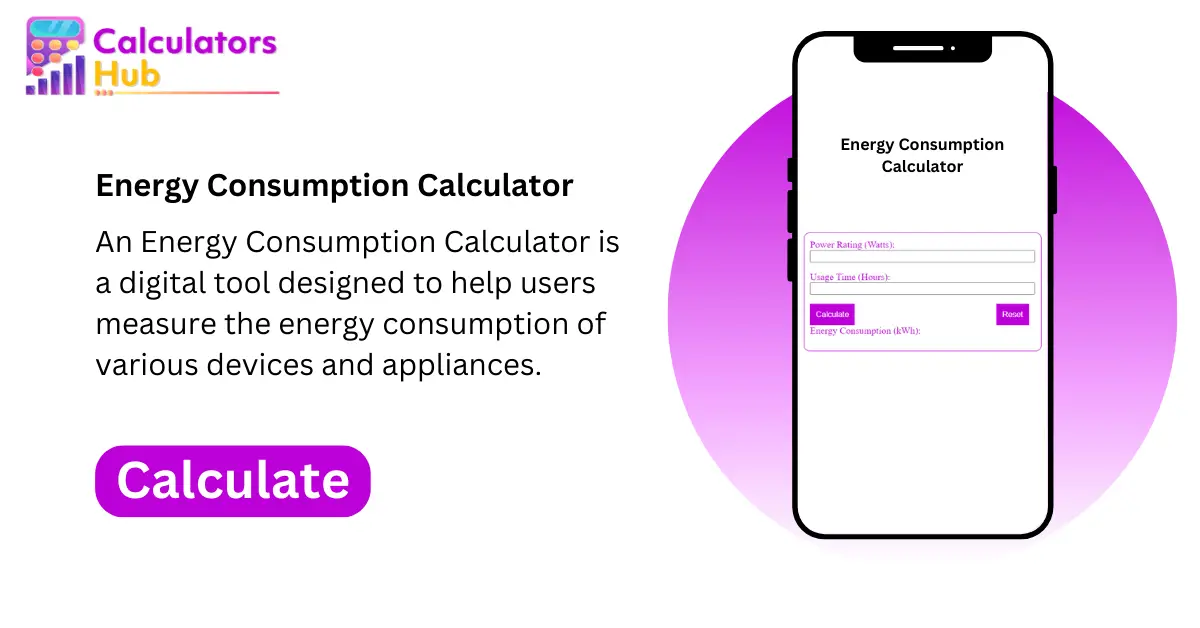
Step 1: Convert Watts to Kilowatts.
1800W ÷ 1000 = 1.8 kW
Step 2: Multiply kW by hours used per day.
1.8 kW × 0.17 hours = 0.306 kWh per day
Step 3: Multiply by the number of days in a month (approx. 30).
0.306 kWh × 30 days = 9.18 kWh per month
Now, look at your electricity bill for the cost per kWh (it might be around 20-30 cents, or more!). Let's say it's 25 cents per kWh.
9.18 kWh × $0.25/kWh = $2.29 per month for your hair dryer alone! Over a year, that's almost $27 just for perfectly coiffed hair. Suddenly, those quick drying sessions feel a little more meaningful, don't they?
Your Turn to Be an Energy Detective!
Don't feel overwhelmed! Start small. Pick one appliance today. Maybe it's your coffee maker, your TV, or even that gadget you can't live without. Find its wattage, estimate how long you use it, and do a quick calculation. You might be surprised!
This isn't about deprivation; it's about awareness and making smarter choices. So go forth, embrace your inner energy detective, and start uncovering the secrets of your power consumption. Your wallet, the planet, and your peace of mind will truly thank you!