
Boiling Point And Melting Point Of Magnesium
Hey there, curious minds! Ever stop to think about what makes things... well, things? Like, why is that ice cube icy, and why is that metal spoon so... spoony? The answer, my friends, often lies in the fascinating world of melting points and boiling points! And today, we're diving into the wonderful world of magnesium!
Yeah, yeah, I know what you're thinking: "Magnesium? Sounds like something out of a dusty science textbook!" But trust me, this stuff is way cooler than you think. We're talking about the stuff that helps your muscles relax, makes fireworks sparkle, and even builds some pretty impressive structures. And understanding its melting and boiling points? That's like unlocking a secret code to its awesomeness.
Melting Point: From Solid to... Less Solid!
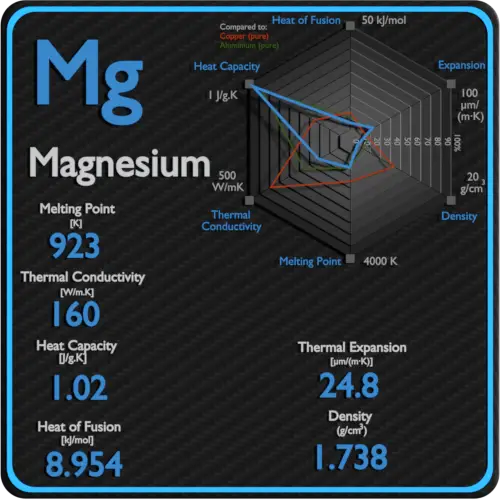
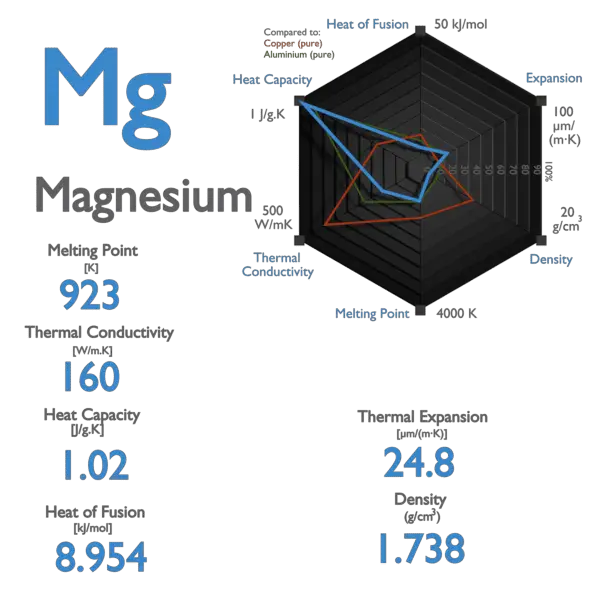
Okay, so what exactly is a melting point? Simply put, it's the temperature at which a solid turns into a liquid. Think of an ice cube. Below 0°C (32°F), it's solid ice. But crank up the heat just a tad, and boom! Water! The same principle applies to magnesium, only on a much, much hotter scale. We are talking about approximately 650°C (1202°F)!
Must Read
Why is this important? Well, imagine you're designing a car engine (stick with me here!). You'd need to know how hot the engine can get before its components start to, shall we say, misbehave. Knowing magnesium's melting point allows engineers to safely and effectively use it in different applications.
And let's not forget fireworks! Magnesium burns with a brilliant white light. By mixing it with other chemicals and carefully controlling its melting and burning, pyrotechnicians can create those stunning visual displays that make us all go "ooh" and "ahh". Pretty cool, huh?
Boiling Point: Taking the Heat to a Whole New Level!
Now, let's turn up the heat – literally! The boiling point is the temperature at which a liquid turns into a gas. So, if we keep heating our liquid magnesium, eventually we would reach its boiling point, which is approximately 1090°C (1994°F)! That’s seriously hot! (Please don't try this at home!)
You might be wondering, "Why would anyone care about boiling magnesium?" Great question! Understanding the boiling point is crucial in processes like vacuum distillation, a technique used to purify metals. By carefully controlling the temperature and pressure, scientists can separate magnesium from other materials, creating super-pure magnesium for specialized applications. Think of it as metal alchemy, but with a lot more science and a lot less wizard hats.
It also affects processes like casting. It determines how magnesium behaves as it solidifies. Understanding the boiling point helps control the solidification process which helps create things as strong and perfect as possible.

But here's the real kicker: Knowing the melting and boiling points of elements like magnesium helps us understand the very fabric of the universe. It helps us understand the properties of alloys that may one day build incredible technologies!
More Than Just Numbers: A World of Possibilities!
See? Melting and boiling points aren't just dry facts from a textbook. They're essential pieces of information that allow us to harness the power of materials like magnesium. They are crucial to making better, more efficient, and yes, even more dazzling things. It even helps with the manufacturing of strong, lighter alloys.

From the cars we drive to the fireworks we marvel at, magnesium, and our understanding of its melting and boiling points, plays a vital role in shaping our world. And that, my friends, is pretty darn exciting!
So, the next time you see a sparkler, think about the magnesium inside and remember the amazing science behind it. Think about the knowledge of melting and boiling points that made it possible.
Don’t stop here. Keep exploring, keep questioning, and keep learning! The world is full of fascinating facts just waiting to be discovered. Who knows? Maybe you’ll be the one to unlock the next great scientific breakthrough!
