
Bedroom Smoke Detector Placement Diagram

Ah, the smoke detector. Our tiny, plastic hero. The silent guardian against fiery doom. But let's be honest. Sometimes, this hero feels a bit like that one guest who just doesn't know when to leave. Especially in the bedroom.
You know the drill. It's 3 AM. Deep sleep. Then, a chirp. Just one. An innocent little beep. Your eyes snap open. You lie perfectly still, breath held. Was that real? Or a phantom sound from a dream?
Then it happens again. Beep! Ah, yes. The dreaded low battery signal. And where is this symphony of terror usually located? Right above your head, of course. Or just outside your door. Ready to pierce your slumber with surgical precision.
Must Read
We've all seen the little instruction booklets. They come with every new smoke detector. Tucked away like a secret scroll. Inside, there's always a
diagram. A pristine, almost angelic drawing of a perfect house. White walls. No clutter. And the little round detector, placed ever so perfectly.
This
diagramshows the ideal placement. Right in the middle of the ceiling. Or high on a wall. Away from vents. Not too close to the bathroom, obviously. It’s all about physics, smoke paths, and optimal detection.
But let's talk about the real world. Our bedrooms. Our sanctuaries. These aren't pristine, white-walled laboratories. They are often a delightful chaos of laundry piles, forgotten snacks, and the general clutter of life. And in this real world, the placement of that smoke detector becomes a very personal, very emotional topic.
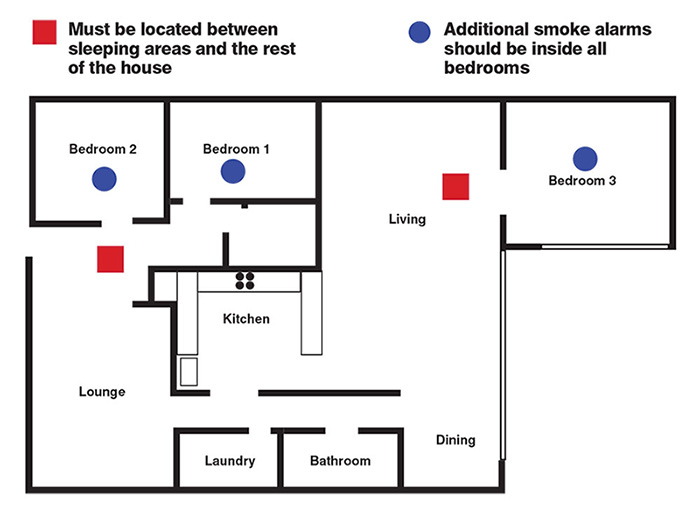
My "unpopular" opinion? That
diagramneeds an update. It needs a dose of reality. It needs to consider our precious sleep. And our overall sanity.
The Classic Ceiling Placement: A Love-Hate Relationship
The most common advice? Stick it on the ceiling. Right in the middle. This makes sense for catching smoke early. Hot air rises, smoke rises with it. A perfect partnership.
But consider this: you're lying in bed. Staring at the ceiling. And there it is. A little white disc, looming. Waiting. Ready to unleash its siren song directly into your ear canal. You burnt toast in the kitchen? Not even a whiff reached the bedroom yet, but somehow, your bedroom smoke detector knows. And it shrieks.

It’s like having a tiny, well-meaning, but incredibly over-sensitive security guard living in your ceiling. A guard who shouts, "DANGER!" when you accidentally leave the bathroom door open during a steamy shower. Or when your roommate burns popcorn three rooms away.
The High Wall Placement: A Slight Improvement, Maybe?
Some
diagramssuggest high on a wall. About 4 to 12 inches from the ceiling. This is slightly better for aesthetics, perhaps. It’s not quite so directly over your face. You can almost pretend it’s not there. Almost.
But the principle remains. It's still high. It's still mighty. It's still programmed to detect the tiniest particle of... well, anything it deems suspicious. Dust? A stray hair from your pet? The ghost of a burnt candle wick from last week? Beep! Beep! Beep!

And let's not forget the spiderwebs. The bane of all high-wall detectors. Nothing quite says "wake up!" like a false alarm triggered by a tiny eight-legged friend building a home directly over the sensor. It’s enough to make you consider a career in spider-herding.
The Unofficial, Sanity-First Diagram
So, what would my ideal
diagramlook like for a bedroom? It wouldn't ignore safety, of course. But it would be a bit more... understanding. More human-centric.
Perhaps it would show the smoke detector on the wall opposite the head of the bed. Not directly over you. A little distance. A subtle hint of acoustic respect. Or maybe near the bedroom door, but not the one closest to the kitchen. It’s about creating a buffer zone.

My
diagramwould feature an arrow pointing to the ideal spot, and another arrow, slightly mischievous, pointing to a tiny soundproofing patch on the ceiling directly above the bed. Just kidding! Mostly.
The point is, we all want to be safe. We want our smoke detectors to work. They are vital. Truly. But perhaps, just perhaps, the official
diagramscould include a footnote. A small, polite suggestion: "For optimal sleep, consider your personal sensitivity to high-pitched beeping."
So, next time you're installing one, or pondering that 3 AM chirp, remember. The
diagramis a guide. But your peace, your sleep, and your sanity? Those are non-negotiable too. Let's find a placement that works for everyone. Especially you, the one trying to get some rest.