
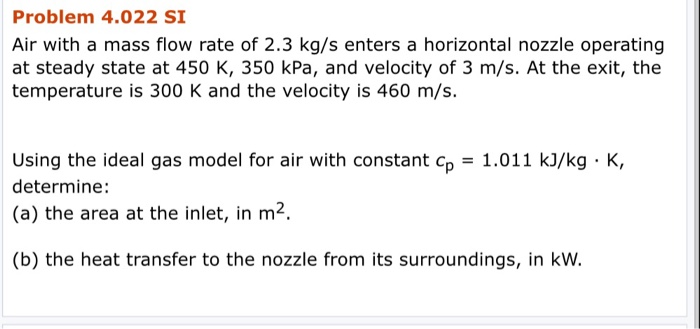
Air With A Mass Flow Rate Of 2.3
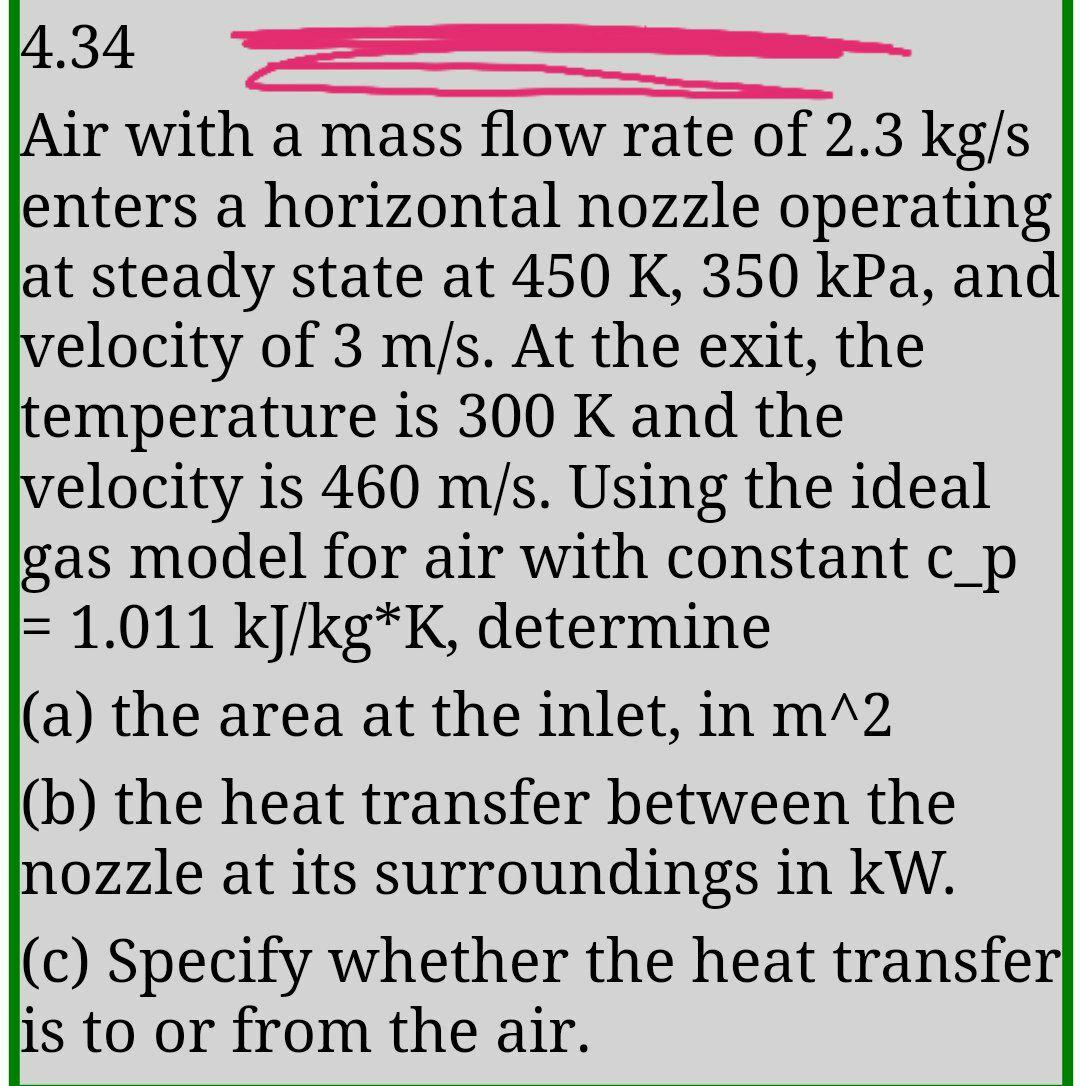
So, picture this: I'm at this café, right? Latte in hand, contemplating the universe (as you do), and I overhear someone talking about... air. Not just any air, mind you, but air with a mass flow rate of 2.3. Now, I'm not usually one to eavesdrop, but "mass flow rate"? That sounds like some serious sci-fi stuff. Turns out, it's not quite rocket science, but it's still pretty interesting. Especially when you think about how it affects, well, everything.
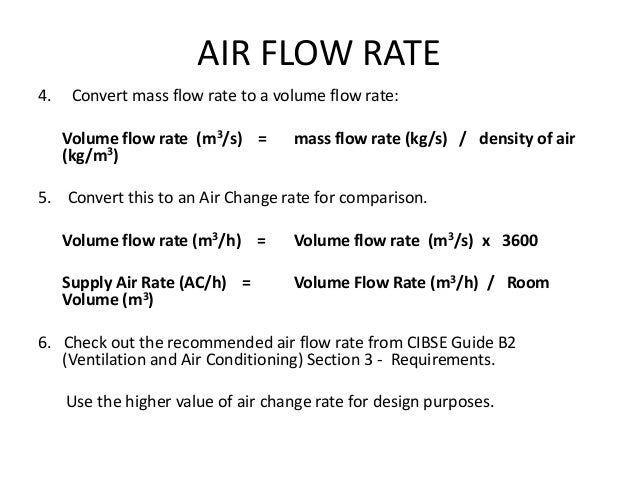
Okay, so what is mass flow rate? Basically, it's how much stuff – in this case, air – is zooming past a certain point in a certain amount of time. We're talking about the mass of the air, not just the volume. Think of it like this: imagine a bouncer at a club letting people in. He's not counting how much space they take up (volume), he's counting how many actual humans (mass) are squeezing through the door every minute. Our "bouncer" is the pipe, tube, or even the atmosphere that the air is flowing through. And 2.3? That's just the number of kilograms (or pounds, depending on where you are) of air that are rocketing through that point every second. That's pretty darn fast!
Now, 2.3 what, you might ask? Good question! We're talking about a mass flow rate of 2.3, let's say, kilograms per second (kg/s). Because, you know, units matter. Otherwise, we're just talking about a mysterious number, and nobody likes those. Unless you're a mathematician, maybe.
Must Read
Why should you care? Well, because mass flow rate is everywhere! Think about your car engine. It needs a specific amount of air to mix with the fuel for combustion. Too much or too little air, and your engine sputters and dies (or at least gets really grumpy). That's mass flow rate doing its thing.
Or consider an air conditioning system. It's moving air around to cool your house. The mass flow rate of that air determines how quickly and effectively your house cools down. A low mass flow rate? Prepare to sweat. A high mass flow rate? Time to break out the sweaters, even in summer!
Let's get dramatic for a second. Imagine a giant, super-powered hair dryer (because why not?). If it had a crazy-high mass flow rate, like, say, 23 kg/s, it could probably knock over small trees. Okay, maybe really small trees. Like, bonsai trees. But still! The point is, mass flow rate has oomph. It's got power. It's the reason you can dry your hair in five minutes instead of an hour (thank you, science!).
The Math (But Don't Panic!)
Alright, I know what you're thinking: "Math? In my fun café story?" Don't worry, I'll keep it brief. The basic formula for mass flow rate is: Mass Flow Rate = Density x Area x Velocity.

Let's break that down:
- Density: How much "stuff" is packed into the air. Denser air means more mass. Think of a really crowded subway car versus an empty one.
- Area: The size of the "pipe" the air is flowing through. A bigger pipe means more room for air to flow.
- Velocity: How fast the air is moving. Speedy air equals a higher mass flow rate.
So, if you know the density of the air, the area it's flowing through, and how fast it's moving, you can calculate the mass flow rate. Easy peasy, lemon squeezy! (Okay, maybe not that easy, but you get the idea.)
Fun Fact: Mass flow rate is often used in engineering to design and optimize systems. Engineers can use these numbers to make sure that everything is working efficiently. Want to build a better jet engine? Gotta know your mass flow rates! Want to make a more efficient furnace? Mass flow rate is your friend!
Mass Flow Rate Mishaps (And How to Avoid Them)
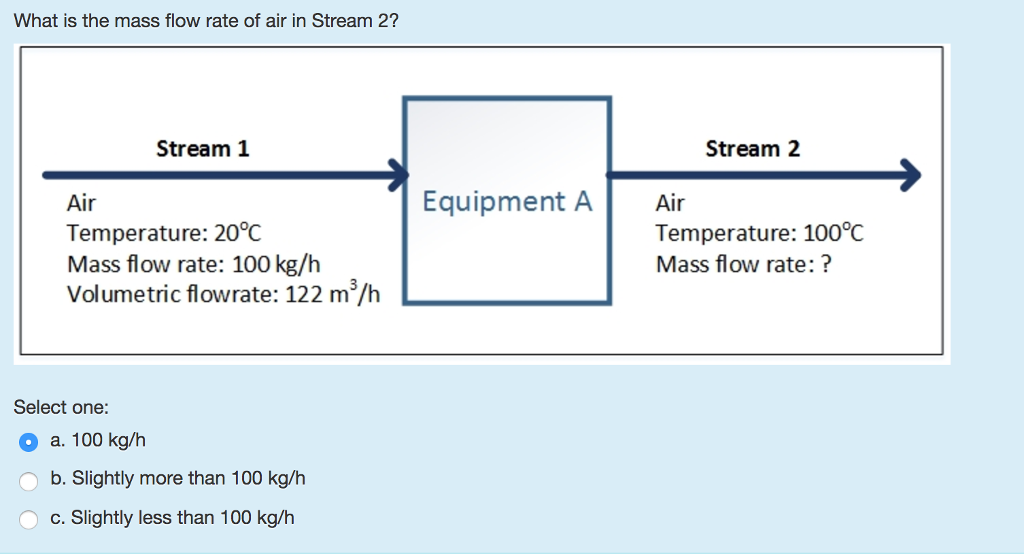
So, what happens when things go wrong with mass flow rate? Well, let me tell you, it's not pretty. Imagine a power plant needing a specific mass flow rate of air to burn fuel. If the mass flow rate is too low, the plant can't generate enough power. Cue the rolling blackouts. Nobody wants that!
Or think about a chemical plant. If the mass flow rates of different chemicals aren't carefully controlled, you could end up with a... well, let's just say a very unpleasant surprise. Explosions are generally frowned upon. Accuracy is key!
How to avoid these mishaps? Careful planning, precise measurements, and a whole lot of engineering know-how. Plus, a healthy dose of caution. Don't mess with air unless you know what you're doing!
So, there you have it. A crash course in mass flow rate, delivered with a side of café chat and a sprinkle of absurdity. Next time you hear someone talking about air, remember the mighty mass flow rate. It's the unsung hero of countless processes, from drying your hair to powering the world. And it all started with a simple number: 2.3.
Now, if you'll excuse me, I need to go adjust the mass flow rate of my latte. It's not quite hitting the spot.