54 As A Product Of Prime Factors
Ever look at a number and wonder what makes it tick? Like peeking under the hood of a car to see the engine, or breaking down a complex recipe into its basic ingredients? That's exactly what we're going to do today with the number 54, and trust me, it's more fun and useful than it sounds! We're diving into the exciting world of prime factorization, a fundamental concept in mathematics that’s not just for mathematicians but for anyone who loves puzzles, problem-solving, or just understanding how things work.
So, what exactly is prime factorization? Think of prime numbers as the LEGO bricks of the number system. A prime number is a whole number greater than 1 that has only two factors: 1 and itself. Numbers like 2, 3, 5, 7, 11 are primes – they can't be broken down into smaller whole number multiplications. Prime factorization is simply the process of breaking down a non-prime number into its unique set of prime LEGO bricks that, when multiplied together, build up that original number. It’s like finding the genetic code of a number!
Why is this useful? Well, understanding a number's prime factors gives us incredible insight into its properties. It's the basis for everything from simplifying fractions and finding common denominators to understanding cryptographic security and even designing efficient algorithms. It helps us see relationships between numbers that aren't immediately obvious, making complex calculations simpler and shedding light on numerical patterns. It's a fundamental tool for decoding the world of numbers.
Must Read
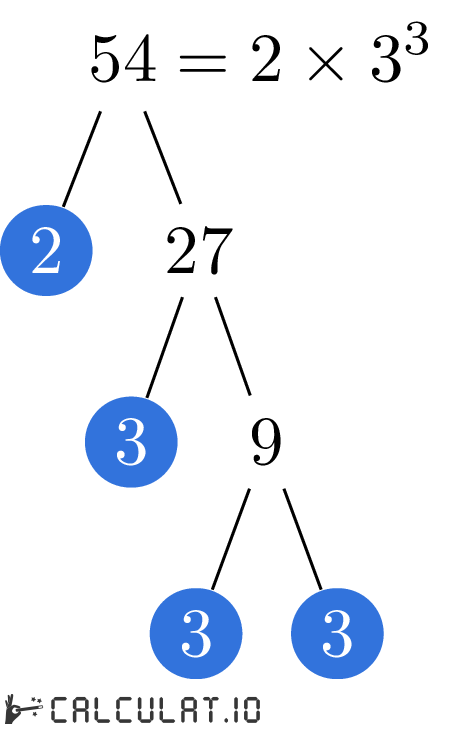
Let's take our star number, 54, and dismantle it. We want to find its prime factors. We start by asking: what's the smallest prime number that divides 54? That would be 2.
- 54 ÷ 2 = 27. So, 54 = 2 × 27.
- 27 ÷ 3 = 9. So now we have 54 = 2 × 3 × 9.
- 9 ÷ 3 = 3. So our full breakdown is 54 = 2 × 3 × 3 × 3.
Isn't that neat? We've uncovered the unique numerical fingerprint of 54. This specific combination of primes (one 2 and three 3s) is unique to 54. No other number shares this exact set of prime factors. This unique identification is why prime factorization is so powerful. It allows us to understand numbers at their most basic level, simplifying complex problems and revealing the beautiful, underlying structure of mathematics. So next time you see a number, try breaking it down – you might just discover its fascinating secret life!